

The James Webb Space Telescope has made a series of important discoveries while studying interstellar comet 3I/ATLAS. This icy traveler from deep space is only the third object of its kind recorded by astronomers. Analysis of its chemical composition has not only shed light on distant stellar systems but also helped improve our understanding of the origins of our own Solar System.
The Interstellar Visitor’s Spectral Mystery

Interstellar comets form in disks of gas and dust around other stars before leaving their home systems and wandering through the Galaxy. Unlike local comets, which follow closed orbits around the Sun, interstellar travelers pass us only once before disappearing forever. The age of 3I/ATLAS dates back to the dawn of the Universe, making it a unique “time capsule.”
An international team led by the Southwest Research Institute (SwRI) used James Webb’s NIRSpec spectrograph for three observing sessions between August 2025 and April 2026. As the Sun warmed the comet, it released gas that carried dust and icy grains into its coma.

By splitting the comet’s light into a spectrum, scientists expected to see the standard signature of water ice: characteristic absorption bands at 1.5, 2.0, and 3 microns. But 3I/ATLAS surprised them: the bands at 1.5 and 2.0 microns were barely visible. Computer modeling showed that the comet consists of microscopic ice grains approximately 1 micron across or smaller, heavily mixed with dust. In such tiny particles, light penetrates only a short distance into the ice, suppressing the shorter-wavelength absorption bands.
A “Twin” from the Outskirts of the Solar System
The properties of the released dust changed as the comet traveled. As 3I/ATLAS moved away from the Sun in April 2026, James Webb detected the appearance of larger icy particles. This could have resulted either from uneven solar heating or from deeper layers being exposed as the surface vaporized.
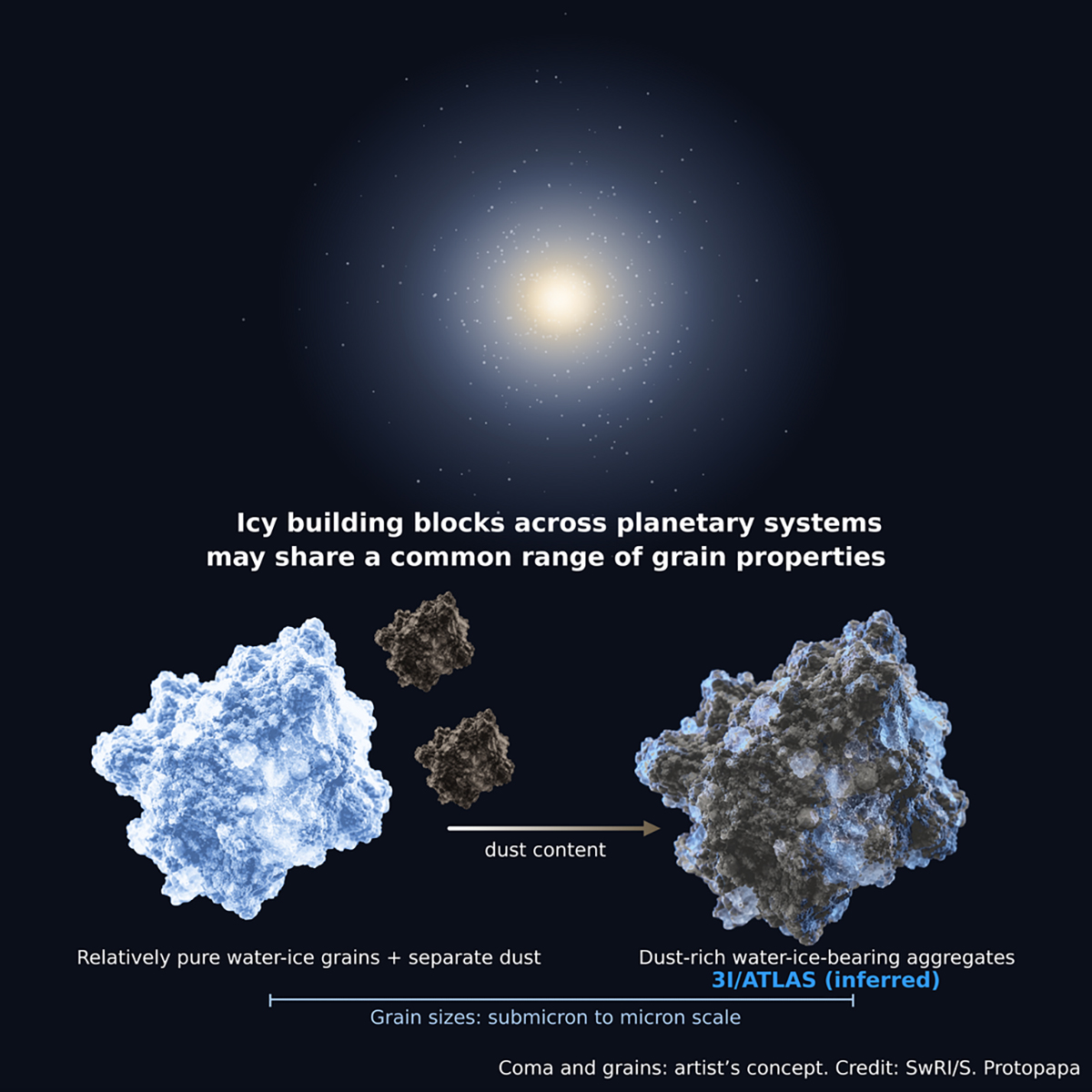
The biggest surprise was the spectral similarity between 3I/ATLAS and trans-Neptunian objects—icy bodies orbiting in the distant outskirts of our Solar System, beyond Neptune’s orbit. These distant worlds are considered remnants of primordial material preserved since our system formed, and they display exactly the same unusual spectral profile.
One Recipe for the Entire Galaxy
The findings suggest that the building blocks of planets, known as planetesimals, around other stars have physical properties very similar to those in our own system. Water ice in protoplanetary disks throughout the Universe initially forms as microscopic grains containing varying amounts of dust. These original characteristics remain preserved in icy bodies for billions of years.
Further observations with the James Webb Space Telescope will help astronomers determine whether 3I/ATLAS is a rare exception or a typical representative of comets in our Galaxy.
Previously, we reported on how much material comet 3I/ATLAS lost during its close approach to the Sun.
Based on material from skyatnightmagazine.com
