
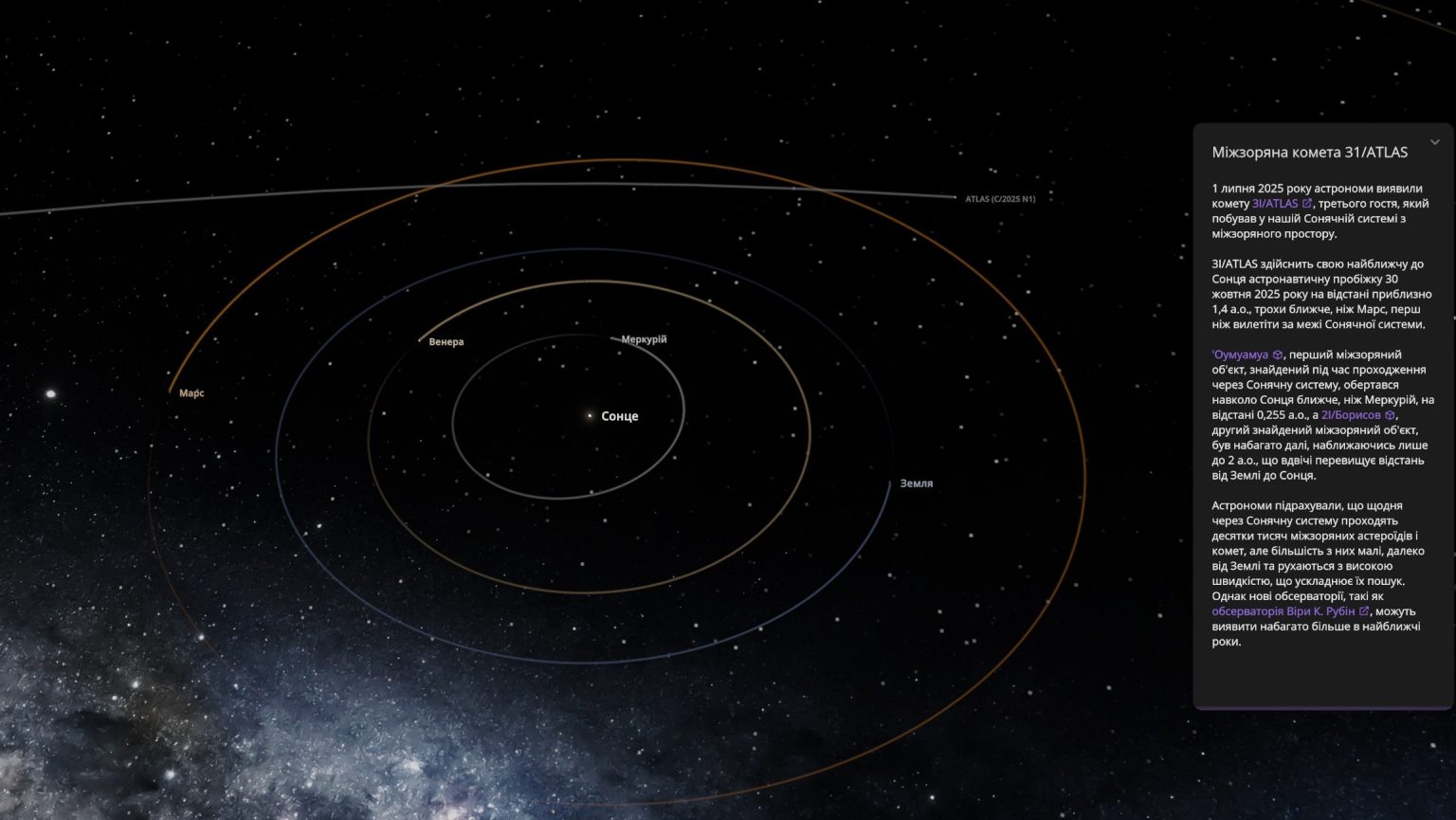
An international team of astronomers led by British scientists has obtained new and unique data on the origin of the interstellar comet 3I/ATLAS. It is only the third object known to science to have entered our Solar System from interstellar space. The results of a detailed spectroscopic analysis, published in the journal Monthly Notices of the Royal Astronomical Society, show that the comet formed under cold conditions, far from its parent star.

From time to time, icy bodies that formed millions of years ago near completely different stars enter our Solar System. These objects are called interstellar objects. Because they preserve primordial material from other stellar systems, studying them gives scientists a rare opportunity to understand how planets and comets form in different regions of the Milky Way.
Comet 3I/ATLAS was discovered relatively recently, in July 2025. After passing the Sun, it rapidly headed back into deep space. However, astronomers managed to use this brief visit for a series of unique observations.
Secrets of the Ionized Tail
The study was led by Dr. Lea Ferellec of the School of Engineering, Physics and Mathematics at Northumbria University, with the participation of scientists from the University of Edinburgh. The researchers focused on studying ionized gas that was flowing from the comet as it moved away from the Sun under the influence of the solar wind.
The observations were carried out using the new WEAVE instrument (WHT Enhanced Area Velocity Explorer) in LIFU (Large Integral Field Unit) spectroscopy mode. The instrument is installed on the 4.2-meter William Herschel Telescope (WHT), which is part of the Isaac Newton Group of Telescopes in the Canary Islands.
Thanks to the instrument’s high sensitivity and the telescope’s new guiding system, scientists were able to identify five different types of ions in the comet’s tail simultaneously. This is an outstanding result for comets in general and an unprecedented achievement for an interstellar visitor.
A Cosmic “Freezer”
The main discovery was the measurement of the ratio of nitrogen to carbon monoxide in the comet’s gas stream. The high concentration of nitrogen indicates that 3I/ATLAS formed at a temperature below −240 °C.
Such extreme cold is possible only in the distant outskirts of a stellar system — much farther from the parent star than the orbits of most planets.
“This object gives us a rare opportunity to study matter that formed in an environment radically different from our Solar System,” explains Dr. Lea Ferellec. According to her, each such interstellar object brings us closer to understanding how new worlds are born in the Universe.
A New Era in Asteroid Astronomy
The success of the observations confirmed the high effectiveness of modern equipment. According to Isaac Newton Group Director Rubén Sánchez-Janssen, instruments such as WEAVE-LIFU open new horizons for studying not only interstellar visitors, but also comets and asteroids within the Solar System. The detailed recording of the evolution of an ion tail as the object moved farther away was carried out for the first time in the history of astronomy.
Previously, we reported on how the unexpected composition of 3I/ATLAS puzzled astronomers.
