

Astronomers say that comet 3I/ATLAS may have lost a substantial amount of surface material during its close approach to the Sun. They suggest that material buried several meters deep could have been exposed. However, it remains unclear how ancient the affected layers might be.
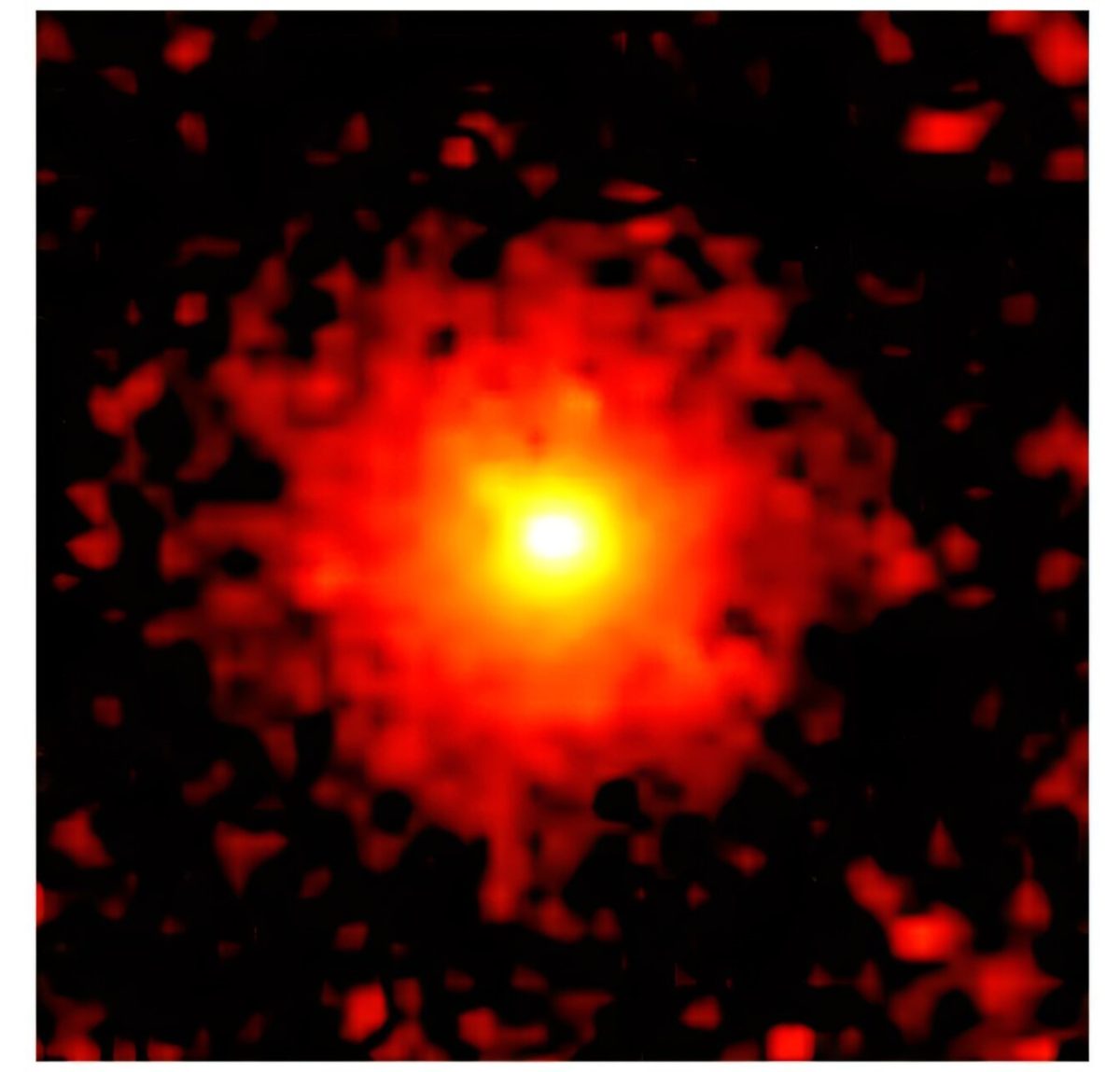
An Interstellar Comet Stripped Bare by Its Encounter with the Sun
Researchers at Michigan State University recently proposed an intriguing hypothesis about the interstellar comet 3I/ATLAS, which visited the Solar System in 2025. According to phys.org, the findings were published in Monthly Notices of the Royal Astronomical Society. The idea is that not only could the comet itself have affected the Solar System, but the Sun could also have affected the comet.
As with any other comet approaching the Sun, 3I/ATLAS experienced increased outgassing as previously frozen substances were released. The comet lost substantial quantities of these gases, along with dust and other material, and scientists have now estimated how much.
They based their conclusions on observations of the comet’s brightness and changes in its trajectory. However, astronomers remain uncertain about the precise shape and composition of its nucleus. They therefore modeled the solid portion of 3I/ATLAS as a sphere approximately 1.3 kilometers in diameter and examined what would happen if its composition varied.
What the Research Revealed
The simulations showed that comet 3I/ATLAS could have lost a layer of material between 1.7 and 5.2 meters thick during its close approach to the Sun. But this applies only if its composition resembles that of ordinary comets that regularly orbit our star. There are reasons to believe its dust content was actually higher. If so, it could have lost as much as 10 meters of ice.
However, this estimate of the missing layer’s thickness assumes that erosion was distributed evenly across the entire surface. It does not show how deeply individual areas were eroded. According to the researchers’ calculations, the maximum depth of exposed material could have ranged from 3.4 to 10.5 meters with a typical dust content, and from 8.6 to 26.7 meters with a higher proportion of silicates.
Why are scientists so interested in all this? Because the encounter with the Sun may have exposed layers on 3I/ATLAS so deep that they had remained sealed off from the outside world for hundreds of millions of years—perhaps even since the comet formed in the system of an unknown star. What might be hidden inside?
