

Amazon’s commercial internet service from low Earth orbit could launch by the end of the year. The company has begun mass-producing satellites, and those already in space are sufficient to start the service. Its main rival will be Starlink, which has faced almost no competition so far.
The Thousandth Satellite
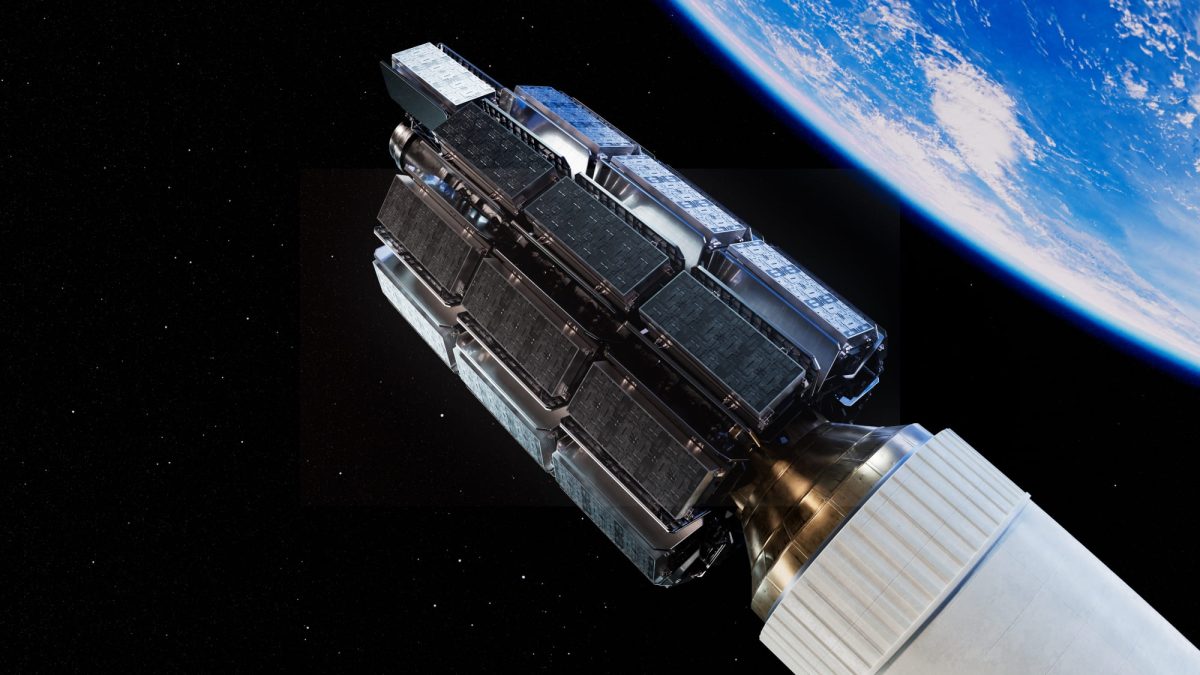
The thousandth satellite for the Amazon Leo constellation was recently assembled at the company’s factory in Kirkland, Washington. The first batch of 27 satellites took six months to assemble. Now the factory can produce the same number every week, project leader Rajeev Badyal told Ars Technica in an interview.
Manufacturing director Paul Palcisco identifies testing as the biggest obstacle. Traditional spacecraft testing relies on NASA standards written decades ago. The procedure takes days or weeks. Engineers combined it with high-volume testing methods borrowed from consumer electronics manufacturers. A single spacecraft can now be tested in a few hours without compromising quality, Palcisco says.
The Network Is Already Working
There are currently 396 Amazon Leo satellites in orbit, some of which are still moving to their operational altitudes. This is approximately one-eighth of the first-generation constellation, which is planned to comprise 3,232 spacecraft. According to Rajeev Badyal, there are already enough to launch the service. During the conversation, he watched Formula 1 on his phone through the Leo network, using an antenna on the office roof.
The next launch is scheduled in a few weeks aboard a United Launch Alliance Vulcan rocket. The rocket is returning to flight after a nozzle problem that has now been resolved. Before the end of the year, the company also expects a launch with Arianespace and at least one more Vulcan flight.
A Competitor to Starlink
The project intended to compete with SpaceX is led by a former Starlink executive. Rajeev Badyal oversaw SpaceX’s network in its early years, but Elon Musk fired him eight years ago for being overly cautious.
Chris Weber, Amazon Leo’s vice president of business, identifies speed as the network’s main advantage. He says it will deliver download speeds of up to 1 gigabit per second and upload speeds of 400 megabits per second. He estimates Starlink’s corresponding figures at approximately 350 and 40 megabits per second.
Some customers, whose names Weber did not disclose, have already signed agreements specifically because of the network’s performance. For some, the decisive factor was the speed at which data could be uploaded from the terminal. Known customers include Delta Air Lines, which chose Amazon Leo over Starlink for its aircraft.
Security is another selling point. Traffic is encrypted using AES-256, considered one of the strongest encryption standards, and customers can request a private connection. In that case, data travels from the antenna through a satellite and a ground station directly to the customer’s data center or the Amazon Web Services cloud, bypassing the public internet.
What Subscribers Will Get
Chris Weber promises home users the best value for money and integration with other Amazon services. No pricing was disclosed in the interview.
For Ukraine, the arrival of a second global operator has practical significance. Starlink has become the backbone of communications for the military and civilian infrastructure, so an alternative offering the claimed higher speeds would reduce dependence on the decisions of a single company.
