

Astronomers have discovered a true rarity in our galactic neighborhood: a planetary system where six worlds move in a precisely coordinated dance. They orbit the star HD110067, approximately 100 light-years from Earth. Its brightness makes it the most prominent known system containing four or more planets—and therefore a particularly promising target for studying their structure.
The Planets’ Orbits
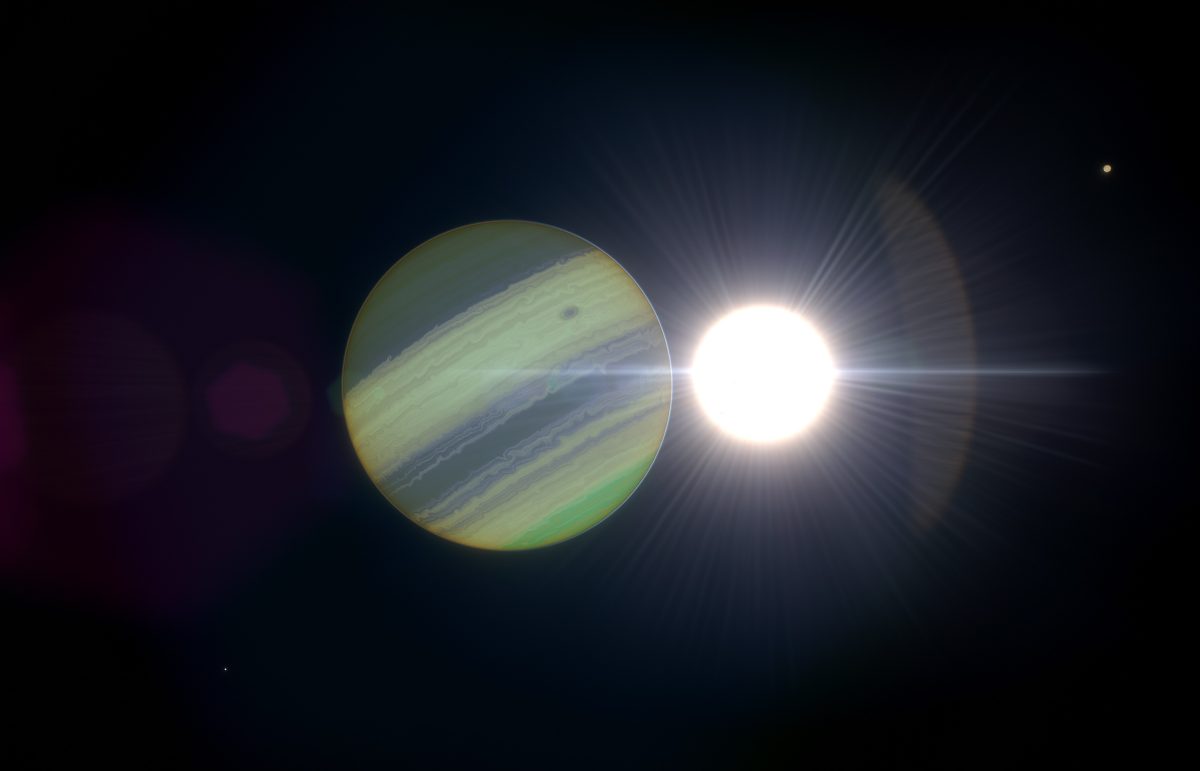
The discovery began in 2020, when the TESS space telescope detected the first transits—the characteristic dips in a star’s brightness when a planet passes in front of it. Scientists initially identified only two objects. A subsequent series of observations suggested that four planets might exist, but determining their orbits remained difficult for some time.
The picture became clearer when the European Space Agency’s (ESA) CHEOPS telescope—the Characterising Exoplanet Satellite—joined the investigation. Its data confirmed the first three planets and revealed the star’s main secret: all its planets are in orbital resonance.
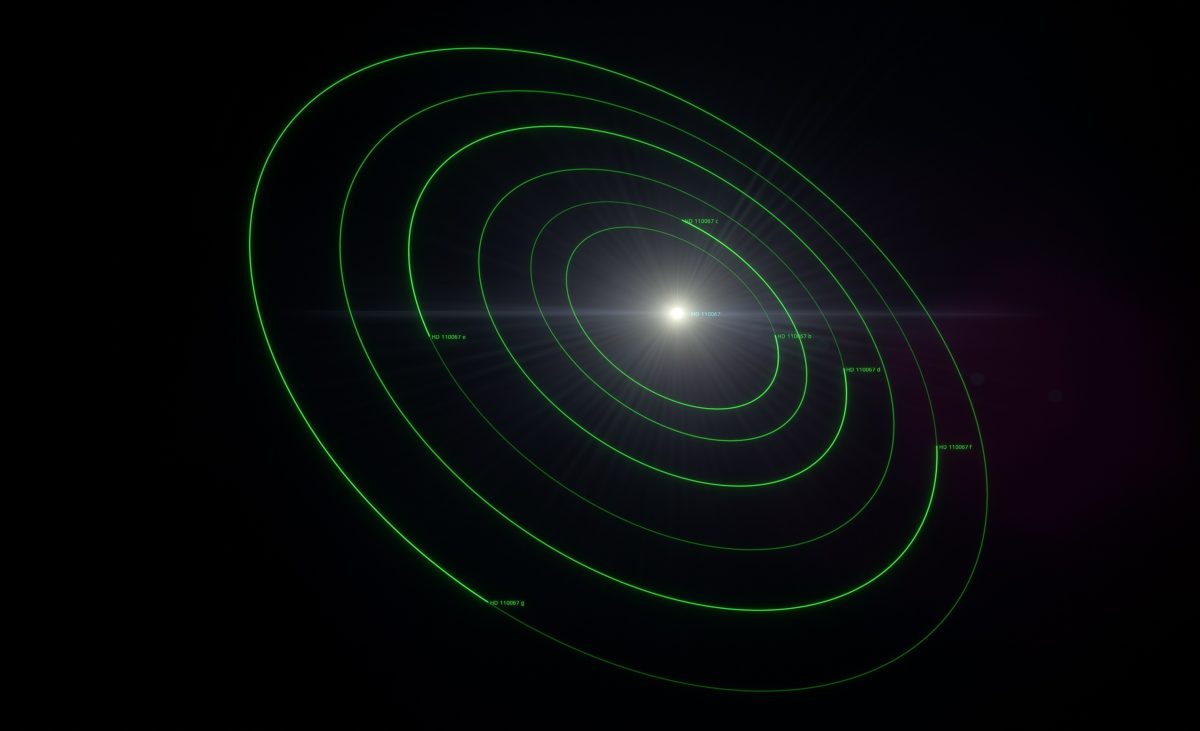
The innermost planet completes an orbit around the star in 9.11 days. The next takes 13.67 days. The third rounds out the inner trio with an orbital period of 20.52 days.
Having identified this mathematical rhythm, scientists could predict the orbits of other planets that had remained undetected. By comparing their mathematical model with earlier anomalies in the star’s brightness, the team confirmed the existence of three additional outer planets.
Primordial Chaos
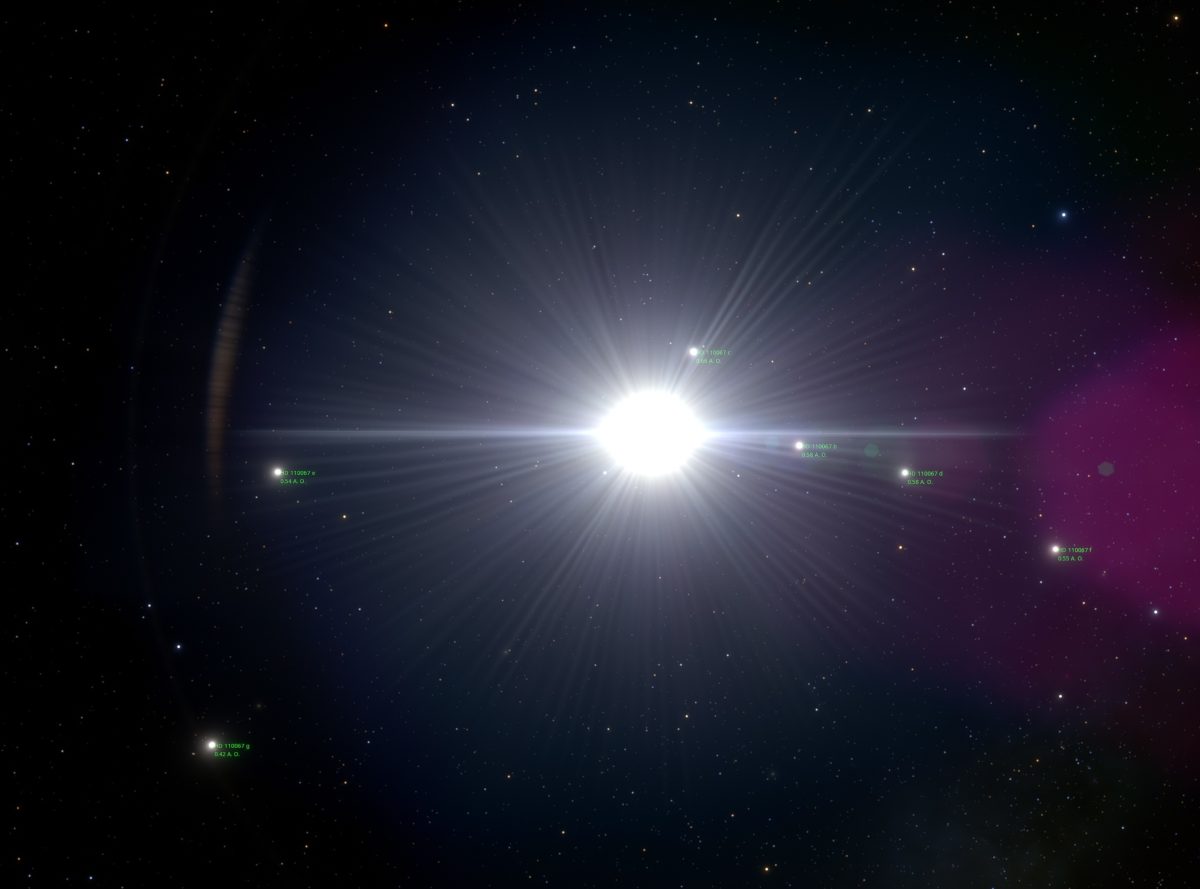
Most planets are generally born in similar resonant configurations. Over time, however, this delicate balance is easily disrupted: the emergence of a giant hydrogen-rich world, the gravitational influence of a neighboring star, or powerful collisions can shift orbits chaotically. Scientists estimate that only about 1% of all planetary systems retain their original orbital resonance.
HD110067 offers a unique opportunity to see a system in its original configuration—as it formed billions of years ago.
What Lies Beneath the Atmospheres?
Astronomers estimate that each of the six worlds has a mass lower than Neptune’s. Our Solar System contains no counterparts to planets of this class. They have extensive, dense atmospheres resembling the envelopes of Uranus or Neptune.
These gaseous envelopes make HD110067 an excellent candidate for detailed analysis with the James Webb Space Telescope. Researchers want to determine whether these planets are rocky worlds like Earth or Venus, but with exceptionally thick atmospheres, and whether a solid surface with oceans of liquid water exists beneath their clouds.
Previously, we reported on how an exoplanet close to Earth turned out to be an ocean world.
Based on material from Sky at Night Magazine
