

Interstellar comet 3I/ATLAS carries a chemical clue to conditions in the planetary system it came from—information preserved long before it reached our Sun. Its methane is exceptionally rich in heavy hydrogen, suggesting that the comet’s frozen ingredients formed in an extremely cold environment around another star—or in the cloud that existed before the star formed.
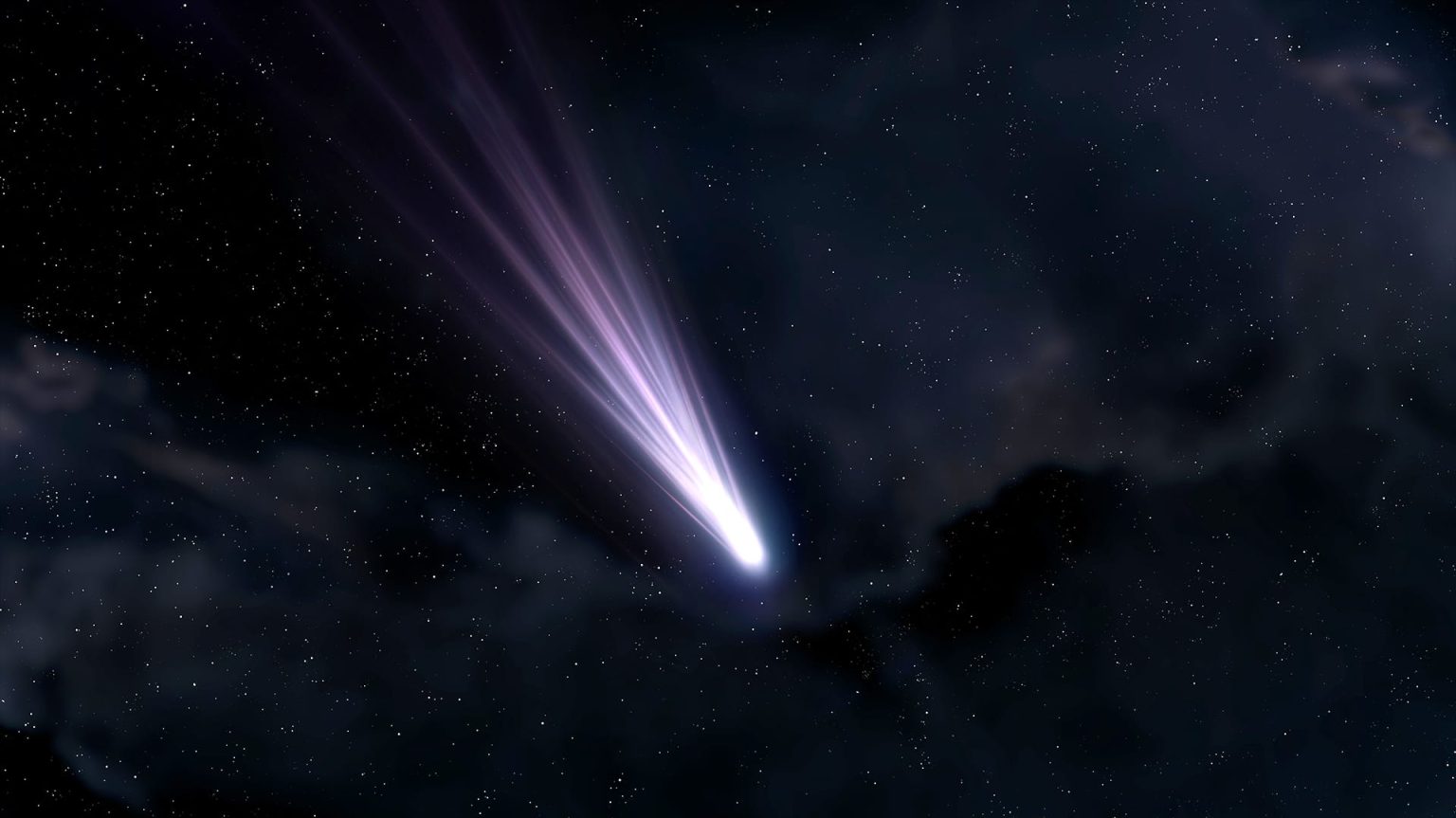
A Space Telescope Explores an Interstellar Comet’s Chemistry
Using the James Webb Space Telescope, Nathan Roth of American University and NASA’s Goddard Space Flight Center, together with colleagues, measured the ratio of heavy to ordinary hydrogen in 3I/ATLAS. It is approximately 13 times higher than the corresponding value for comet 67P/Churyumov–Gerasimenko, which likely originated in our Solar System, according to phys.org.
Their findings, published in Nature Astronomy, give scientists a rare opportunity to investigate the early chemistry of another planetary system. The challenge is to reconstruct the conditions under which the ice formed from the properties of the gas now escaping from it.
Searching for Deuterium’s Signature in the Comet’s Coma
Heavy hydrogen, known as deuterium, has an additional neutron in its nucleus. It can replace ordinary hydrogen in a methane molecule, which consists of one carbon atom bonded to four hydrogen atoms. This substitution changes the molecule’s infrared signature, allowing astronomers to distinguish the two forms, although the version containing deuterium produces a much weaker signal.
On December 22 and 23, 2025, James Webb observed comet 3I/ATLAS when it was approximately 2.4 times farther from the Sun than Earth is. The telescope analyzed infrared radiation from the coma—the cloud of gas surrounding the comet’s icy nucleus.
The researchers modeled and subtracted the light from other gases, then searched for faint traces of the heavier form of methane among the much brighter signatures of ordinary methane. These signals revealed a deuterium-to-hydrogen ratio, or D/H ratio, in methane of approximately 3.2%. “This D/H ratio exceeds every other value measured for methane in the Solar System,” the authors write.
The comparison with comet 67P, a Jupiter-family comet thought to have originated in the Kuiper Belt, is particularly useful because it is the only other comet in which deuterium-containing methane has been detected. That measurement required a detailed, close-up investigation by the Rosetta spacecraft. James Webb detected the molecule remotely in 3I/ATLAS, a visitor from beyond our Solar System.
Methane Ice Offers Clues
In extremely cold gas, certain chemical reactions favor the incorporation of deuterium into molecules. At temperatures around 10 degrees above absolute zero, reactions that could reverse this enrichment become less effective. Chemical reactions on interstellar dust grains can therefore produce deuterium-rich ice that eventually becomes part of a comet.
The new measurements also offer a clue to the timing of formation. The D/H ratio in methane was approximately three times higher than previously measured in water from 3I/ATLAS. The researchers suggest that the methane may have formed later, after chemical processes in the surrounding environment had more time to concentrate heavy hydrogen.
The Conditions in Which Comet 3I/ATLAS Formed
The team argues that the methane result is consistent with 3I/ATLAS originating in a cold cloud or an environment surrounding a forming star, with relatively few elements heavier than helium and intense cosmic-ray bombardment. These energetic particles help trigger reactions that enrich molecules with deuterium.
However, this offers a plausible history rather than a uniquely identified birthplace. Direct measurements of methane’s D/H ratio in distant star-forming environments are lacking, and the few chemical models that provide such estimates do not reach the value measured in this study.
The comet therefore presents a serious challenge to these models. Dense material around young stars can conceal the chemical composition of ice from telescopes, but comet 3I/ATLAS has brought some of that material into view. Any account of how its ingredients formed must now explain why its methane contains so much heavy hydrogen.
