

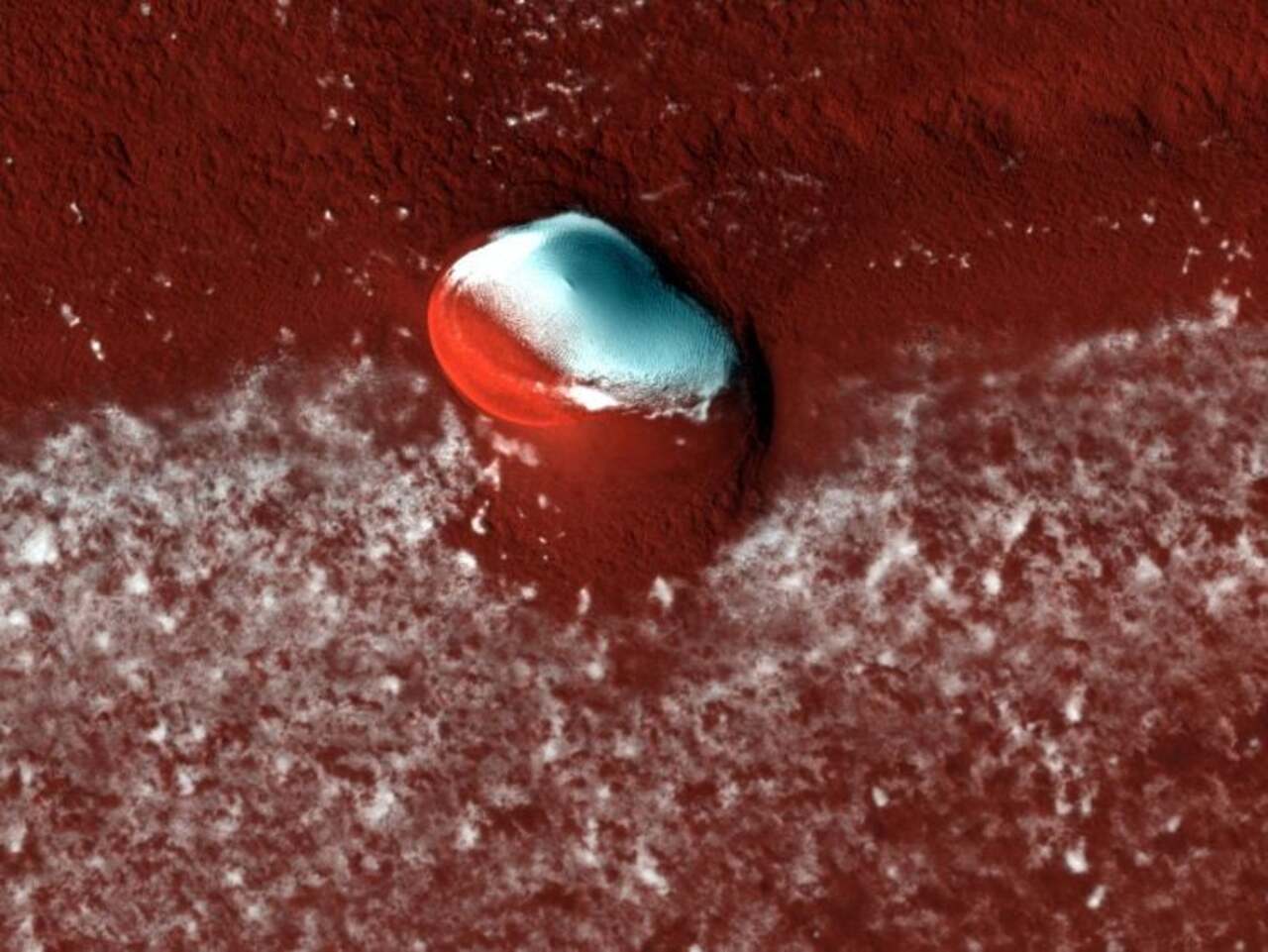
Bright ice deposits on the floors of small craters near Mars’s north pole expand and retreat from year to year. Planetary scientists identified the cause of these fluctuations by analyzing nearly twenty years of orbital images. The amount of ice in each crater depends largely on how much seasonal frost remains around it, rather than on changes affecting the entire polar cap.
Ten Martian Years
Planetary scientists tracked 36 craters on the northern residual polar cap—the permanent layer of water ice exposed in summer when the seasonal covering of frozen carbon dioxide disappears. The largest craters measure up to 300 meters across, while one of the best studied is about 57 meters wide, roughly half the length of a football field. Between 2006 and 2025, the High Resolution Imaging Science Experiment (HiRISE) camera aboard Mars Reconnaissance Orbiter captured 228 images of these craters.
Ten Martian years passed during that period, each lasting 687 Earth days. Bright deposits changed in 32 craters, mostly alternating between expansion and retreat. Four others remained unchanged, and the authors do not explain why. The study was published in the peer-reviewed journal Journal of Geophysical Research: Planets.
Why Monitor Craters?
Mars’s northern cap consists of layers of water ice mixed with dust, reaching a total thickness of several kilometers. Planetary scientists have long suspected that these layers preserve part of Mars’s climate history, much like ice cores on Earth. To read that record, researchers need to know whether the uppermost layer is currently accumulating or losing ice.
Previous observations offered conflicting answers. Some data indicated that the cap was losing ice, while other evidence suggested that its surface was very young and had been renewed until recently.
The ice on the floors of these craters is very young, probably no more than a few thousand years old. Only a small amount has accumulated over that time. Even frost that forms or disappears during a single summer can therefore noticeably change the extent of the ice on a crater’s floor.
The Role of Seasonal Frost
When more frost covered the area around a crater, the deposit inside generally grew as well. When the surrounding frost diminished, the deposit retreated. In three-quarters of cases, changes inside and outside the craters followed the same direction.
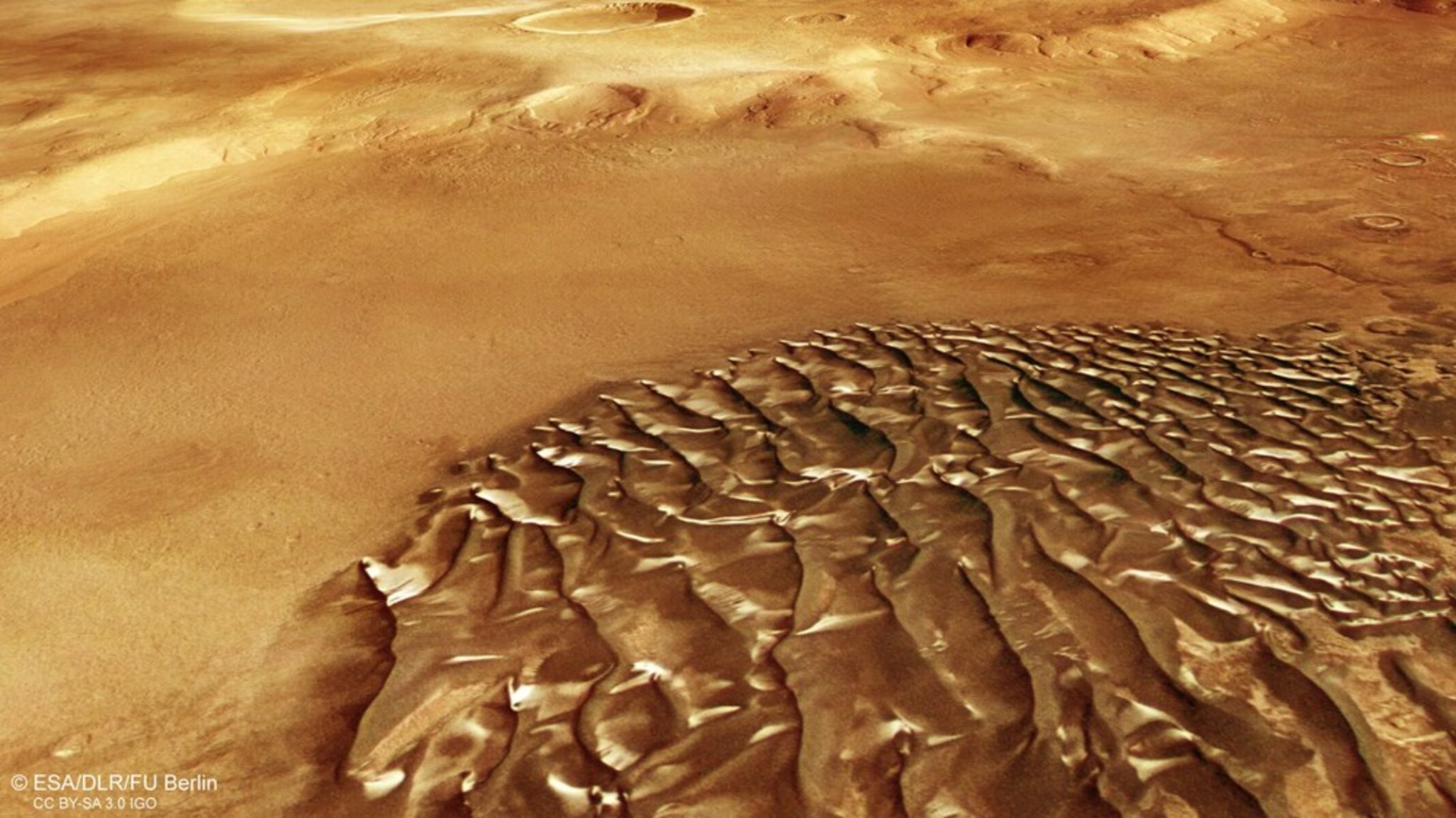
The summer water cycle offers an explanation. In early summer, solar radiation turns ice directly into vapor. Toward the end of summer, the atmosphere cools, and the vapor settles back onto the surface. Frost covers both the plain surrounding a crater and its floor. If some of the previous year’s frost survives until the end of summer, a new layer of ice builds up on the crater floor. If not, the ice there becomes thinner.
As Universe Today notes, Mars’s axial tilt varies much more dramatically than Earth’s, so the planet’s climate undergoes wider fluctuations overall. The study’s authors suggest that the cap is currently close to equilibrium, gaining approximately as much ice as it loses.
For researchers trying to read the climate record preserved in the cap’s layers, this is an important caveat. An individual crater cannot reveal whether the entire cap is gaining or losing ice. Establishing that will require monitoring many craters simultaneously and accounting each time for how much frost remains around each one.
Shadows and Dust
Three craters showed a different pattern. On at least one occasion, the surrounding frost and the ice inside changed in opposite directions, suggesting that conditions within the craters themselves have a greater influence on the ice. Exactly which conditions remains unclear. The authors suggest that carbon dioxide frost persists longer in shaded areas because they receive less sunlight. Water frost settles on top of it and may survive for part or all of the summer.
Following the global dust storm of 2018, the deposits shrank more frequently, but there are too few observations to establish that the storm was responsible. The same storm coated the Opportunity rover’s solar panels with dust, and contact with it was never restored. Climate models will be needed to test both hypotheses, which the authors identify as their next step.
