

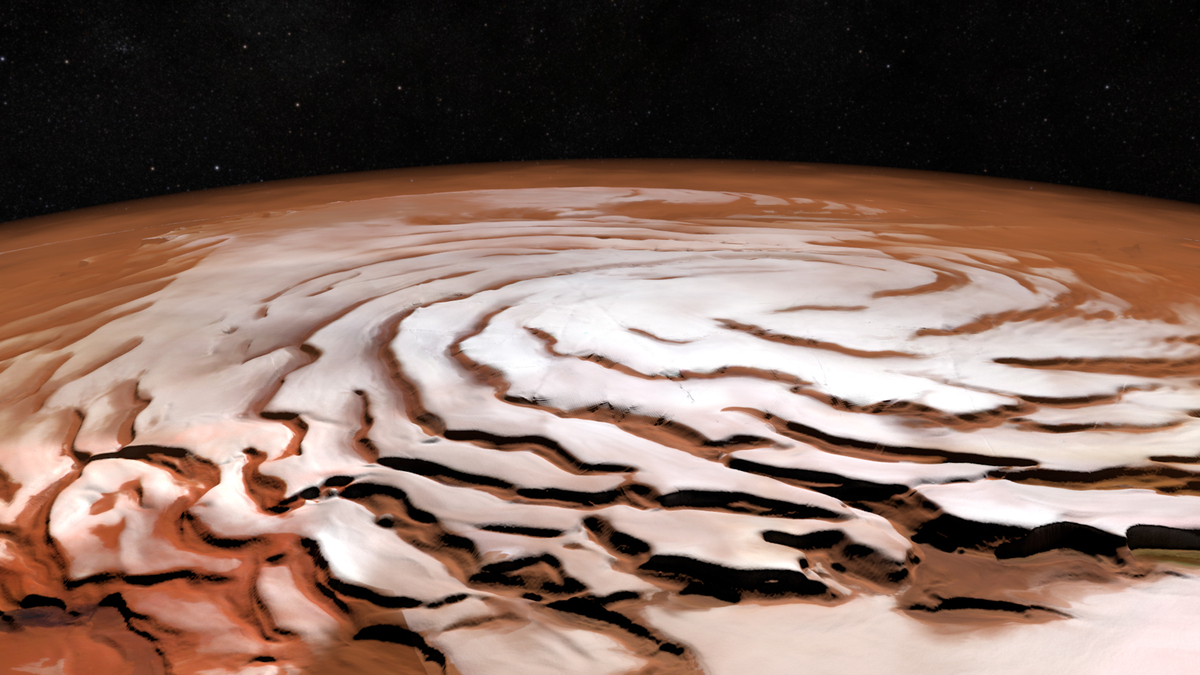
The ice at Mars’s north pole has turned out to be much cleaner than previously thought. It contains several times less dust than earlier estimates suggested. This conclusion came from a reanalysis of existing observations using a model that had been tested on snow on Earth. A thin frost layer that settles on the cap in winter contains noticeably more dust.
Less Than Three Percent Dust
Exposed water ice near the north pole of Mars contains less than 3% dust by total mass of the mixture. Previous calculations suggested up to 25%.
The new result was obtained by Pari Mohan and Aditya Khuller, a senior research scientist at the University of Washington Applied Physics Laboratory. The paper was published in the peer-reviewed journal npj Space Exploration.
According to radar data, the proportion of impurities throughout the roughly 1.5-kilometer-thick layered ice deposits beneath the cap does not exceed 13% by mass. This is an average value, so an individual layer may contain more dust. However, the previous estimate for the surface — about one-quarter of its mass — was difficult to reconcile with this limit, whereas the new estimate fits comfortably within it. The authors were able to reconcile these data by taking into account the structure of the deposits, where layers of nearly pure ice alternate with separate layers in which dust makes up between one-quarter and three-quarters of the mass.
Dusty Winter Frost
The authors link seasonal changes in the brightness of the polar ice to fine-grained water frost. It settles in winter and contains between 1% and 2% dust. In summer, this layer sublimates — that is, it turns directly into vapor without becoming liquid — exposing older, coarse-grained ice underneath, where the dust content is below 1%.
As Aditya Khuller explained in a comment quoted by Universe Today, “by tracking how the brightness changed over time, we found that frost forms in winter and it is dustier. During the Martian summer, it disappears and reveals cleaner, older ice.” The researchers were able to distinguish these two layers using spectra obtained during different parts of the Martian year.
A flyover video of Korolev Crater on Mars, created from images taken by the European Space Agency’s Mars Express spacecraft. The 82-kilometer-wide crater is filled with water ice throughout the year. Source: SciTech Daily
A Model Based on Earth Ice
The brightness of ice in different parts of the spectrum depends on grain size, dust content, and the way the layers are arranged. Previous models relied on numerous assumptions about these parameters, so the same spectrum could be explained by very different combinations of them. Even at the landing site of the Phoenix spacecraft, where the ice was studied directly at the surface, estimates of dust content varied significantly.
Pari Mohan and Aditya Khuller used a model that had previously been tested against measurements of snow, firn, and ice on Earth. Firn is granular, compacted snow that has not yet turned into ice. Using this model, the authors reanalyzed data from the orbital spectrometers aboard Mars Express and Mars Reconnaissance Orbiter, as well as images from the Phoenix lander. The grain sizes in the upper layer of Martian polar ice generally fell within the range characteristic of grains in terrestrial firn.
A Record of an Ancient Climate
The polar cap consists of a one-meter-thick upper layer of ice, beneath which lie layered deposits about 1.5 kilometers thick. The composition of the layers is used to reconstruct the conditions under which they formed. Because of variations in the tilt of the planet’s axis, ice has repeatedly migrated between the poles and mid-latitudes over the past several million years.
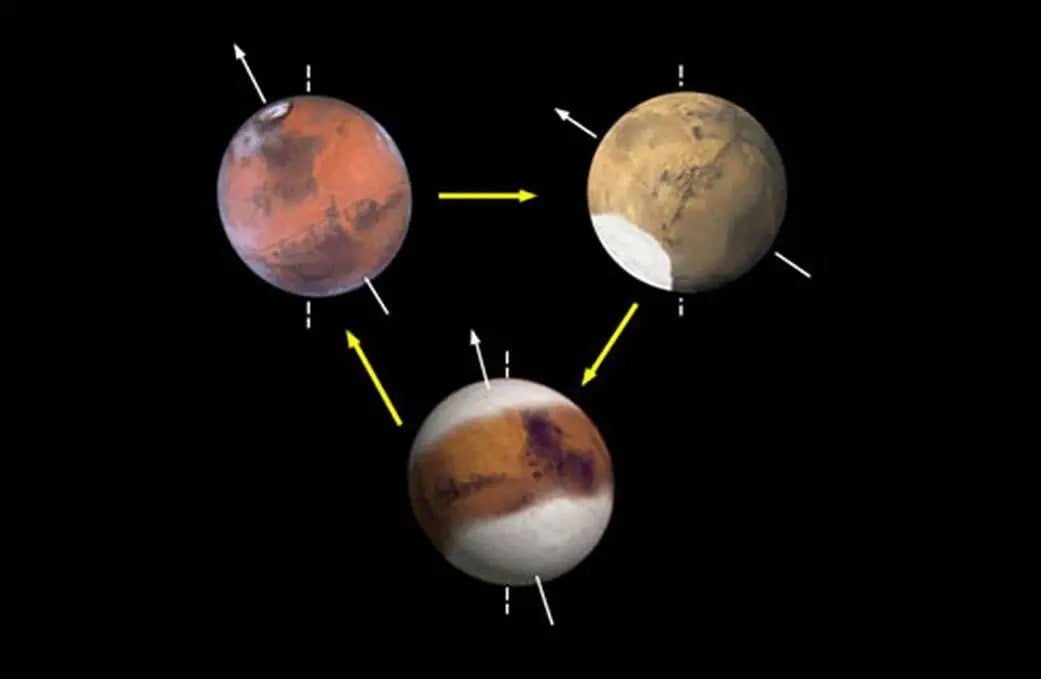
According to the authors’ hypothesis, the cleaner ancient ice may have accumulated during periods of lower axial tilt, when dust storms occurred less often or did not occur at all. However, they do not rule out the possibility that impurities migrated within the ice over time.
The authors estimate that the upper meter of the cap contains up to 10 billion tons of dust. If this dust were spread evenly across the area of the cap, it would form a layer about 3.5 millimeters thick. Returning that amount of dust to the atmosphere could noticeably change the planet’s climate. The authors propose using the new constraints on dust content and grain size to refine models of polar-ice stability and the climatic history of Mars.
