

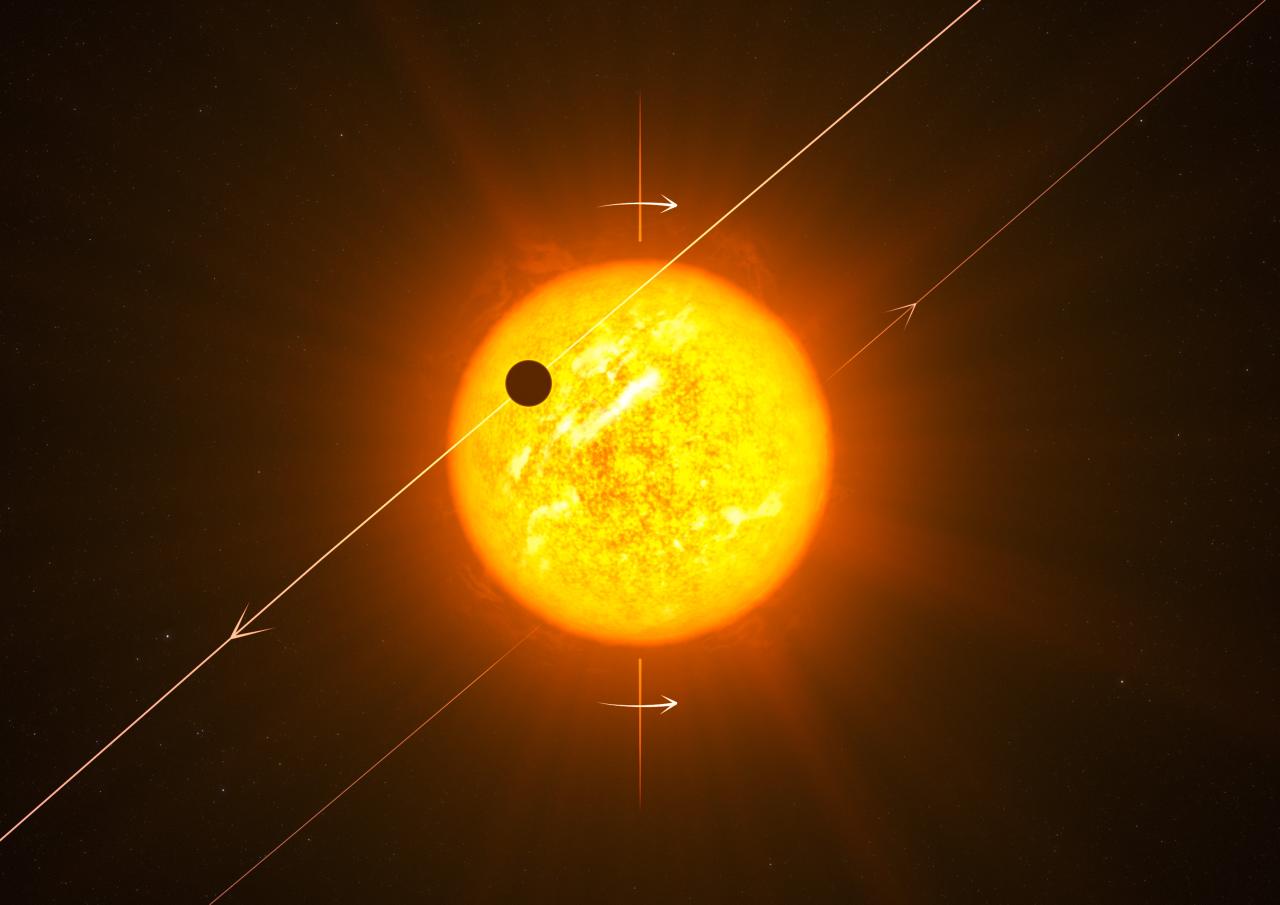
The NIRPS spectrometer, located at a high-altitude observatory in Chile, has enabled astronomers to detect the highly unusual exoplanet GJ 3090 b. Its orbit is strongly tilted relative to the equatorial plane of its star. In addition, the planet moves in the opposite direction to the star’s rotation.
Discovery of a New Exoplanet
According to www.iac.es, an international team led by the University of Geneva (UNIGE), including researchers from the Instituto de Astrofísica de Canarias (IAC), determined the orbital configuration of the exoplanet GJ 3090 b using the NIRPS spectrograph, developed with the participation of the IAC and installed on the 3.6-meter telescope at the La Silla Observatory (ESO, Chile).
The planet shows a significant misalignment with the star’s rotational axis and orbits in the direction opposite to the rotation of its star. This mystery becomes even more complicated because there is no massive companion in this planetary system capable of influencing the planet’s orbit and therefore explaining such a configuration.
A star and its planets form when a cloud of gas and dust somewhere in space collapses. The cloud then forms a disk around the emerging star, inside which planets will form. This protostar and its disk rotate in the same direction. In this ideal scenario, planets formed in the disk will orbit in the same direction as their star and in the same plane as the stellar equator, perpendicular to the star’s axis of rotation. Astronomers call such systems “aligned.”
In the Solar System, all eight planets orbit in the same direction as the Sun, but there is a small angle between their orbital planes and the star’s equatorial plane. This angle, often referred to as “psi,” ranges from about 3 to 7 degrees depending on the planet. For Earth, for example, it is slightly more than 7 degrees. This small deviation from the ideal scenario may indicate disturbances that occurred during the formation of our Solar System, such as an encounter with another star or an asymmetric collapse of the original cloud.
“Measuring the ‘psi’ angle provides clues about the formation and evolution of planetary systems. It is therefore quite natural for us to try to measure it for other planetary systems,” comments Yann Carteret, a doctoral student in the Department of Astronomy at the Faculty of Science of the University of Geneva (UNIGE) and first author of the study on the planet GJ 3090 b.
How Was the Planet GJ 3090 b Discovered?
GJ 3090 is a red dwarf, a star that is cooler and smaller than our Sun. The planet GJ 3090 b, which orbits it, was first detected by the TESS space telescope, which scans the sky for transits — small periodic dips in a star’s brightness caused by a planet passing in front of it. The planet has a radius 2.2 times that of Earth and a mass 4.5 times greater, making it a “sub-Neptune” — the most common class of exoplanets in our Galaxy.
The NIRPS instrument (Near-Infrared Planet Searcher) — an extremely stable spectrograph installed on ESO’s 3.6-meter telescope at the La Silla Observatory — was used to detect two other planets in the system, confirm the presence of GJ 3090 b, measure its mass, and, above all, determine its unusual orbital configuration.
“It was precisely thanks to NIRPS’s capabilities in the infrared range that we were able to achieve the precision needed to measure the angle between the planet’s orbital plane and the star’s equatorial plane for such a small planet,” notes Jonay González, an IAC researcher who leads the Spanish part of the project and is a co-author of the study.
The Cause of the Strange Orbital Configuration
The “psi” angle for GJ 3090 b is approximately 136 degrees. Only five other multiplanet systems are known to contain a misaligned planet with an angle greater than 70 degrees. However, unlike those other systems, there is no evidence of a massive object — another star or planet — orbiting GJ 3090 that could account for such a configuration.
Astronomers still cannot explain the exoplanet’s unusual orbit. However, they note that in the case of GJ 3090, the star may have accumulated an uneven retrograde secondary disk in which the planets of this system later formed.
Spain’s participation in the development of NIRPS was coordinated by the Instituto de Astrofísica de Canarias, which contributed to the design, development, and commissioning of the instrument’s fiber bundle. In addition to Jonay I. González Hernández, Vera M. Passegger, Rafael Rebolo, Alejandro Suárez Mascareño, and Atanas Stefanov also participated in the recent study.