

The Webb Space Telescope (NASA/ESA) has shared a stunning image of a turbulent “cauldron” of star formation. The telescope targeted LHA 120-N 159, or simply N159, a giant stellar nursery located 161,000 light-years away in the Large Magellanic Cloud. The region captured in the image spans approximately 230 light-years.
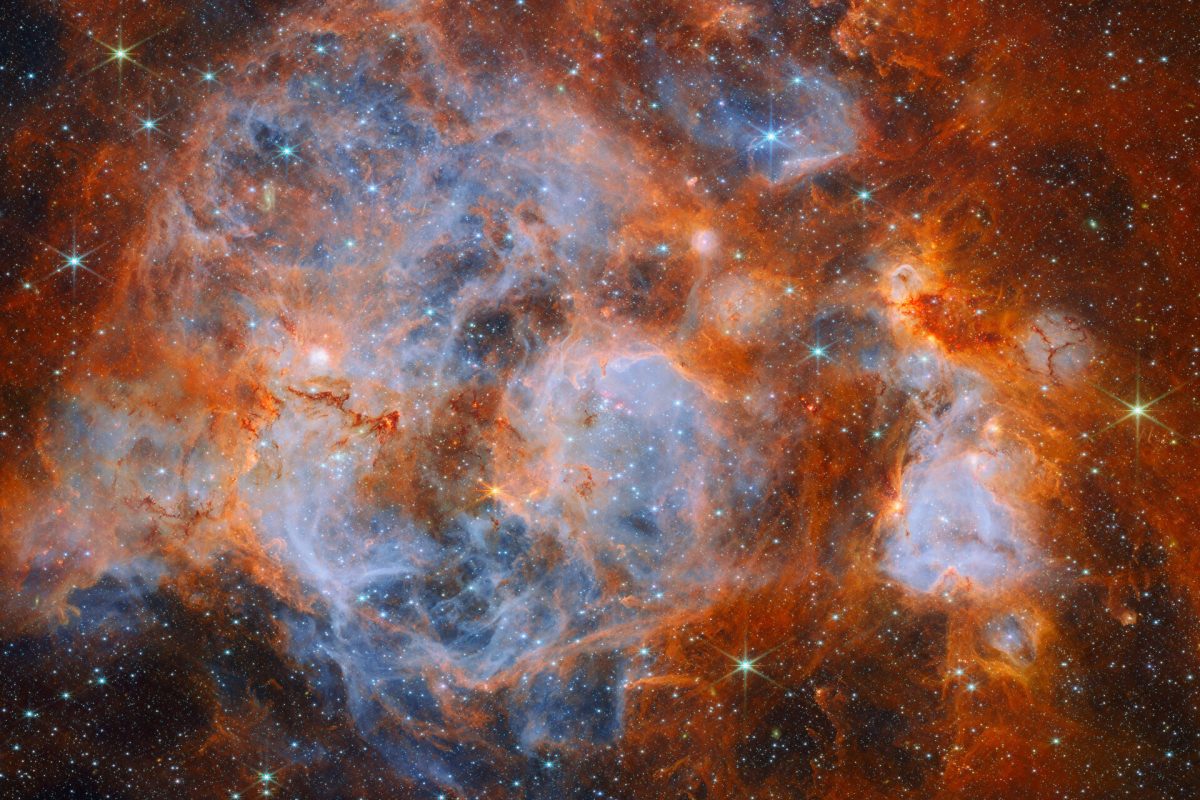
N159 belongs to a class of objects known as H II regions—areas of space filled with ionized hydrogen. In these regions, dense, cold molecular clouds collapse under their own gravity, giving rise to a new generation of stars.
Once formed, massive stars emit intense ultraviolet radiation that ionizes their surroundings, causing them to glow brightly. Meanwhile, powerful stellar winds carve enormous cavities into the nebula and shape dense ridges of gas. James Webb’s Near-Infrared Camera, NIRCam, captured these processes in exquisite detail.
A Light Show in the Gas Clouds
Glowing orange clouds of dust and gas surround the center of the image. Their distinctive glow comes from polycyclic aromatic hydrocarbons—complex, carbon-based organic compounds. Pale blue patches mark ionized hydrogen, while dark red filaments trace the densest and coldest regions of molecular gas.
These dark red structures act as a shield, protecting embryonic stars from the destructive radiation of neighboring giants. A closer look reveals young stars within these filaments and orange pillars of gas.
A Window into the Ancient Universe
Astronomers estimate that N159 is no more than 3 million years old, making it one of the youngest star-forming regions in the Large Magellanic Cloud. It harbors thousands of newborn stars.
N159’s main scientific value lies in its chemical composition. Unlike our own Galaxy, the Large Magellanic Cloud has significantly lower “metallicity,” meaning it contains far fewer elements heavier than hydrogen and helium. Observations of N159 therefore allow astronomers to study star formation under conditions closely resembling those in the early Universe.
Previously, we reported on how embryonic planets were discovered in the Universe’s smallest protoplanetary disks.
Based on material from Phys
