

Thanks to the exceptionally sharp “vision” of the ALMA radio telescope array, astronomers have resolved intricate details where they previously saw only a dark void. Scientists discovered rings, gaps, and cavities in extremely compact disks of gas and dust around young stars. These structures extend through the inner regions of planetary systems, at distances comparable to the scale of our own Solar System.
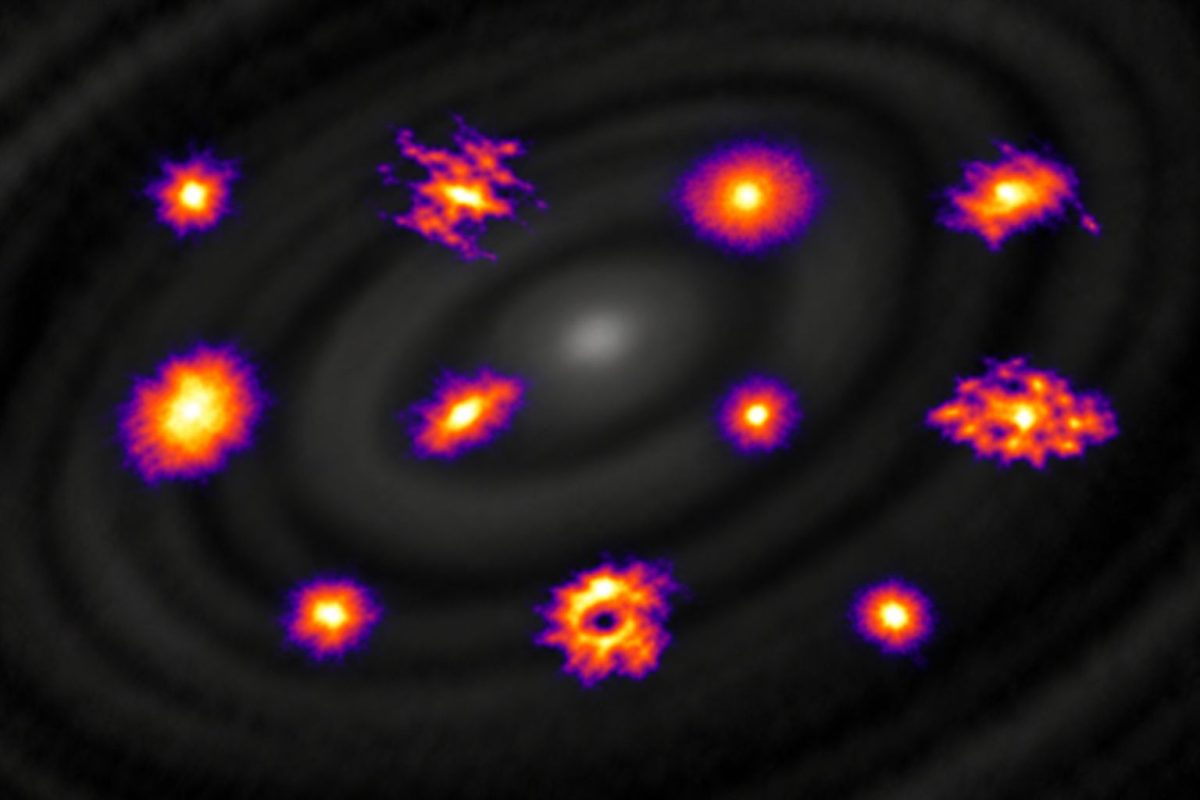
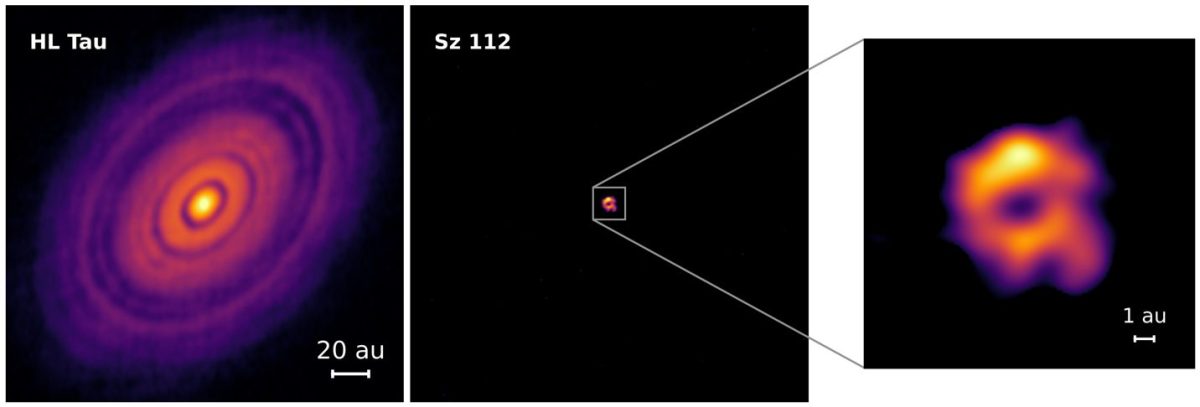
Previously, ALMA’s most spectacular images showed vast, expansive disks with clearly defined rings where new worlds are born. Smaller disks, by contrast, appeared smooth and uniform. This raised a logical question: do small systems evolve according to different laws of physics, or did the images simply lack sufficient resolution?
Maximum Power
An international team of astronomers led by Pietro Curone of the University of Chile decided to investigate. They pointed ALMA’s antenna array at 11 ultracompact protoplanetary disks in the star-forming region of the constellation Lupus. Observations were conducted at a wavelength of approximately 0.9 millimeters with an angular resolution of 0.02 arcseconds—the telescope’s current observational limit. At the distance of the targets, this corresponds to a scale of approximately two astronomical units, twice the distance between Earth and the Sun.
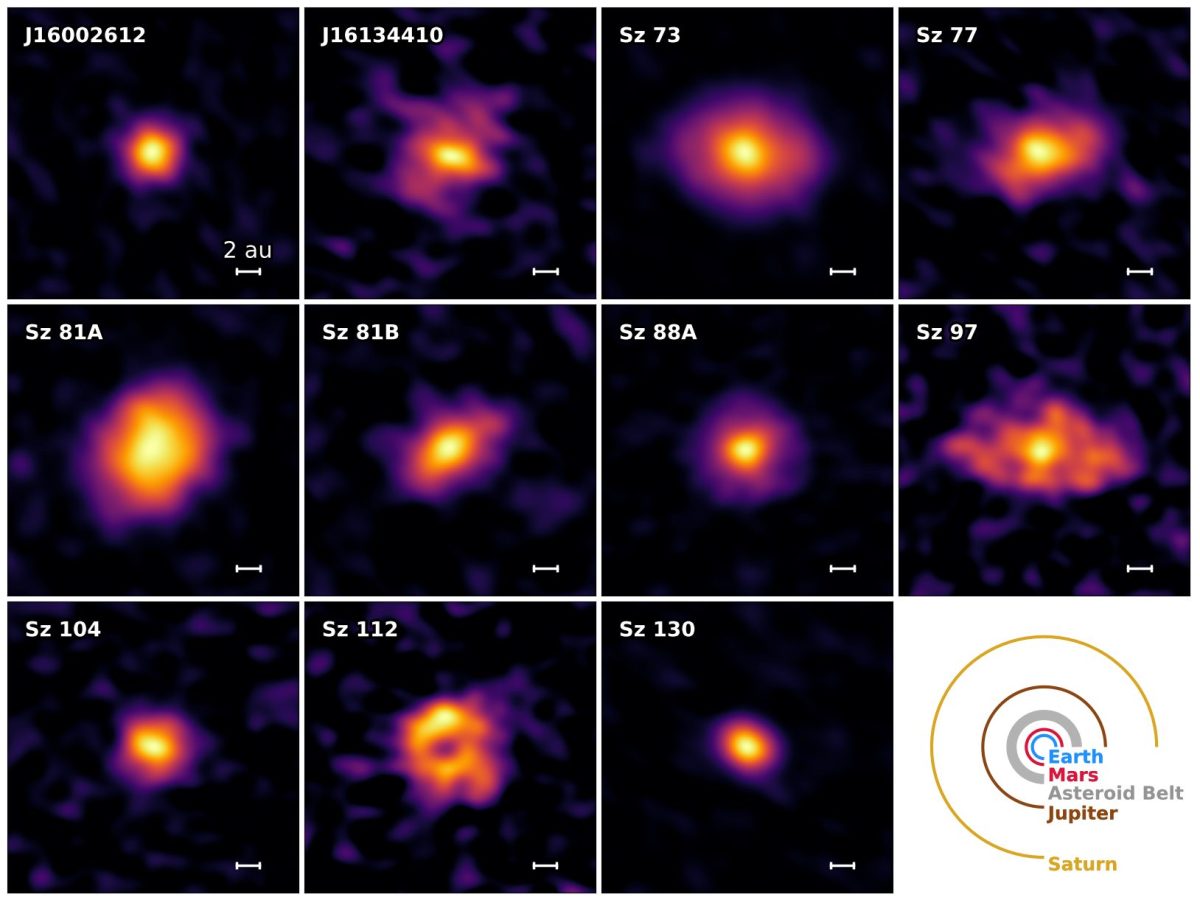
The results exceeded expectations. Clear internal structures within 10 astronomical units of the star were found in four of the 11 disks, while three others showed strong indications of such features. In the Sz 112 system, the telescope detected a central cavity with a radius of just 1.6 astronomical units.
“For a long time, the smallest disks appeared much simpler. We have demonstrated that this was merely an illusion caused by insufficient resolution,” Pietro Curone emphasizes.
The Cradle of Super-Earths
This discovery is fundamentally important. Dust in a protoplanetary disk continually loses speed and drifts inward, risking destruction in the star long before it can form a planet. The detected rings and gaps act as “pressure traps”: they halt this drift, accumulate solid material, and create favorable conditions for building planets.
Calculations show that if the observed gaps were carved by planets’ gravity, the planets responsible would have masses comparable to super-Earths or mini-Neptunes. For the first time, scientists have come close to observing planets at precisely the orbital distances where most mature exoplanets are typically found.
Astronomers also uncovered another surprise: the Sz 73 and Sz 130 systems have faint outer rings extending far beyond their bright central disks. This suggests that even the smallest disks may be much larger and more complex than previously thought.
We previously explained how astronomers search for exoplanets.
Based on material from almaobservatory.org.
