

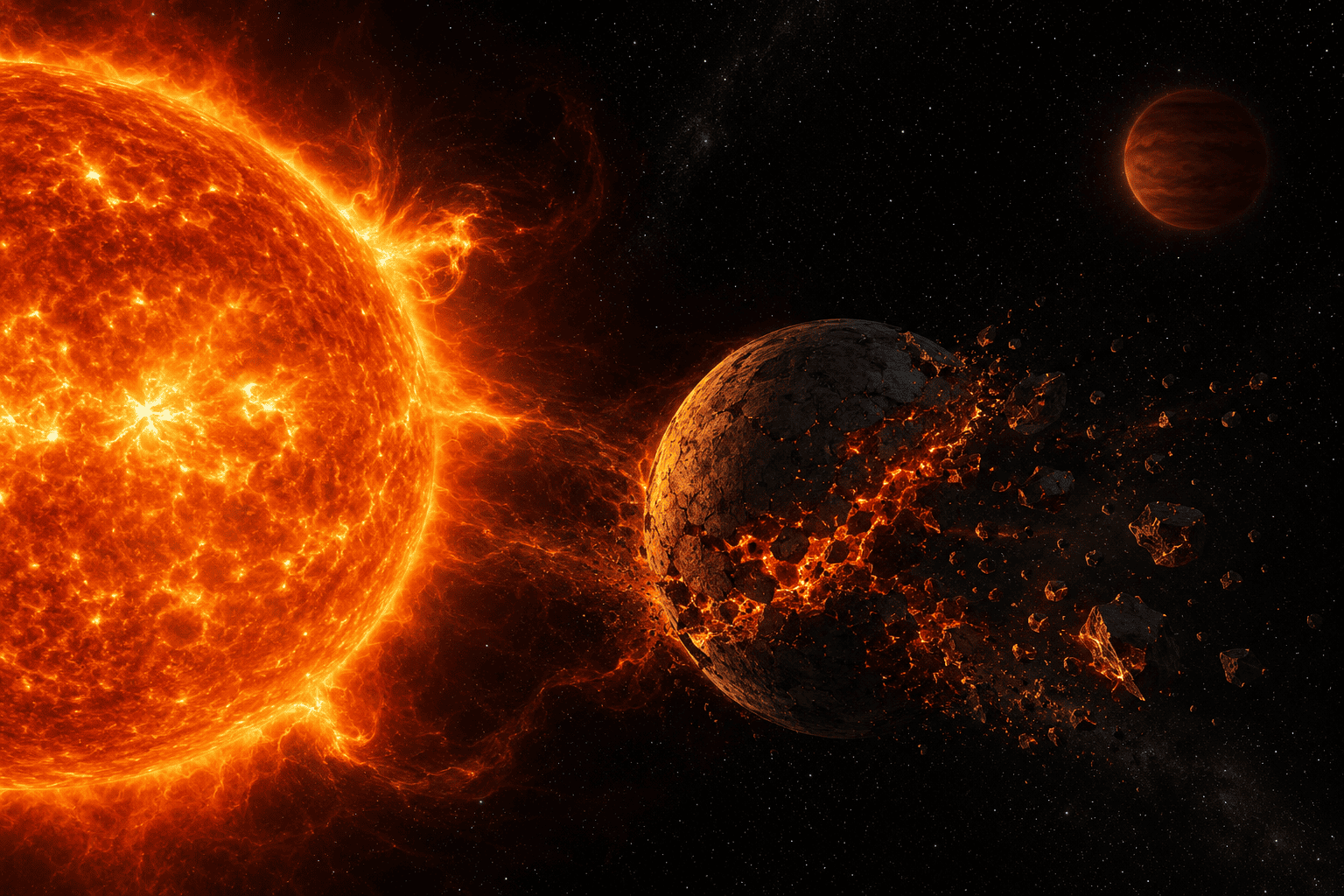
A star 1,300 light-years away аstronomers have discovered a sun-like star, TOI-5882, with an abnormally high lithium content. This is most likely the result of a recent capture of a rocky planet. Evidence for this the chemical composition of its atmosphere. A brown dwarf was discovered nearby that may have disrupted the planet’s orbit and sent it crashing into the star.
“You are what you eat” in space
The star TOI-5882 has caught the attention of researchers due to the abnormally high lithium content in its atmosphere. Brooke Kotten of the University of Michigan offers a simple explanation. There is much more lithium in planetary material than in stars, so when a planet is swallowed up, the star takes in all that lithium along with it.
The star itself had not yet become a red giant, and therefore could not have engulfed the planet through natural expansion. This happens at the end of a star’s evolution, when it swells to hundreds of times its original size and engulfs the nearest planets. This will happen to the Sun in about 5 billion years. By then, it will have expanded to roughly the orbit of Mars, swallowing up the inner planets of the Solar System, including Earth.
A possible mechanism
A brown dwarf (an intermediate object between planets and stars) has been discovered near TOI-5882. It also formed from a gas-and-dust cloud but did not accumulate enough mass to undergo nuclear fusion. The brown dwarf is about 20 times larger than Jupiter, which is equivalent to about 2% of the Sun’s mass. This is enough to exert a gravitational influence on nearby planets, and the team believes that it could have disrupted the planet’s orbit and sent it crashing into the star.
Absorption events last only a few days or weeks, so it is nearly impossible to observe them in real time. Astronomers have to piece together what happened using circumstantial evidence, much like detectives at a crime scene.
What kind of planet was it?
To determine exactly what kind of object had been swallowed, the team compared the chemical composition and lithium content of 62 stars of similar age and size. Based on the amount of lithium, they were able to determine that the swallowed planet belonged to the super-Earth class and had a mass ranging from two Earth masses to approximately 18, which corresponds to the mass of Neptune.
Melinda Soares-Furtado, the study’s senior author and an assistant professor at the University of Wisconsin, notes that TOI-5882 exceeds 97% of the stars in the comparison sample in terms of lithium content, and this result remains consistent regardless of the analysis method used.
Several other stars in the control sample also have elevated lithium levels, although not as pronounced. The team will continue to investigate the cause of these anomalies. The study was published in The Astrophysical Journal.
According to space.com