

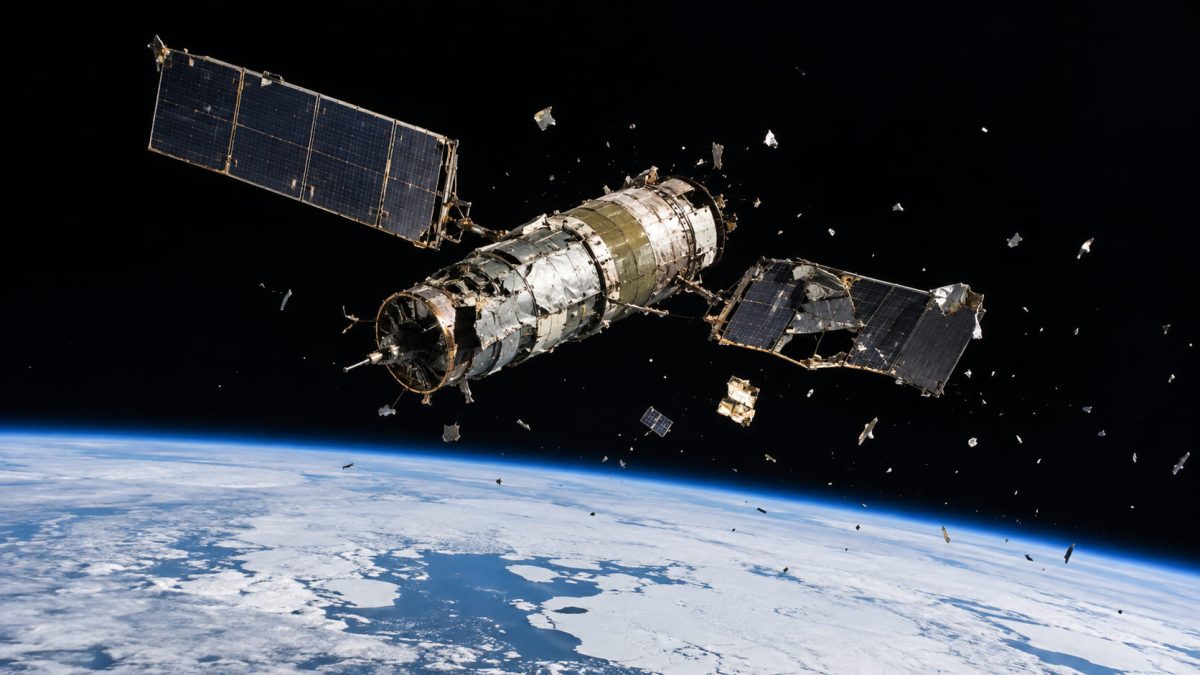
An old Soviet weather satellite has broken apart in low Earth orbit, creating a cloud of debris around it. The spacecraft has been inactive for decades, and debris at this altitude remains in orbit for a very long time. The cause of the breakup has not yet been established.
An Altitude with Almost No Drag
Meteor-2-7 belonged to the Soviet Meteor-2 series of weather satellites and was launched into orbit in May 1981. Its instruments monitored cloud cover and collected data on Earth’s atmosphere. The main body of the spacecraft continues to orbit at an altitude of about 855 kilometers. This is roughly twice the altitude of the International Space Station, which orbits at approximately 420 kilometers.
The atmosphere there is so thin that it barely slows small objects down. According to NASA, debris at an altitude of around 800 kilometers can remain in orbit for decades or even centuries, depending on its size. The new cloud of fragments will therefore threaten other spacecraft for many years.
A Signal over Australia
The breakup on October 5 was detected by LeoLabs, a company that tracks satellites and space debris using a network of radars. Specialists spotted several new objects near the inactive satellite as it passed over a radar station in Western Australia. Observations from other radars confirmed the formation of debris.
Space debris expert Jim Shell provided a more precise time for the event. The breakup occurred at 12:45 p.m. Kyiv time, with a possible margin of error of 10 minutes. The exact number of fragments has not yet been announced, but estimates suggest several dozen.
Explosion or Collision?
There are currently two possible explanations. A malfunction or explosion may have occurred inside the spacecraft. The other possibility is a collision with an object in orbit.
Jim Shell favors the collision explanation, although he acknowledges that the cause will probably never be determined. The orbital region at an altitude of 855 kilometers is heavily littered with debris. Moreover, at the time of the breakup, the satellite was near the highest latitude it reaches, as its orbital plane is inclined at 81 degrees to the equator. This is where debris density is greatest.
Large-scale breakups have occurred at this altitude before. In 2007, China used a missile to destroy its own Fengyun-1C weather satellite at an altitude of about 865 kilometers, producing more than 3,000 trackable fragments. A significant proportion of them still orbit Earth.
An Alarming Series
According to EarthSky, LeoLabs described this incident as part of an alarming trend, having recorded several similar breakups over the past six months. In March, dozens of objects appeared around the Starlink 34343 satellite following a malfunction that SpaceX attributed to a likely internal energy source rather than a collision. In August, a spent Long March rocket stage broke apart, potentially producing anywhere from several dozen to hundreds of fragments.
Objects in low Earth orbit travel at around 28,000 kilometers per hour, so even a small fragment can seriously damage a spacecraft. Every new breakup increases the risk of Kessler syndrome, a chain reaction in which debris causes further collisions, which in turn generate even more debris.
NASA scientists Donald Kessler and Burton Cour-Palais described this scenario back in 1978. It involves a gradual accumulation of collisions rather than an instantaneous catastrophe, making certain orbital regions increasingly hazardous over the years. The fragments of Meteor-2-7 will gradually descend and eventually cross lower orbits, where the International Space Station and thousands of Starlink satellites operate. For their operators, this means more collision-avoidance maneuvers, each of which consumes fuel and shortens a spacecraft’s operational life.
There are currently no large-scale orbital cleanup programs, only isolated demonstration projects. In 2024, the Japanese company Astroscale brought its ADRAS-J spacecraft to within about 15 meters of a spent H-IIA rocket stage. Its next mission is intended to capture the stage and remove it from orbit. The Kyiv-based startup Kurs Orbital is working on similar technologies, developing a spacecraft for rendezvous and docking with other satellites. However, a single mission can remove only one large object, while each breakup like that of Meteor-2-7 adds dozens of new ones.
