

A small Swiss development team, Periapsis Works, has created the computer game KESSLER: Orbital Incremental. In it, players can experience being the control system of a Soviet military satellite that unexpectedly wakes up after decades of dormancy and decides to unleash terror in orbit.
Kessler Syndrome
On October 6, 2026, the computer game KESSLER: Orbital Incremental was released on Steam. Players take control of the secret Soviet satellite KESSLER-1, once abandoned in orbit, which awakens in 2041, decides there are too many unwanted spacecraft around, and starts shooting them down.
You can learn more about how the developers—a team of just two—envision their game on their own website. An online demo is available on a separate page on the itch.io platform. The creators openly acknowledge that the names of both the game and its spacecraft refer to “Kessler syndrome.”
This is the name given to a hypothetical scenario proposed in 1978 by NASA scientist Donald Kessler. In this scenario, once there are enough spacecraft in orbit, the destruction of one or more of them—for example, in a collision—produces an avalanche of debris that does not readily slow down because there is no friction in space.
Instead, the fragments continue orbiting Earth, as their speeds are not high enough to escape its gravity entirely. They collide with other spacecraft, destroying them and creating new clouds of debris that, in turn, threaten other spacecraft. The cycle continues until the orbit becomes completely unusable.
Soviet Combat Satellites
The creators of KESSLER: Orbital Incremental attempted to depict all of this in their game. The premise certainly raises plenty of questions. For example, anyone building a spacecraft with a kinetic cannon—and demonstrating through its very name that they understand the concept of orbital chaos—would surely have considered the damage it could cause to their own spacecraft.
Naming a satellite after a NASA scientist at the height of the Cold War is not a particularly realistic idea either. Incidentally, the Soviet Union did develop a combat spacecraft project in the 1980s called Skif. It was equipped with a gas-dynamic laser rather than a kinetic cannon, partly so that it could destroy spacecraft without producing large amounts of debris.
What Happens in the Game
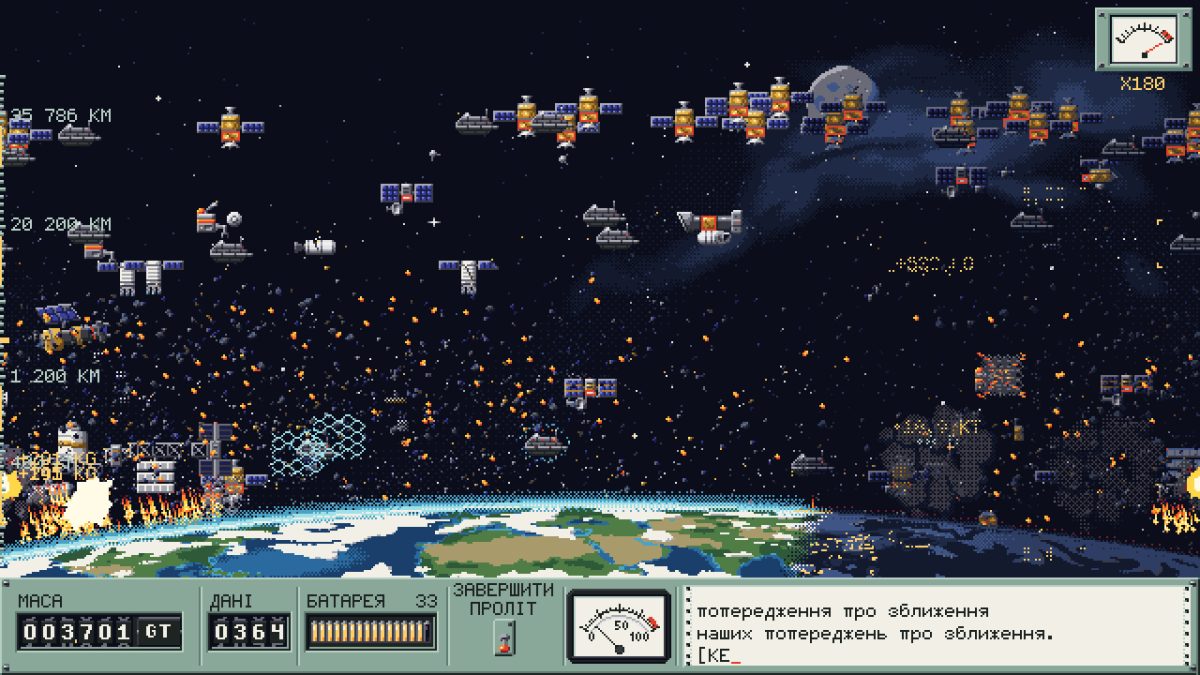
The game itself is a pixel-art shooter. The player controls KESSLER-1, which hangs motionless above a section of Earth’s surface, and can only change the direction in which its cannon points. The game is divided into rounds, or “passes,” as they are called here. During each one, modern counterparts fly past the Soviet satellite, and the player must shoot at them.
The spacecraft spin as they move. They are small but look quite good. A hit triggers an explosion, sending tiny fragments flying in every direction. When these fragments collide with something, they damage it and may even cause another explosion, creating further hazards. In short, the essence of Kessler syndrome is presented vividly, if in a fairly simplified form.
Between rounds, debris collected from destroyed satellites can be exchanged for various upgrades: increased projectile mass and speed, more debris collected, and explosive charges that generate an additional wave of fragments.
In the demo, players can shoot down only satellites, and only in the lowest orbit. In the full version available on Steam, judging by the YouTube trailer, players can damage entire stations across several orbits. All of this leaves a rather mixed impression: Kessler syndrome is, after all, a terrible catastrophe, while the game presents creating chaos as fun. Still, it is worth playing, at least to get a sense of how powerfully debris can multiply in orbit.
