
Streams of superheated gas surrounding a distant black hole have proved far more powerful than previously believed. They extend well beyond the galaxy that hosts the object and disturb matter around neighboring groups of stars. Until now, scientists thought that such effects remained confined to a single galactic system.
A Source in the Constellation Draco
The quasar H1821+643 is located approximately 3.4 billion light-years away in the direction of the constellation Draco. It lies at the center of a large galaxy cluster and is surrounded by a cloud of superheated plasma that glows in the X-ray spectrum. Universe Today reports on the work of Japanese astronomers.
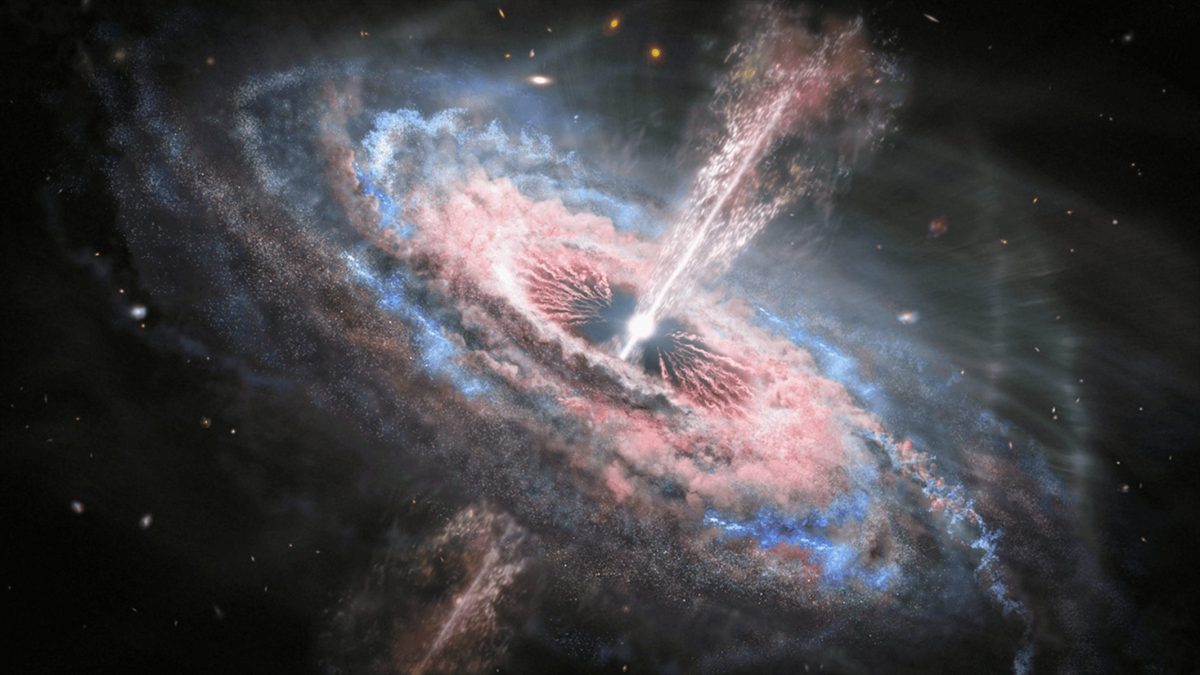
The luminosity of objects of this class is produced by matter falling toward a supermassive black hole. Some of this material does not reach the event horizon. Instead, radiation pressure accelerates it and creates high-speed outflows directed away from the black hole.
X-Ray Observations
The motion of the hot plasma was traced using the X-Ray Imaging and Spectroscopy Mission, or XRISM. The key evidence came from spectral lines of ionized iron. By measuring their shifts, astronomers were able to determine the speed and direction of the material’s movement in different parts of the cluster.
The data revealed a picture of constant turbulence. Rather than remaining calmly distributed around the core, the superheated gas moves chaotically and spreads across a broad region of space.
The Scale of the Shock Wave
At its greatest extent, the disturbance reaches approximately 300,000 light-years, three times the estimated width of the Milky Way. The amount of energy transported to this distance is equivalent to several billion supernova explosions.
Previously, such outflows were thought to remain confined within their host galaxies. According to Satoshi Yamada of Tohoku University, the actual strength of the process exceeded earlier calculations by more than a hundred times. The findings were published in the peer-reviewed journal Nature Astronomy.
Our Galaxy’s Active Past
The supermassive black hole Sagittarius A* at the center of the Milky Way is currently quiet, but this was not always the case. There is evidence that it underwent an active phase approximately six million years ago, leaving behind hot, diffuse gas in the surrounding region.
The structures associated with that ancient episode are known as the Fermi bubbles. They extend approximately 25,000 light-years from the Galactic Center in each direction. This is twelve times less than the distance reached by the outflows surrounding the quasar H1821+643.
Astronomers know of more than one million quasars, most of which are located in distant regions of the Universe. Satoshi Yamada says the next step will be to observe such objects simultaneously across several regions of the electromagnetic spectrum.
