

Berlin-based startup Orbital Matter says it has become the first company to 3D-print a rigid beam in open space. Until now, such devices had operated in space only inside the International Space Station’s pressurized modules. The beam was manufactured aboard a small satellite and used to partially deploy its solar panel. The company considers the result proof that large spacecraft components can be built directly in orbit.
Printing in a Vacuum
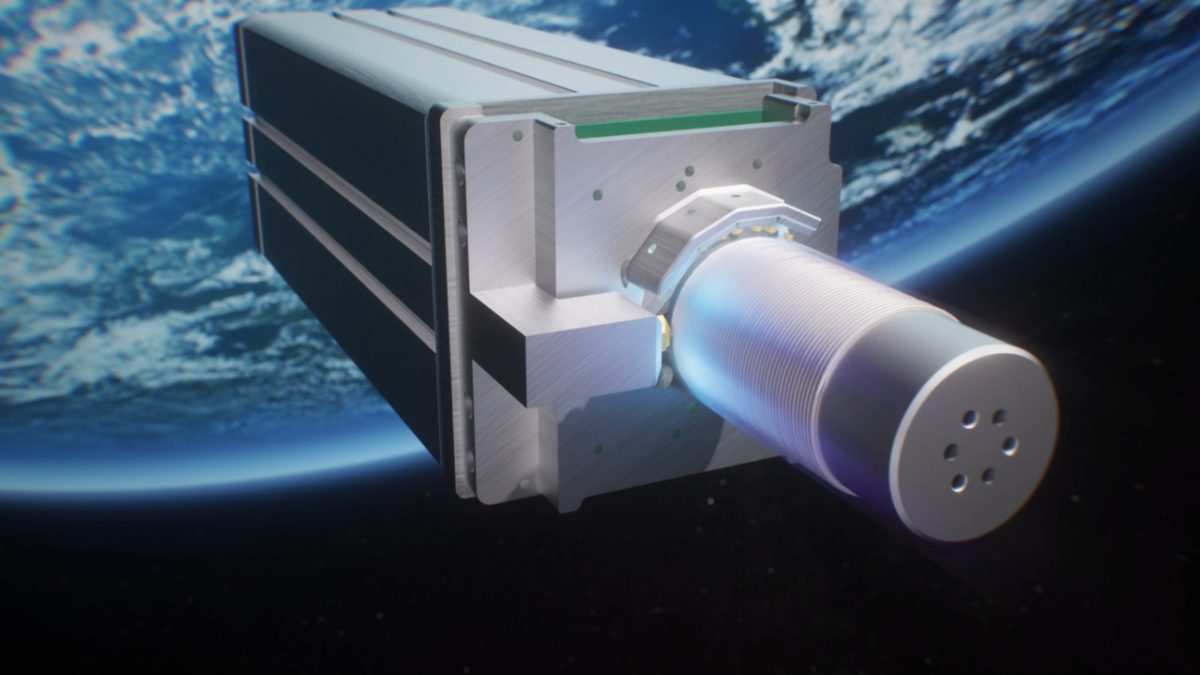
The Replicator 2 satellite, weighing approximately 13 kilograms, launched on July 7, 2026, aboard a Falcon 9 rocket as part of the Transporter-17 mission, according to an Orbital Matter announcement. It carried four independent printers. Each extrudes liquid resin in coils, while ultraviolet radiation triggers a reaction that turns it into a solid polymer. A rigid cylindrical beam grows layer by layer.
Animation of an Orbital Matter 3D printer producing a beam aboard a satellite. Credit: Maciej Frolow
On the ISS, printers operate inside a pressurized module with air and a stable temperature. In open space, volatile substances can evaporate from uncured resin, while sharp temperature changes alter its viscosity and prevent layers from bonding.
The satellite’s four printers had different tasks. Two were supposed to print beams to extend a solar panel, while the other two were intended to deploy an antenna and a camera.
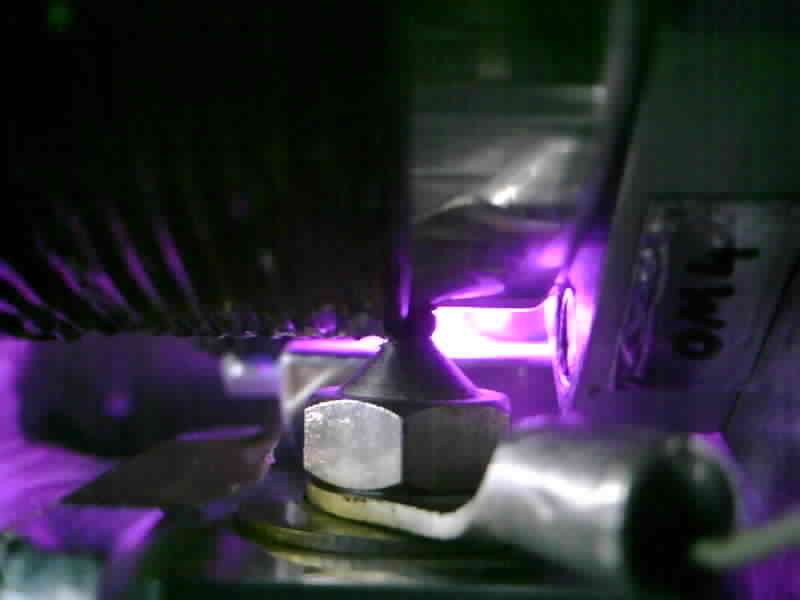
One of the two printers assigned to the panel failed because of an anomaly, leaving only the second operational. Its first attempt in August was unsuccessful because gaps remained between the resin layers, preventing the beam from forming a continuous structure. Engineers updated the software, and the second attempt succeeded. The new beam measured 32.5 centimeters—slightly longer than a school ruler—and was used to partially deploy the solar panel. The company has not yet reported on the performance of the printers intended for the antenna and camera.
Company co-founder and Chief Technology Officer Robert Ignatysin explained why so many printers were installed. The team decided to learn in orbit and update the software as it went, rather than spend years testing every option on Earth.
A Cramped Fairing
Why print structures in space at all? Future spacecraft, including orbital data centers, will need more electricity and larger cooling radiators. Yet they must still fit inside a fairing—the protective shell at the top of a rocket.
Today, large solar arrays and telescope mirrors are folded like origami and deployed once in orbit. Company co-founder and CEO Jakub Stoiek told TechCrunch: “Replicator 2 provided the first proof that a solar array can simply be built in space at whatever size a mission requires.” The startup worked with Thales Alenia Space on Replicator 2 and has a broader partnership with ESA.
The first part was printed aboard the ISS in 2014 using a printer made by Made In Space, which was later acquired by Redwire. In 2023, Redwire used NASA funding to manufacture beams in a vacuum chamber on Earth, but a spacecraft for this kind of orbital printing was never launched.
From Centimeters to Meters
The beam’s length is limited only by the amount of resin onboard, and engineers consider 100 meters achievable. Starlink V2 satellites have 20-meter solar arrays. A 100-meter beam would be almost three times longer than a single ISS solar array wing, which measures approximately 35 meters.
The company will conduct its next demonstration in 2028 with Bulgarian satellite manufacturer EnduroSat, according to Payload. Larger printers will be installed on a larger satellite to deploy a 5-kilowatt array. By 2030, the startup expects to achieve more than 100 kilowatts from a single wing.
Several satellite manufacturers are already considering the printer-assisted deployment system (PADS) for extending solar arrays, antennas, and other components. For now, Replicator 2’s results are known only through the company’s own statements. The 2028 mission will therefore need to demonstrate whether the technology can successfully scale from centimeters to meters.
