

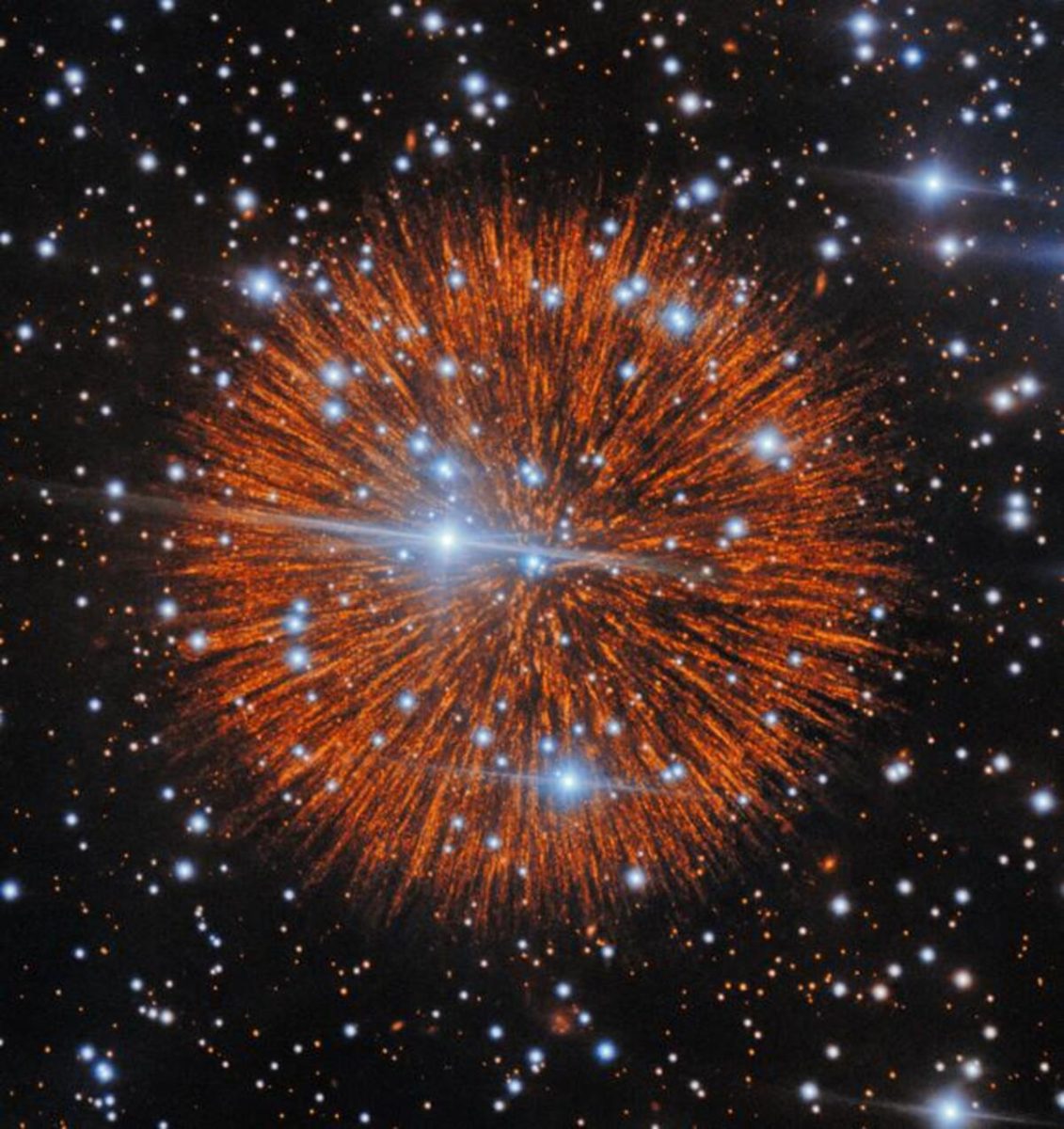
The nebula left behind by a supernova that people saw in the sky during the Middle Ages has turned out to be more complex than it appeared. The thin rays of gas extending from the explosion site actually consist of chains of nearly identical clumps, resembling strings of pearls. New images also reveal that the star that survived the explosion remains almost exactly at the nebula’s center, pointing to a remarkably symmetrical blast.
Clumps Larger Than the Solar System
The Pa 30 nebula lies in the constellation Cassiopeia, approximately 7,500 light-years away. The center of our Galaxy is 26,000 light-years from Earth, making the nebula about 3.5 times closer. This proximity allowed an international team led by Tim Cunningham of the Harvard–Smithsonian Center for Astrophysics and Ilaria Caiazzo of the Institute of Science and Technology Austria to obtain the most detailed images of the object to date using the Gemini North telescope.
The images revealed approximately ten times as many gas filaments as previous observations. Each filament turned out to be a chain of dense clumps.
The clumps are nearly identical in size. According to Ilaria Caiazzo, the planetary region of our Solar System could fit inside each one about ten times over, with room to spare. Neptune’s orbit alone spans roughly 9 billion kilometers. The reason for this uniformity remains unknown, and the team plans to reproduce it in models. The findings have been published in the peer-reviewed journal The Astrophysical Journal.
Why the Star Is Called a “Zombie”
The Pa 30 remnant is associated with the supernova of 1181, independently recorded by Japanese, Chinese, and Arab observers. The nebula itself was spotted by an amateur astronomer in 2013. This event is one of five supernova explosions from the pre-telescopic era whose remnants astronomers struggled to find for a long time.

The supernova of 1181 belonged to the rare Type Iax category. These explosions involve a white dwarf: the dense remnant of a star that has exhausted its fuel and is roughly the size of Earth. For Pa 30, the researchers propose a scenario involving a collision between two white dwarfs.
A thermonuclear explosion usually destroys a white dwarf completely. In Pa 30, the reaction engulfed only part of the material, leaving a fragment of the star intact. An object that would normally have been destroyed continues to shine, earning it the nickname “zombie star.”
A Symmetrical Explosion
But why does the star’s central position matter so much? An asymmetrical explosion should have given it a kick. Explosions obey the law of conservation of momentum: if material is expelled more forcefully in one direction, the surviving object recoils in the opposite direction, like a gun when fired. Over 845 years, the star would then have moved noticeably away from the center.
The team measured an upper limit on the star’s speed across the sky and found it to be remarkably low. According to Ilaria Caiazzo, the star is barely moving away from the explosion site, suggesting that material was expelled almost evenly in all directions, as reported by Space.com. Suspected remnants of other similar explosions in the Galaxy move much faster. The best-known example is designated LP 40-365. This white dwarf also survived a partial thermonuclear explosion and is now racing through the Milky Way at hundreds of kilometers per second.
Searching for Similar Remnants
Type Iax supernovae are also observed in distant galaxies, but there they appear as point-like flashes. The structure of a remnant can only be resolved in our own Galaxy and a few of its nearest neighbors. Pa 30 is currently the only known object of this kind in the Milky Way where both the nebula and its central star are visible.
Tim Cunningham does not consider Pa 30 an anomaly. Reliable historical records of supernova explosions cover only about a thousand years, so older remnants of this type may still remain undetected. The team plans to use Pa 30’s distinctive features to search for similar objects in large astronomical datasets.
