

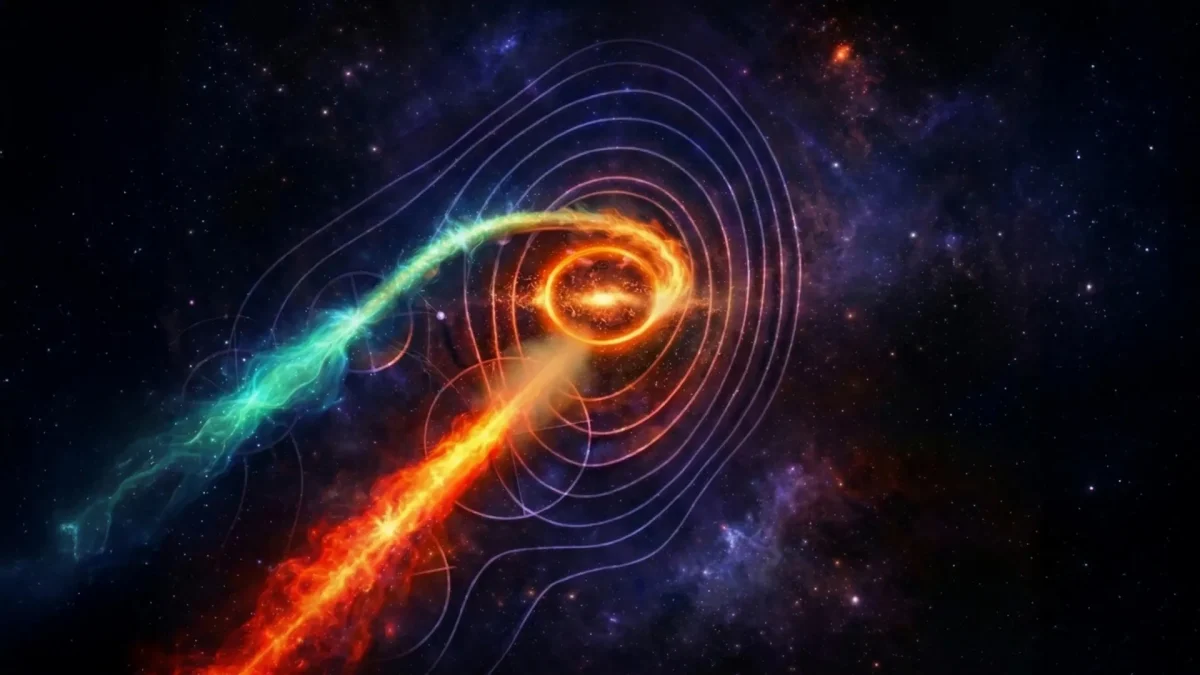
Two supermassive black holes are likely orbiting each other at the center of a distant galaxy. Evidence for the second comes from its own particle jet, which went unnoticed for years. The pair is so close that the black holes could merge within a century—a mere instant by astronomical standards. If so, astronomers will have a rare opportunity to observe two such black holes approaching a collision.
Black Holes with a Short Orbital Period
According to calculations by Silke Britzen’s team at the Max Planck Institute for Radio Astronomy, the pair in Markarian 501 completes an orbit approximately every 121 days. The black holes are separated by 250–540 astronomical units, each equivalent to the distance between Earth and the Sun. For objects with masses ranging from 100 million to a billion times that of the Sun, this is a very small separation.
By the fall of 2026, Voyager 1 was approximately 173 astronomical units from Earth. This means the black holes are only about one and a half to three times farther apart than Voyager 1 is from us.
Their orbit is shrinking as the pair loses energy through gravitational waves. Depending on their actual masses, the black holes could merge in as little as 100 years, according to the Max Planck Society. However, light from Markarian 501 takes approximately 460 million years to reach Earth. If the calculation proves correct, the merger actually happened long ago, but its light and gravitational waves will not reach Earth for roughly another century.
The Hidden Jet
Supermassive black holes exist at the centers of almost all large galaxies, and mergers are likely one of the ways they gain mass. Galaxies collide regularly. Yet no close pair of such black holes has ever been conclusively identified.
To find one, Silke Britzen’s team analyzed radio observations of Markarian 501’s core at several frequencies, collected on dozens of days over approximately 23 years. This elliptical galaxy in the constellation Hercules is known as a blazar. Its central black hole ejects a jet of particles at nearly the speed of light almost directly toward Earth, making it appear extremely bright. The results were published in the peer-reviewed journal Monthly Notices of the Royal Astronomical Society.
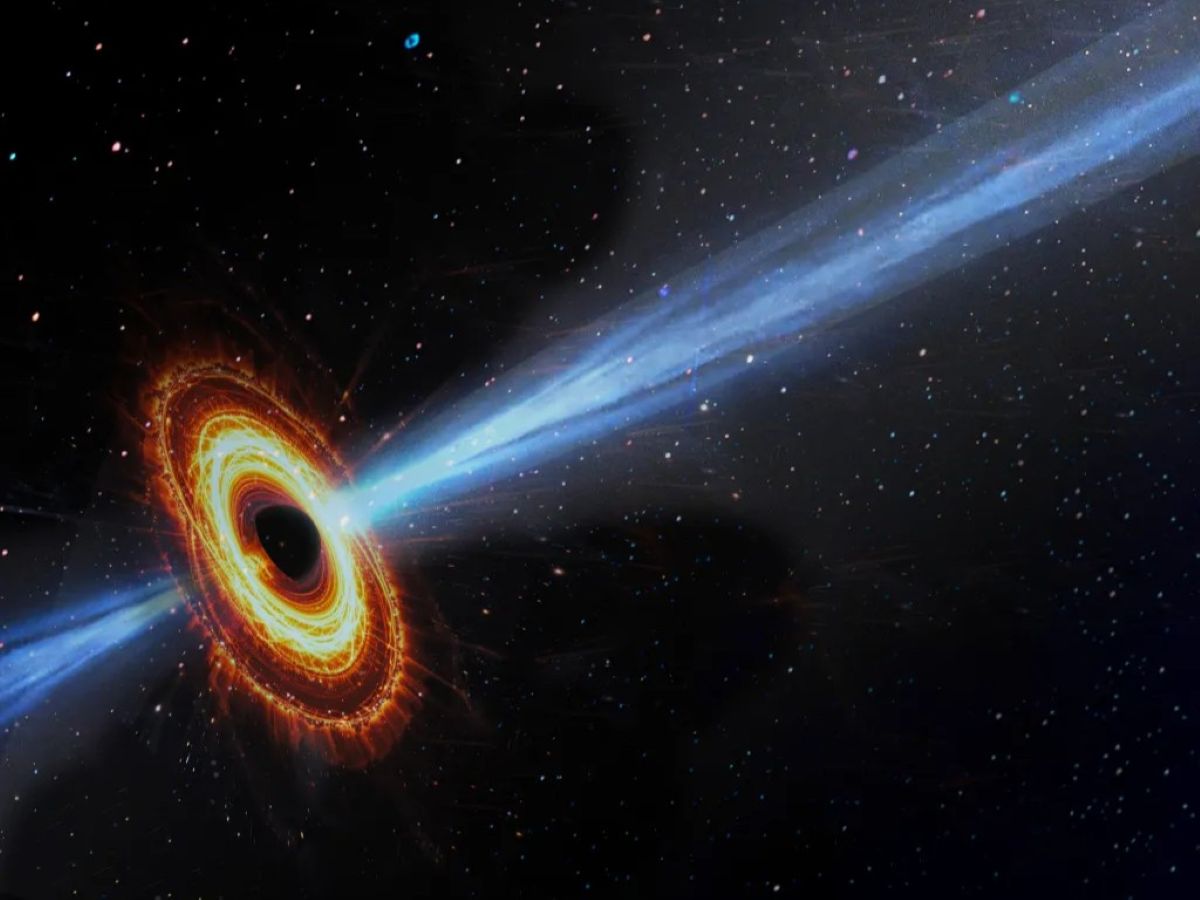
The data revealed another jet. It points away from our line of sight, making it much fainter and allowing it to remain unnoticed for a long time. Such jets originate near black holes, where magnetic fields accelerate matter outward. The second jet therefore points to another black hole, according to ScienceDaily.
Over several weeks, the second jet emerged from behind the larger black hole and moved counterclockwise around it, before repeating the motion. The researchers calculated the orbital period from these repetitions and regular changes in brightness. In June 2022, the system’s emission appeared ring-shaped. One possible explanation is that Earth and both black holes were aligned at the time, allowing the gravity of the nearer black hole to bend the light from the jet behind it like a lens.
A Signal from Pulsars
It will not be possible to track their approach directly because the galaxy is too distant. Even the Event Horizon Telescope, which produced the first images of black holes, lacks the resolution to show the two separately. However, the pair should emit gravitational waves at extremely low frequencies—tiny disturbances in spacetime.

Astronomers search for such waves using pulsar timing arrays. Pulsars are neutron stars that emit radio pulses at highly precise intervals. A gravitational wave passing between a pulsar and Earth slightly stretches and compresses space, causing the pulses to arrive a little earlier or later. Astronomers measure these barely perceptible shifts.
If a signal from Markarian 501 is detected, its frequency should gradually increase as the black holes draw closer, notes study co-author Héctor Olivares of the University of Aveiro. In 2023, the European Pulsar Timing Array and other collaborations reported evidence of a gravitational-wave background—the combined signal from numerous distant sources. For these arrays, Markarian 501 offers an opportunity to link part of that background to a specific pair of black holes.
