

Astronomers have publicly presented a unique animation with the highest resolution ever achieved, showing in detail a giant jet erupting from a supermassive black hole. Creating this short video required more than 27 years of observations and advanced artificial intelligence algorithms.
Blazar 3C 345 Under the Gaze of Radio Telescopes
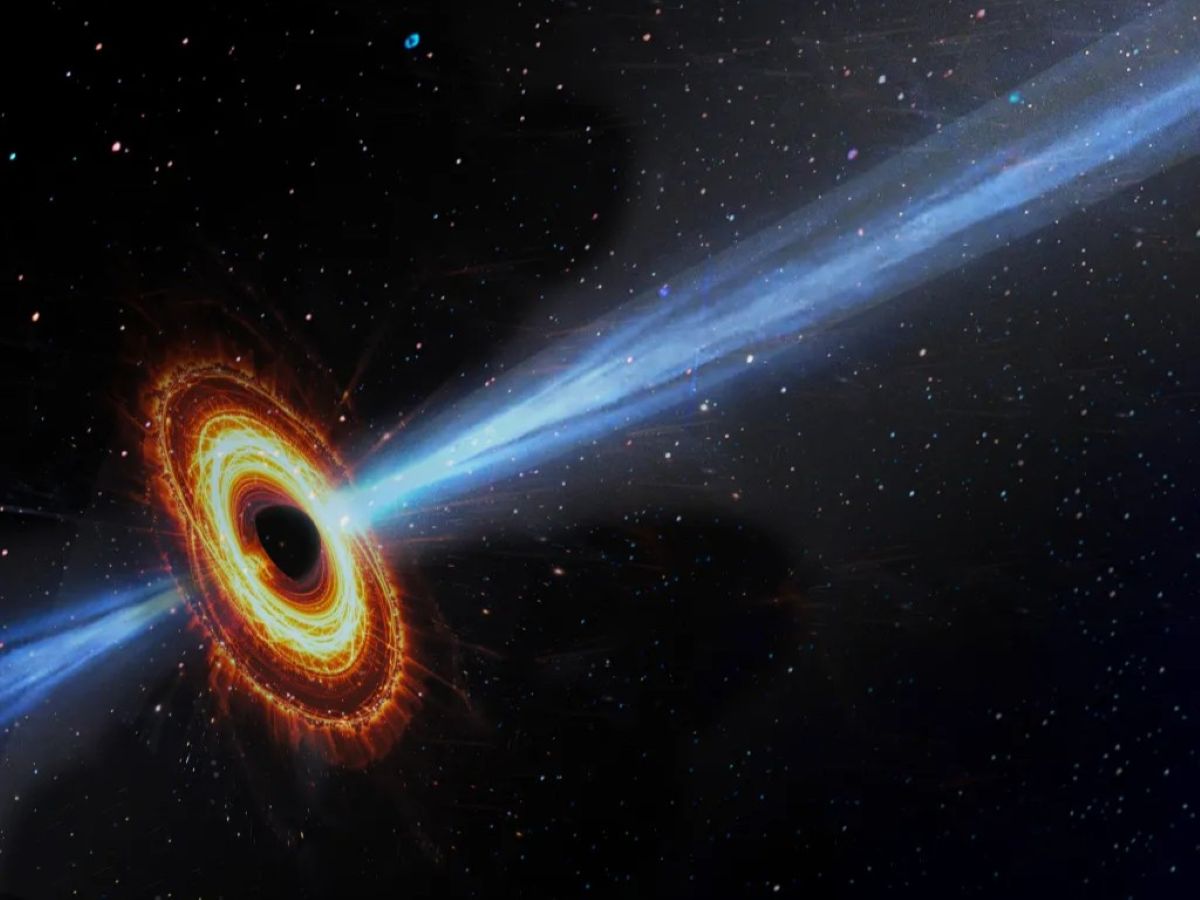
The main subject of the study was blazar 3C 345, located in the constellation Hercules. A blazar is a special type of quasar — an extremely bright supermassive black hole at the center of a distant galaxy that is active and “feeds” on surrounding matter. In the process, it launches powerful jets of gas and plasma into space, moving at speeds close to the speed of light and emitting enormous amounts of X-rays and gamma rays.
To capture the dynamics of the jet, scientists collected 116 images taken between 1995 and 2022. The observations were carried out using the network of 10 radio antennas of the Very Long Baseline Array (VLBA), located across the United States. The network provides broad sky coverage, but because of the limited number of telescopes, the resolution of individual two-dimensional images remained insufficient for studying the finest details.
Artificial Intelligence Improves Image Sharpness
To overcome the technical limitations and combine the fragmented images into a continuous video, the researchers used a neural network called Kine. This machine-learning model can analyze observations made at different points in time while simultaneously studying the spatial and temporal relationships in the data.
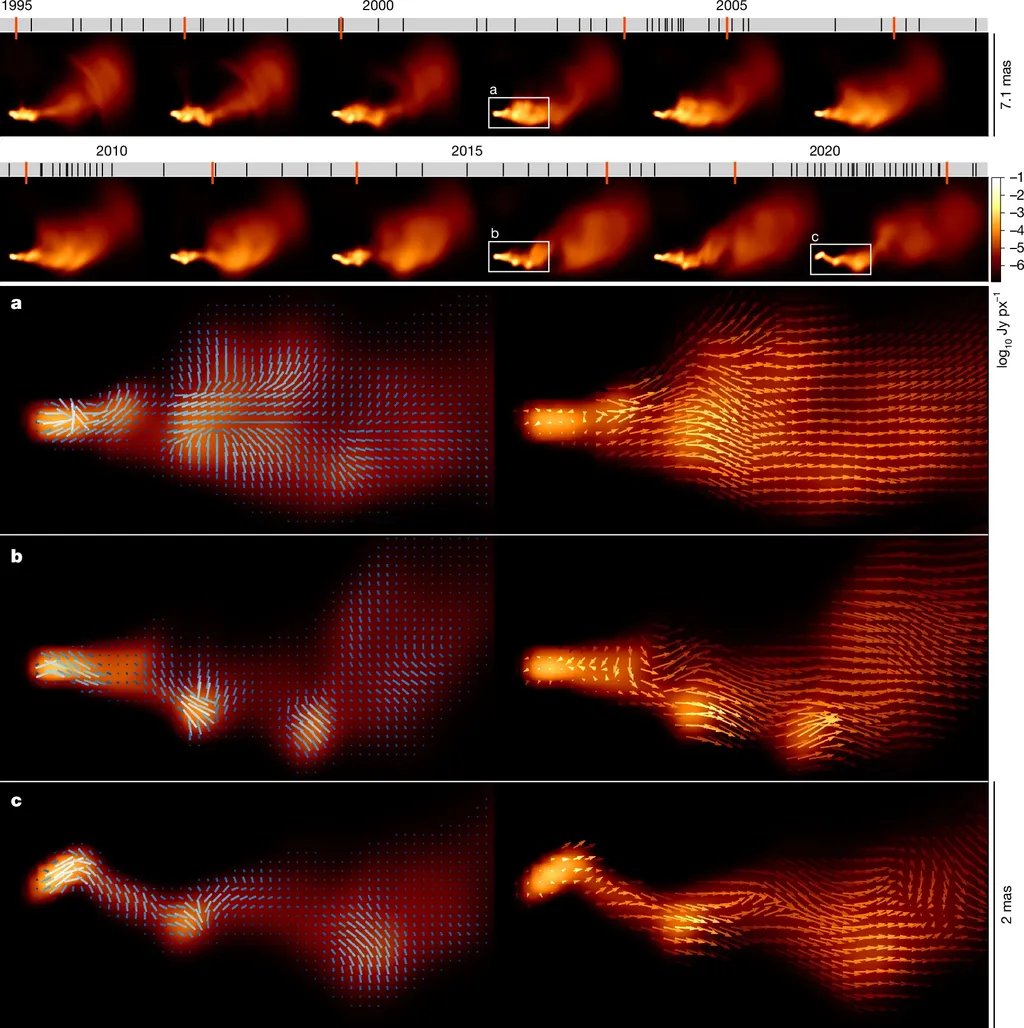
Thanks to Kine, the team achieved a resolution four times higher than that of any individual frame. This made it possible to measure the speed of plasma moving inside the jet with unprecedented precision.
A Challenge to Theoretical Models
The processed data surprised astrophysicists. The brightest components of the jet appeared to move at speeds 10–13 times faster than the speed of light, while the surrounding gas moved somewhat more slowly — at apparent speeds 9–12 times the speed of light.
According to the study’s first author, Marianna Foschi of the California Institute of Technology, this conflicts with established ideas. It was previously thought that the bright spots were shock waves propagating through the plasma and therefore should move significantly faster than the surrounding material. The new data do not completely rule out the shock-wave model, but they call it into question for objects of this kind.
Prospects for Astronomy
Scientists plan to adapt the Kine algorithm for analyzing other variable cosmic sources. The new method could fundamentally change the way plasma-jet dynamics are studied, allowing researchers to measure the speed of matter at any point within cosmic outflows with high precision.
According to Live Science
