

New simulations show a possible scenario for the birth of the Milky Way. According to it, at the very beginning, thousands of separate tiny galaxies existed in the region where our Galaxy is now located. They merged relatively quickly into one enormous system, but before that they displayed an incredible diversity of forms.
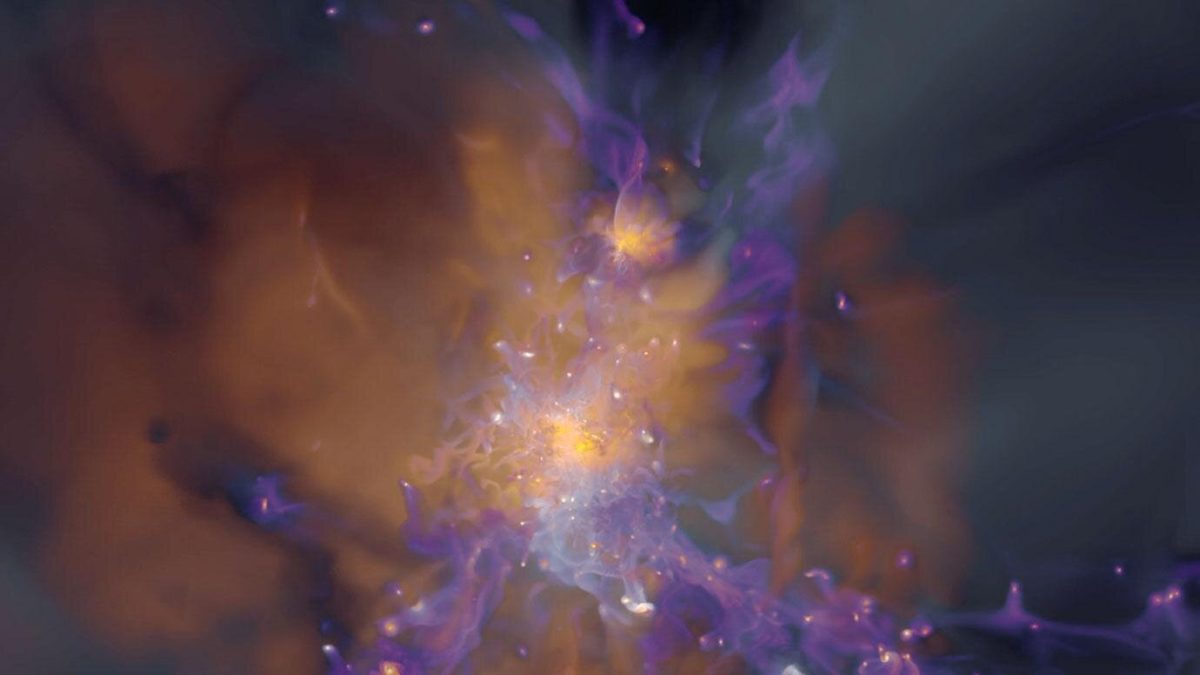
How the Milky Way Was Born
Scientists have long wondered how galaxies such as the Milky Way, with supermassive black holes at their centers, could have grown so quickly to their present-day sizes. As reported by phys.org, scientists from the University of Chicago have proposed an interesting new theory presented in six papers published in The Open Journal of Astrophysics.
The problem is that even the most powerful space telescopes, such as Hubble or James Webb, can barely peer into the part of the Universe that, because of the finite speed of light, we still see as it was approximately 300 million to 1 billion years after the Big Bang. It was during this period that gas and dust began forming the first stars.
Astronomers cannot directly see all of this, but space telescopes, especially in recent years, have nevertheless revealed many interesting details. The authors of the study used these observations as the basis for large-scale simulations. Even with the use of supercomputers, the work took three years, but the final result proved to be worth it.
Thousands of Small Galaxies
The object of the simulation was the Milky Way familiar to all of us. It is a fairly typical spiral galaxy, and astronomers already knew that it became what we know today after several mergers with smaller systems over the past ten billion years.
However, what the simulation showed genuinely surprised scientists. Instead of one large galaxy, it revealed thousands of small ones. During the cosmic dawn and over the following billions of years, they merged relatively quickly, forming increasingly larger stellar systems.
At the same time, the diversity of dwarf galaxies turned out to be considerable even at very early stages. Some of them were blazing with star formation, while in others it faded fairly quickly. The reason is that they consisted almost entirely of stars belonging to the so-called Population III. These enormous primordial stars were composed almost entirely of hydrogen and helium.
They ended their lives very early, exploding as a special type of supernova. In regions where this process occurred more rapidly, everything had time to burn out and form gas-and-dust nebulae with an unusually high, by present-day standards, abundance of elements heavier than helium. In other regions, this process proceeded more slowly.
Luminous Dwarf Galaxies and Supermassive Black Holes
Most interestingly, some of these dwarf galaxies could shine brightly even though they contained almost no stars. This can be explained by the fact that the stars present in them were extraordinarily luminous and quickly exploded as supernovae. On the one hand, while alive they illuminated the gas and dust, and as they died they ionized them.
Another feature of the new simulation is that it explains very well why galaxies were already quite large at relatively early times and why their black holes had enough time to grow significantly. All they needed were thousands of mergers during the early stages of their existence.