

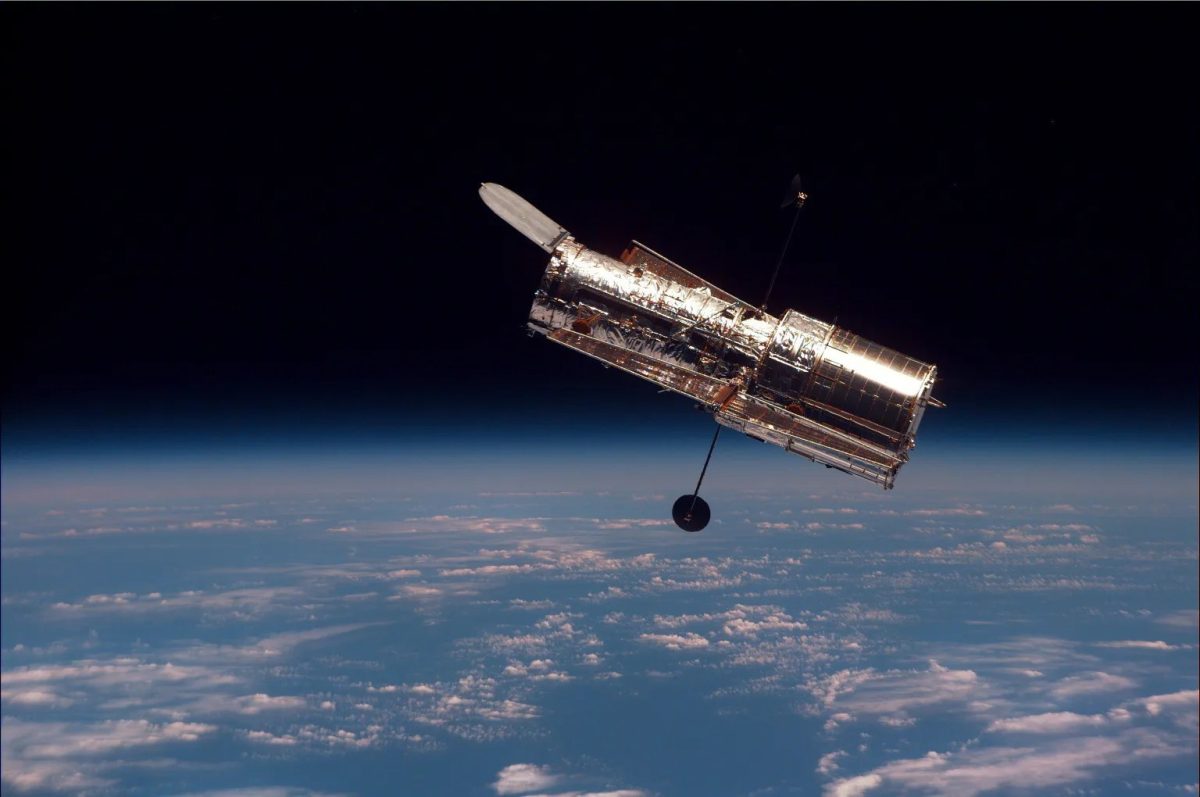
The Hubble Space Telescope has completed its 200,000th orbit around Earth. It was designed for about fifteen years of operation, but it has now been working in orbit for its thirty-sixth year. On the anniversary day, scientists used it to search for a supernova whose light is being warped by the gravity of a distant galaxy cluster. A second image of this explosion will help refine measurements of how quickly the Universe is expanding.
Twenty Years of Overtime
The milestone of 200,000 orbits was reached on September 19. The telescope was launched into orbit aboard the space shuttle Discovery in April 1990. As Space.com notes, at the time it was designed for only fifteen years of operation. Instead, more than thirty-six years have now passed since launch.
During this time, Hubble has traveled more than 8 billion km. The average distance to the Moon is 384,000 km, so that distance would be enough for 10,000 round trips. The total number of observations has exceeded 1.7 million.
A Supernova on Schedule
The Athena supernova was discovered in 2025 with the James Webb telescope. Between it and Earth lies the massive galaxy cluster MACS J0417, whose gravity bends and magnifies the light of distant objects. Rays from the same explosion curve around this mass along different paths and travel different distances. As a result, images of the same supernova appear in the sky several times, with intervals of months or even years.
Athena is expected to appear again in the field of view by early March 2027, so the cluster is being monitored regularly. As NASA notes, timing these repeated appearances will help map the mass of MACS J0417 and refine the rate of expansion of the Universe.
The method itself was proposed in 1964 by Norwegian astrophysicist Sjur Refsdal. It was first tested in 2015, when Hubble detected another supernova, named after Sjur Refsdal, for a second time exactly within the interval predicted by models. Cosmologists need such an independent method because different techniques for measuring the Hubble constant produce noticeably different values, and the cause of the discrepancy has still not been established.
Repairs in Orbit
None of these measurements would have been possible if the telescope’s flaws had not been corrected early in its operation. Immediately after launch, it became clear that the primary mirror had been polished incorrectly. The error in its shape was only about two micrometers, but it caused the images to appear blurred.
A 360° virtual tour of the Hubble telescope explaining the purpose of its mirrors and scientific instruments. Credit: NASA Goddard Space Flight Center
In December 1993, the space shuttle Endeavour arrived at the telescope. Astronauts captured Hubble with a robotic arm, secured it in the cargo bay, and installed corrective optics during five spacewalks. They later returned to the telescope four more times. Altogether, there were 23 excursions outside the spacecraft and more than 165 hours of work in spacesuits.
No other space telescope was designed with direct human servicing in mind. One of these visits in 2002 became the final successful flight of the shuttle Columbia. After the spacecraft’s 2003 disaster, NASA Administrator Sean O’Keefe canceled the next servicing mission as too risky, and only in 2006 did his successor Michael Griffin restore it to the plans. Without that decision, the observatory’s operational lifetime would most likely have ended long before the current anniversary.
The Final Years in Orbit
NASA will no longer send people to Hubble. Since 2024, the telescope has been operating with only one gyroscope, so pointing at targets has become slower. However, the number of observation proposals has not decreased.
There are approximately seven requests for every available hour of telescope time. The reason is its ability to observe in ultraviolet and visible light. James Webb and the new Roman telescope are designed primarily for the infrared range, so Hubble still has no replacement in these parts of the spectrum.
The thin gas at Hubble’s orbital altitude gradually slows the observatory down. Without intervention, it will enter the denser layers of the atmosphere in the early or mid-2030s. As we reported earlier, NASA is considering raising Hubble’s orbit with the help of a private space tug. The obstacle remains the cost of maintaining the telescope, which reached $98.8 million in fiscal year 2025. The agency spends more only on James Webb.
A Tug Instead of a Shuttle
Hubble has no onboard propulsion system. During the final servicing mission in 2009, a docking fixture for a future spacecraft was installed on its exterior. It can be used either by a vehicle that raises the telescope to a higher orbit or by one that carries out a controlled deorbit.
Which of these two scenarios is chosen will depend on whether the agency manages to reduce operating costs. NASA will have to make a decision before Hubble’s altitude falls to a critical level.
