

Scientists used the ALMA antenna array to study the rare giant star HD 87643. In the chaotic accumulation of matter around it, they found numerous complex substances, including sulfur-bearing compounds. Thanks to this, scientists learned more about how different isotopes of this element survive under ultraviolet radiation.
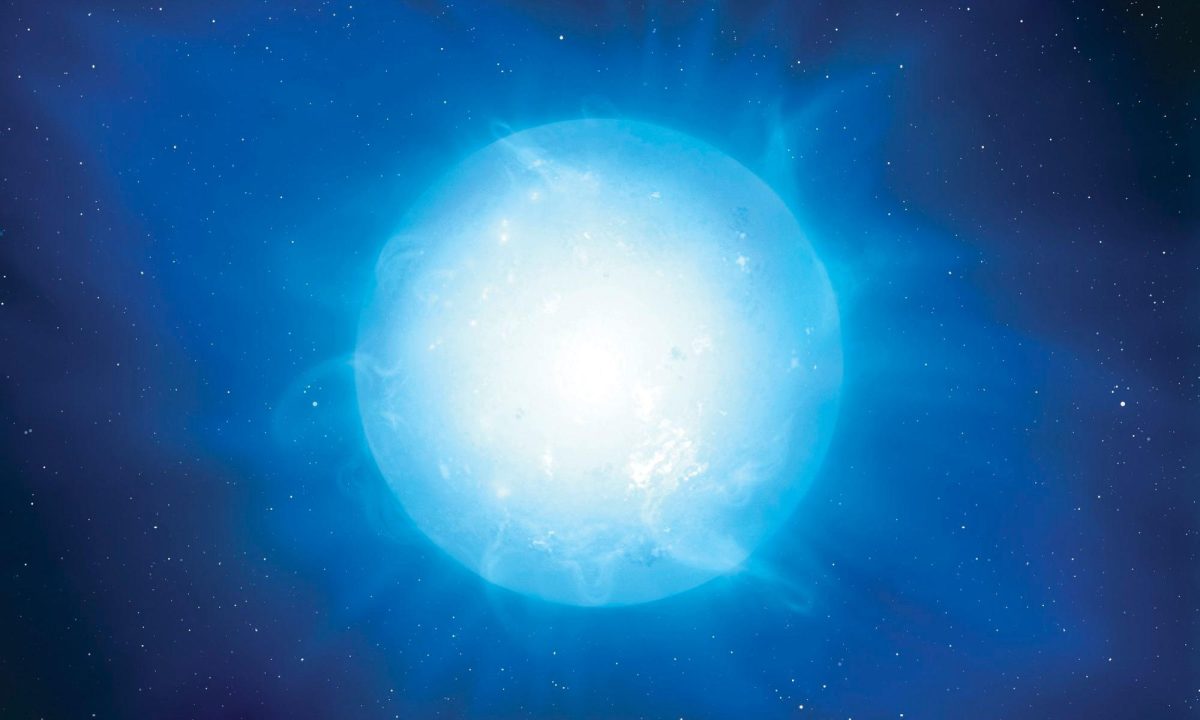
The Mystery of the Giant Star
The website phys.org reports that a study of the rare giant HD 87643 has been published in The Astrophysical Journal Letters. A spectroscopic study of its surroundings was carried out using the large South American ALMA antenna array.
The star HD 87643 belongs to the rare sgB[e] spectral class. These giant stars evolve quite rapidly and, at the final stage of their existence, display a large number of emission lines, including some that are normally absent from stellar spectra altogether.
This is actually very important, because it is during this period that a complex system of gas and dust forms around them, interacting with the stars and accumulating various fairly complex compounds. These are precisely what the researchers analyzed in their work. They detected CO, 13CO, OCS, H2CO, SO, 33SO, SO2, HNCO, O13CS, and 13CS.
Sulfur Near the Star
Among all the chemical compounds mentioned above, the scientists were especially interested in those containing sulfur. It is one of the most abundant elements in the Universe and one of the most important components of organic life. However, the pathways of its synthesis and distribution are still not fully understood, and one of them may involve structures that form around massive stars like HD 87643 before they explode as supernovae.
In particular, the scientists were very interested in the isotopic composition of sulfur compounds near the giant star. They contain two varieties of atoms of this element, one slightly heavier and the other slightly lighter. Standard theories of chemical processes suggest that the ratio of the latter to the former in SO should be quite high.
The reason is that sulfur monoxide, SO, is formed through the breakdown of sulfur dioxide under the influence of ultraviolet radiation, which is more than abundant in the spectra of blue giants such as HD 87643. Normally, molecules containing the lighter isotope break down much more frequently.
However, spectroscopic studies of HD 87643 show that the isotope ratio is fairly even. At this point, the scientists proposed that the resistance of sulfur dioxide to breakdown may actually depend significantly on molecules containing the lighter isotope shielding molecules containing the heavier one. In other words, when the lighter-isotope molecules disappear, the heavier isotope becomes more vulnerable.
