

Supermassive black holes appeared in the early Universe much sooner than theory predicts. A new model links their origins to frequent collisions in extremely dense star clusters. In a cluster without a black hole, stars merge during collisions until a single giant star forms and eventually collapses into a black hole. If a black hole already exists at the cluster’s center, nearby stars are destroyed in collisions and turned into gas—a process that could explain the mysterious little red dots in James Webb’s images.
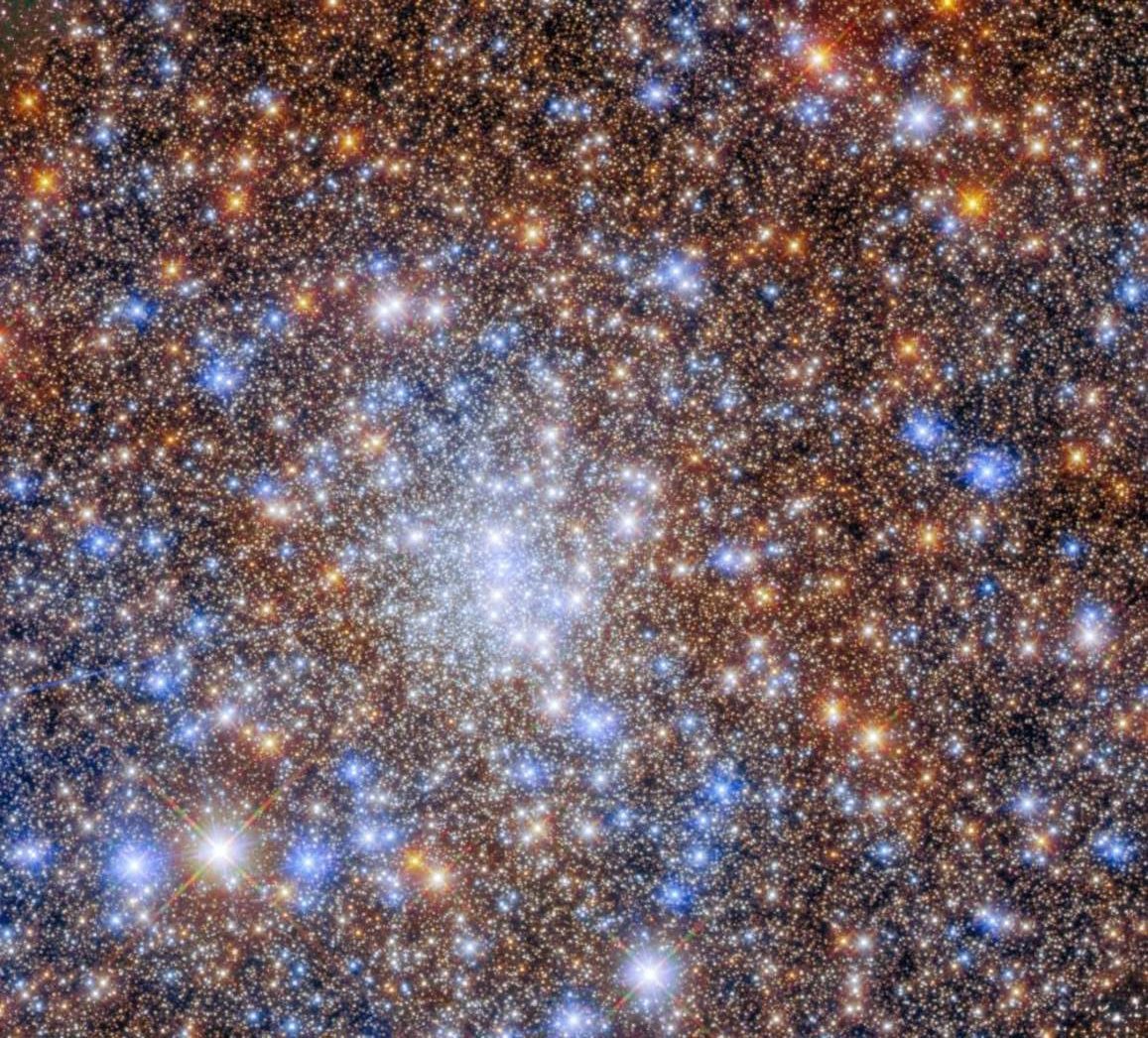
A Star with the Mass of a Cluster
Calculations suggest that a star exceeding 100,000 solar masses could have formed in the densest clusters of the early Universe. For comparison, the most massive known star weighs about 200 solar masses. Lead author Claire Williams of the University of California, Los Angeles, considers the model’s most surprising result to be that mergers continue until a single star’s mass matches that of an entire cluster.
In a dense cluster, stars move too slowly to tear one another apart, so collisions cause them to merge into a single, more massive star. This star gradually slows down and sinks toward the cluster’s center. There, it collides with other stars and continues to grow.
A star exceeding 100,000 solar masses becomes unstable and collapses into a black hole. Under the authors’ simplified assumption, less massive giants of 200 solar masses or more also become black holes, each retaining the mass of its progenitor star. The study was published in the peer-reviewed journal The Astrophysical Journal.
Too Little Time
Supermassive black holes reach millions of solar masses or more, and James Webb is finding them as early as 400–500 million years after the Big Bang. A black hole formed from an ordinary star has a mass of only tens of solar masses.
It cannot accumulate matter beyond a certain rate because radiation from the heated gas pushes incoming material away. This leaves too little time for such a black hole to grow within a few hundred million years.
A seed that starts out with hundreds or thousands of solar masses significantly shortens that path. The authors suggest that these black holes could subsequently have grown into supermassive ones, including through mergers with one another.
A Million Times Denser
For a star exceeding 200 solar masses to form, its cluster must be extraordinarily dense. A cube measuring just over three light-years on each side must contain at least 100,000 solar masses. Near the Sun, the same volume contains a million times less matter—only about a tenth of a solar mass.
Cosmological simulations show that such extremely dense clusters arose naturally in the early Universe. Using James Webb, astronomers have already found similar compact clusters in distant galaxies. According to the model, the densest of these could have produced giants weighing thousands or tens of thousands of solar masses.
Gas Around a Black Hole
If a black hole already exists at a cluster’s center, its gravity accelerates nearby stars to speeds exceeding 600 kilometers per second. At such speeds, the energy of a collision exceeds the energy holding a star together, destroying both stars involved. Gas from their interiors accumulates around the black hole.
This could be what the little red dots look like. As Universe Today notes, this name refers to hundreds of compact, reddish objects from the early Universe seen in James Webb’s images. One explanation describes them as black holes surrounded by dense gas that conceals their X-ray emission and supplies material for their growth.
The model produces gas densities matching those inferred from observations, and sometimes even higher. However, the authors acknowledge that their simplified calculation may overestimate stellar destruction—and therefore the amount of gas—by as much as a factor of ten. They cautiously describe the result as a possible analogue of the little red dots, while allowing that radiation from the most massive black holes could disperse the gas sooner.
A Nitrogen Signature
Gas from destroyed stars originates in their interiors, where nuclear reactions build up nitrogen. It should therefore contain an unusually high proportion of nitrogen relative to oxygen, and such an excess has already been found in compact systems in the early Universe.
The authors have left a precise calculation of the nitrogen produced by this mechanism for future work. They have also postponed estimating how often a black hole in such a cluster would tear stars apart through tidal forces, although the model predicts that these events occur.
