

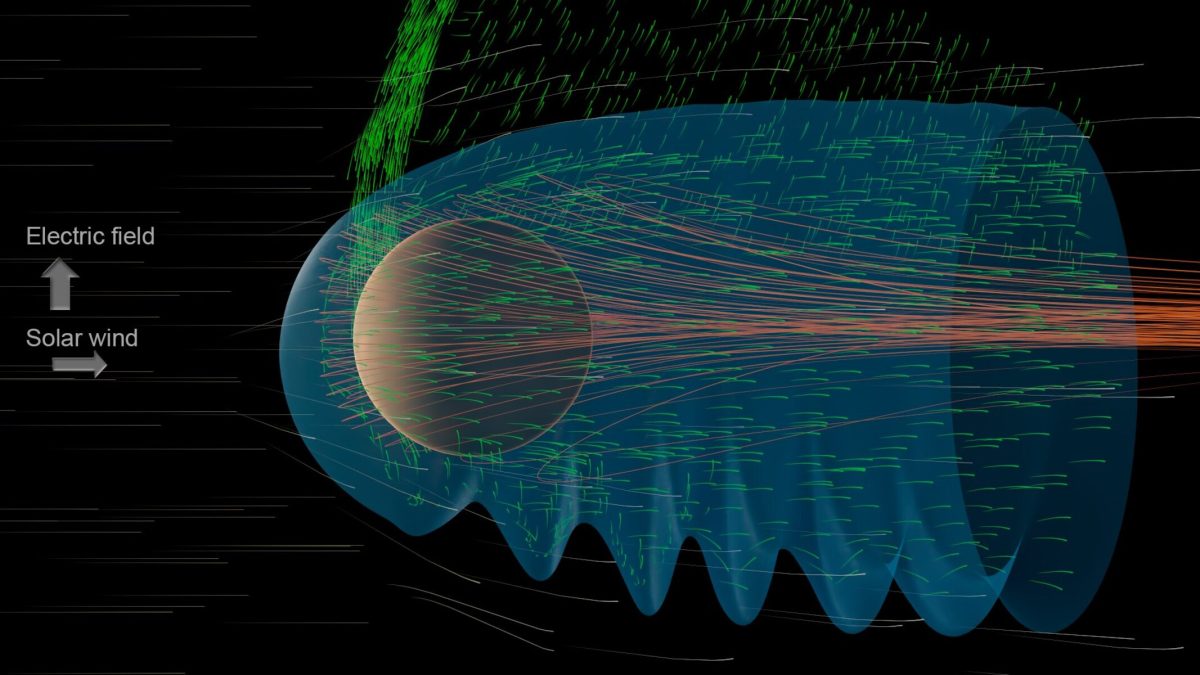
A stream of charged particles from the Sun disturbs the upper layers of the neighboring planet’s atmosphere in much the same way that wind raises waves on water. Large clumps of matter form at the boundary of the gaseous envelope and are then carried into space. Their origin had been explained by several competing hypotheses because direct evidence was lacking. The necessary data have now been obtained through simultaneous measurements made by two spacecraft in orbit.
Without Magnetic Protection
Our planet is protected from the solar wind by a global magnetic field that deflects charged particles. Mars has no comparable shield, so particles from the Sun reach the upper layers of its atmosphere directly.
This process is also associated with the transformation of Mars into the planet we see today. It once had a denser atmosphere and liquid water on its surface, but now neither remains.
Vortices Instead of a Uniform Flow
The mechanism resembles what happens above water in windy conditions. Near Mars, when two gas flows move at different speeds along a shared boundary, the boundary becomes unstable and curls into vortices. Physicists call such structures Kelvin–Helmholtz waves.
Near Mars, they form large clouds of plasma, and ions escape from the planet in entire clumps rather than individually. The origin of these formations had previously been explained by several competing hypotheses.
The findings were published in the peer-reviewed journal Science Advances, Phys.org reports. The observations point specifically to flow instability as the source of the plasma clouds.
Two Spacecraft Instead of One
The main difficulty was that a single probe cannot simultaneously measure the undisturbed conditions ahead of the planet and the flow of ions escaping from its environment. Data collected at different times do not make it possible to establish a reliable connection between cause and effect.
The solution was to combine observations from two missions. China’s Tianwen-1 spacecraft monitored the parameters of the solar wind before it reached Mars, while MAVEN simultaneously recorded ions above the atmosphere. Chi Zhang, a research scientist at Boston University’s Center for Space Physics, and his colleagues had previously tested this approach in a study published in Nature Communications.
Uneven Distribution Around the Orbit
The process does not affect the planet uniformly. Most of the ions escape from one side, and the particular side depends on the direction of the solar wind’s electric field.
According to Chi Zhang, the next step will be to determine the conditions under which Kelvin–Helmholtz waves form most frequently. It is not yet possible to estimate their contribution to the overall loss of the atmosphere. Doing so will require data from a larger number of spacecraft and more sophisticated numerical modelling.
The Next Stage
The MAVEN mission is entering its final stage, so the primary workload will fall on new instruments. Two identical probes have already set out for Mars as part of the ESCAPADE mission, meaning that spatially separated observations were built into its design from the outset. What was a fortunate alignment of spacecraft from independent programs for Chi Zhang and his colleagues will be the standard operating mode of the new project.
Chuanfei Dong, an associate professor of astronomy at Boston University’s College of Arts and Sciences, notes that similar waves may form near any planet without a strong magnetic field. This may also apply to some exoplanets whose atmospheres scientists are currently attempting to study.