

Dust in the Martian atmosphere absorbs sunlight and warms the air. This is a well-known mechanism. However, a new analysis of eight-year-old data presented this week at NAM2026 revealed something unusual. In June 2018, the pattern of warming in the lower atmosphere did not fit any conventional model. It appears that a stream of charged particles from the Sun intensified the effects of the dust storm.
An Additional Factor
Solar energetic particle events, or SEP events, occur when solar flares and coronal mass ejections release high-energy particles into space. Mars is particularly vulnerable to them because of its thin atmosphere and the absence of a global magnetic field. Previous observations have shown that SEP events ionize the planet’s upper atmosphere, produce diffuse auroras, and disrupt radio communications.
However, their effect on the lower layers of the atmosphere, where weather develops, remained unexplored. Astronomers from Lancaster University, led by Lana Williams, analyzed five prolonged SEP events on Mars. In four cases, they found no noticeable effect on temperatures in the lower atmosphere.
A Surprising Coincidence
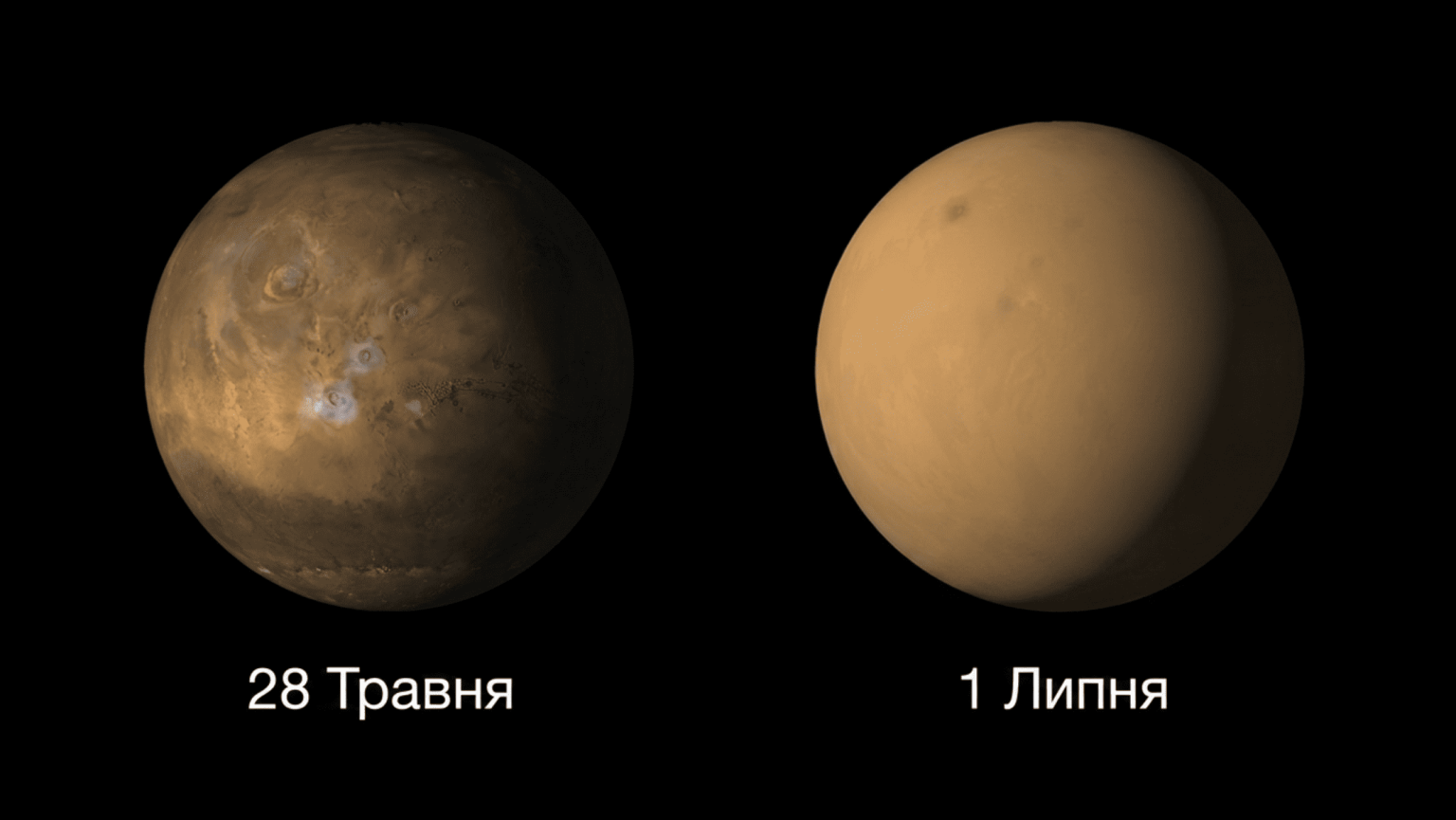
The fifth case was different. In June 2018, an SEP event coincided with the expansion of a global dust storm—the same storm that covered the entire planet and ultimately brought the Opportunity rover’s mission to an end after almost 15 years of operation.
At that time, the researchers found, instruments recorded an abnormal rise in temperature in the lower atmosphere. They compared data from MAVEN, which has studied the Martian atmosphere since 2014, and the Trace Gas Orbiter, which has operated there since 2016, with the expected temperature profiles from the Mars Climate Database. The warming pattern exceeded what could have been caused by the dust storm alone.
A Cautious Conclusion
The authors suggest that solar energetic particles do not act directly. Instead, they alter the chemistry and energy balance of the atmosphere, while the dust storm amplifies the effect. As a result, the lower atmospheric layers receive additional heat.
This hypothesis is based on a single coincidence of events rather than a proven cause-and-effect relationship. The combination of SEP activity and dust may indicate that the Martian atmosphere is more sensitive to external influences than previously believed. If the effect is confirmed, models of the Martian climate will need to be refined.
Future missions may also need to account for the fact that during dust storms combined with intense solar activity, the planet’s atmosphere behaves differently than it does under calm conditions. The results were presented this week at the NAM2026 National Astronomy Meeting in Birmingham, Sci News reports. The findings have not yet undergone peer review.
