

The Curiosity rover came across structures resembling giant honeycombs. From orbit, this area looked bright and uniform, so the actual terrain came as a surprise to the science team.
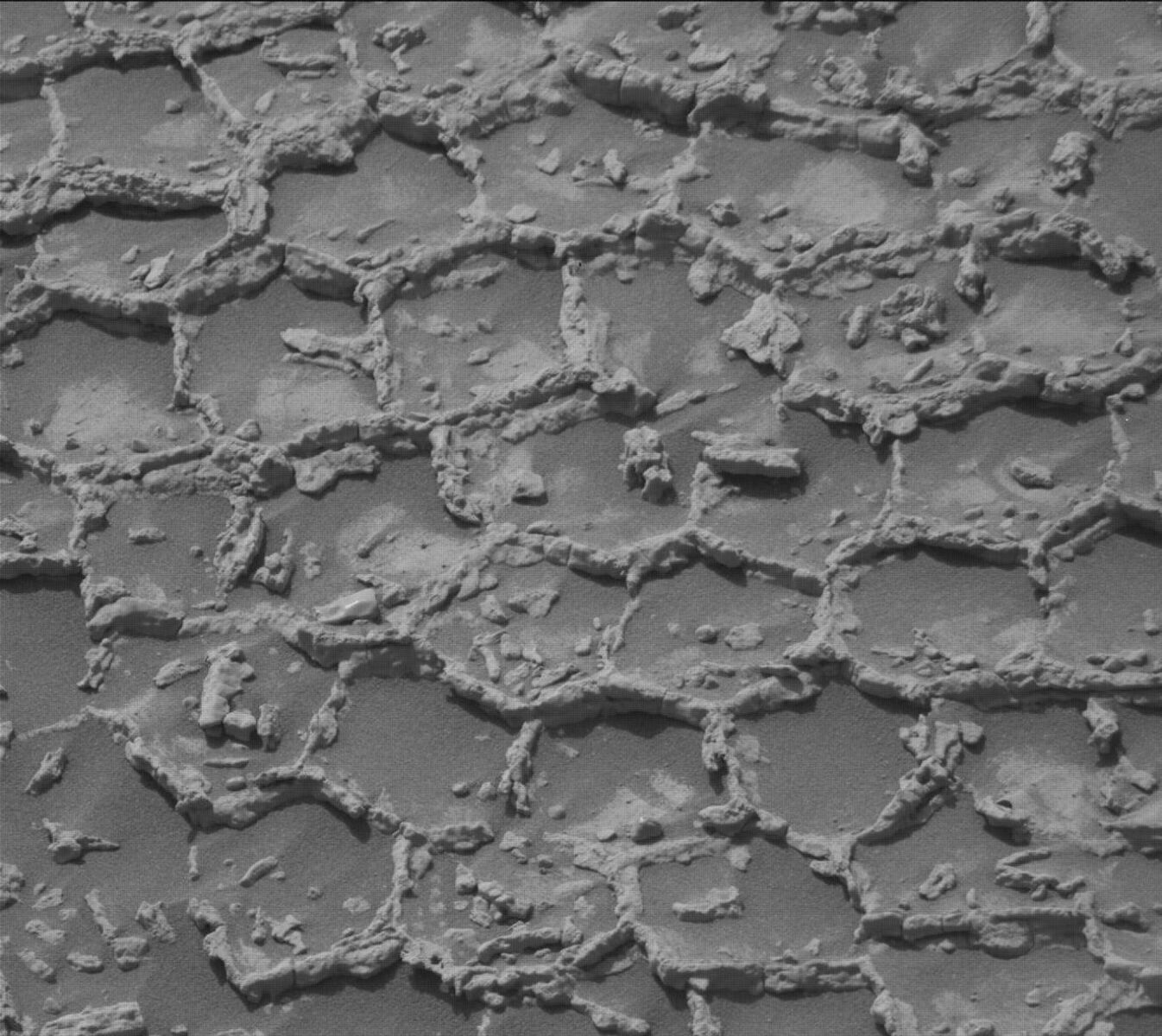
A stone grid instead of a plain
The area had already been noticed in orbital images. It appeared bright and uniform. When the rover approached, the surface turned out to be covered with a network of raised rocky ridges forming closed polygons. Between the ridges, depressions are filled with darker sand.
Polygonal patterns have been seen on Mars before. Their origin is usually explained by cycles of freezing and thawing of water in the soil, the drying of clay-rich deposits, or the thermal contraction of rock. The scale and clarity of these structures, however, set them apart from previous finds.
Small dark fragments of uncertain origin
The entire surface of the area is covered with dark stones ranging in size from pebbles to cobbles. Their origin remains an open question. According to the Curiosity team, they may have rolled down from higher layers of the stratigraphic section, been ejected by distant impacts outside Gale Crater, or even arrived from beyond Mars as meteorites, NASA reports.
Previous analysis by Curiosity of similar dark fragments has found nickel in them. On Earth, such concentrations are often found in meteorites, but in Martian rocks, nickel is less common, and nickel alone is not sufficient evidence of extra-Martian origin. Only more detailed chemical and mineralogical analysis will help to definitively establish the nature of these rocks.
Instruments in action and a course toward a new zone
Over two planning cycles, Curiosity carried out a series of contact and remote investigations. The Alpha Particle X-ray Spectrometer, or APXS, together with the MAHLI close-up camera, studied the ridges and the centers of the polygons.
The ChemCam laser spectrometer, or LIBS, sampled several points at once. These included the ridges, the center of one of the cells, and a dark stone named Cortadera. Separately, the ChemCam RMI camera photographed the top and base of the Cordillera mesa, while Mastcam obtained a series of images of the same structure, nearby depressions, and part of the Valle Grande channel.
The rover has already left the area of bright rocks and entered a zone of darker rocks with an uneven texture. According to orbital data, this is a new type of surface. The geological history of Gale Crater continues to be studied, and many interesting discoveries still lie ahead.
