

Scientists have yet to find a single primordial black hole. However, this does not mean that science rules out the existence of these exotic objects, born in the earliest moments of the cosmos. Moreover, new research suggests that they could be five-dimensional.
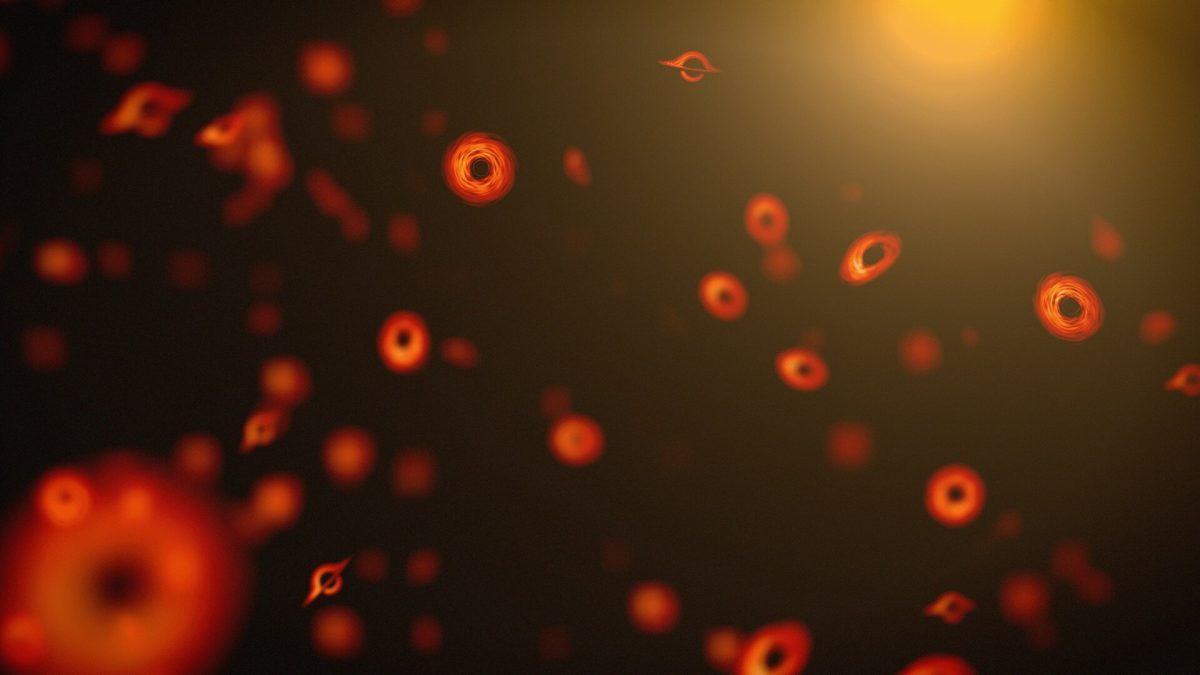
A Hidden Fifth Dimension
As far as we know, primordial black holes do not exist. But if they did, these hypothetical objects would have formed in the early Universe rather than through the deaths of stars, and might even make up dark matter. Most importantly, however, these black holes most likely exist in a dark dimension. This term implies that our space contains a hidden extra spatial dimension. As phys.org reports, a new study explores a possible scenario in which black holes could exist under these conditions.
According to standard cosmology, our Universe exists in four dimensions: three spatial dimensions—length, height, and width—and one dimension of time. In the dark dimension scenario, however, a hidden extra spatial dimension is added to this picture.
This dimension is thought to be approximately one micron wide and hidden from view. While ordinary matter and forces are confined to our standard four-dimensional space, gravity can extend into this additional dimension. Since primordial black holes can be extremely small, this dark dimension could have changed how they formed and survived.
Theoretical Research
So how could scientists investigate such a strange possibility? The answer came not from observations, but from extensive theoretical research in mathematics and physics conducted by a team led by Luis Anchordoqui of Lehman College in the United States. They applied proposed rules of quantum gravity to determine how black holes would behave within the dark dimension theory. The researchers also examined whether these objects would function as standard four-dimensional structures or as five-dimensional ones.
“In this paper, we revisit the formation mechanisms of primordial black holes and ask whether primordial black holes within the dark dimension scenario are actually four-dimensional or five-dimensional black holes,” the study’s authors wrote.
From Four Dimensions to Five
The findings revealed a rather unusual picture. Some primordial black holes would initially behave like ordinary four-dimensional objects. Over time, however, they would become unstable and transform into five-dimensional ones. Others, formed from cosmic strings, would be five-dimensional from the outset.
As for their survival, the additional dimension affects how long they can last. The scientists argue that black holes formed from cosmic strings could have lifetimes comparable to the age of the Universe.
Although this study combines two mysteries into one larger puzzle, it still leaves us waiting for actual evidence. But if even one of them turns out to be true, it could provide detailed insights into the high-energy physics of the early Universe.
