

Black holes that formed in the first moments after the Big Bang have turned out to be far less likely candidates for the Universe’s hidden mass than previously thought. By analyzing gamma radiation from deep space, the authors determined just how small their share of dark matter could be.
The Origin of Primordial Black Holes
Primordial black holes may have formed in the first moments after the Big Bang, in regions where matter was compressed by density fluctuations in the early Universe. Unlike black holes of stellar origin, they do not require the collapse of a star.
For decades, physicists have considered them a possible explanation for dark matter, since such objects do not emit light in the ordinary sense and interact only weakly with other matter.
The Asteroid-Mass Range
Researchers from the University of Auckland and Rice University focused on primordial black holes with masses ranging from 10¹⁴ to 10¹⁷ grams. Physicists refer to this as the “asteroid-mass” range because, in terms of mass, such objects are similar to asteroids, even though their density is typical of black holes.
Objects lighter than 10¹⁴ grams would have completely evaporated since the Big Bang, while those heavier than 10¹⁷ grams evaporate too slowly to produce a detectable signal. Primordial black holes in this mass range are nearing the end of their existence and emit radiation most intensely.
This mechanism is linked to Hawking radiation. A black hole emits thermal particles and gradually loses mass; the smaller it becomes, the higher the temperature of its radiation. In the final stage, this process is accompanied by a burst of gamma rays.
Background Analysis
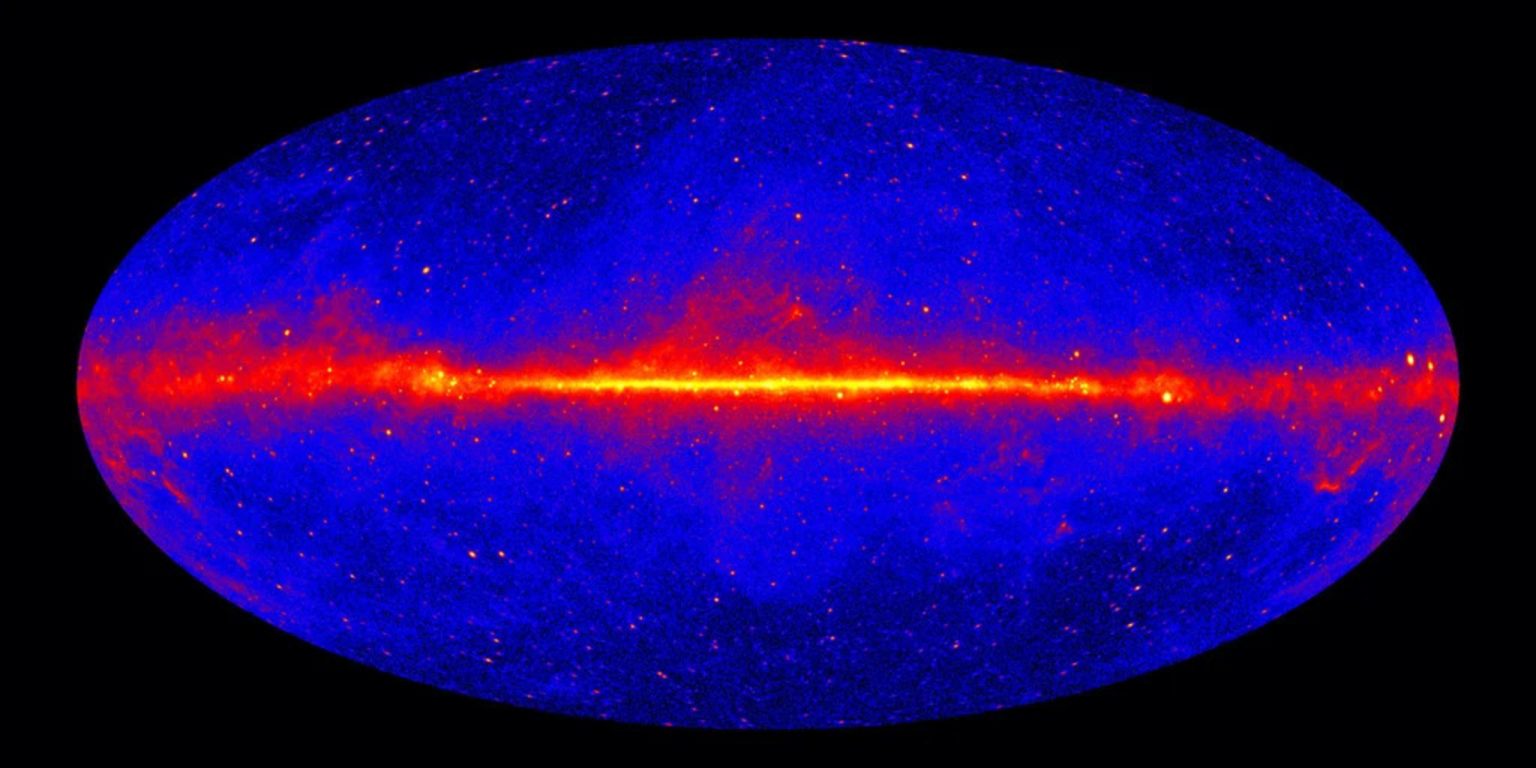
To isolate the signal from primordial black holes, the researchers built a model of the extragalactic gamma-ray background and subtracted the influence of known sources — namely blazars and radio galaxies with active galactic nuclei — as well as gamma rays produced when cosmic rays collide with the Universe’s infrared background.
In parallel, they developed a software tool called GammaPBHPlotter, which models radiation from primordial black holes while accounting for direct Hawking emission, the decay of unstable particles, and the annihilation of positrons with electrons.
Including positron annihilation in the interstellar medium strengthens the contribution to the low-energy part of the gamma-ray spectrum and provides the most precise indirect estimate yet of what fraction of dark matter could be made up of primordial black holes.
According to the authors’ calculations, objects with a mass of around 10¹⁴ grams cannot account for more than one ten-billionth of the observed dark matter. A somewhat higher figure — up to 6% — was obtained for heavier objects with masses of about 3 × 10¹⁶ grams.
Data and the Next Step
A significant limitation of the study is that the available data were collected by instruments aboard the Compton Gamma Ray Observatory: the Energetic Gamma Ray Experiment Telescope (EGRET) and the Imaging Compton Telescope (COMPTEL). The observatory was launched in 1991 and deorbited in 2000. More recent data in this energy range simply do not exist. This is where the so-called “MeV gap” in astrophysical observations lies.
The proposed AMEGO-X — All-sky Medium Energy Gamma-ray Observatory eXplorer — and e-ASTROGAM missions could close this gap, but neither has yet received funding from any major space agency. Both concepts are still being developed technically, and if they are approved, scientists will be able to test whether part of the dark matter mass may be concentrated in heavier primordial black holes.
According to universetoday.com
