

Gamma-ray bursts remain some of the most powerful explosions in the universe, but the properties of the magnetic fields surrounding them have not been measured. Now, astronomers have the opportunity to do so for the first time by studying the polarized radio afterglow of the gamma-ray burst GRB 260310A. Observations with the National Science Foundation’s Very Large Array radio interferometer have also detected the Faraday rotation effect in the afterglow of a gamma-ray burst for the first time. This suggests the existence of an extremely dense magnetized environment around the exploding star.
A New Window into the Magnetism of Gamma-Ray Bursts
Polarized radio emission from the afterglow of a gamma-ray burst has been detected for the first time. This means that the electromagnetic waves oscillate mainly in one direction, rather than randomly. Previously, polarization in the afterglow of gamma-ray bursts had only been detected at shorter wavelengths, particularly with the ALMA radio observatory. Such observations had to be made very quickly, as the radiation decays rapidly after the explosion.
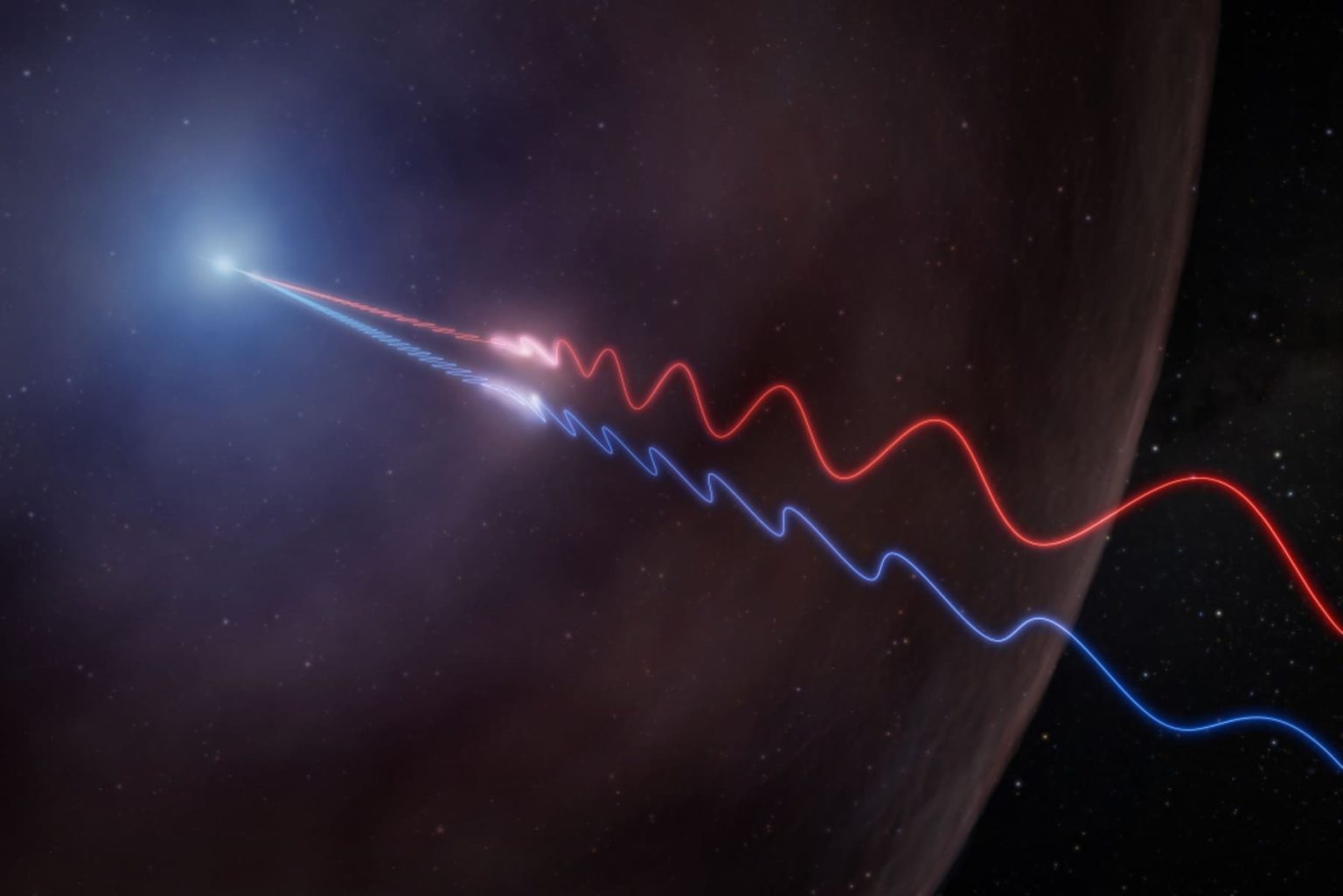
A team led by Collin Christie of the University of Arizona and Tanmoy Laskar of the University of Utah used the National Radio Astronomy Observatory’s Very Large Array (VLA) to work in the centimeter range. This allowed them to not only detect polarization, but also to track how the signal changed at different wavelengths. It was this change that gave rise to Faraday rotation, the phenomenon in which a magnetized plasma changes the orientation of polarized light. The longer the wavelength, the more its plane of polarization rotates.
The Imprint of the Environment
Faraday rotation acts like a magnetic fingerprint. The nature of the rotation can be used to reconstruct the strength of the magnetic field along the path traveled by the light. In the case of GRB 260310A, the field proved to be thousands of times stronger than could be explained by the signal passing through the Milky Way or intergalactic space.
This suggests that the effect is not due to the magnetic field of our Galaxy, but comes from the immediate surroundings of the explosion itself. The analysis showed that the best explanation for the observations is that the gamma-ray burst occurred inside the H II region, a cloud of ionized hydrogen produced by the intense ultraviolet radiation of a young massive star. The stellar wind from this star could also have significantly affected the structure of the environment. This result confirms the connection of long gamma-ray bursts with the death of massive stars and opens a new way to study the environment in which such extreme explosions occur.
The Burst That Created the Opportunity
GRB 260310A produced one of the brightest radio afterglows observed in recent decades and was also located comparatively nearby by cosmic standards. These circumstances made the burst an ideal target for observation.
No previous gamma-ray burst had allowed Faraday rotation to be measured. This requires a signal that is both bright and sufficiently long-lasting, combined with a sensitive instrument. The paper presenting the results has been submitted to The Astrophysical Journal, and its preprint is already available on arXiv, according to the University of Utah.
Kate Denham Alexander, Christie’s academic supervisor at the University of Arizona, emphasizes that continued monitoring of afterglows with the VLA and other radio telescopes will allow scientists to observe the evolution of magnetic structures in real time. This may transform our understanding of how relativistic jets form, which processes supply their energy, and how magnetic energy is released under the most extreme conditions in the Universe.
