

Most planets known to us form alongside their host stars within a shared protoplanetary disk. However, while analyzing data from space observations, an international team of scientists came across something unique: chemical and optical signatures of a gas giant that formed from the material left behind after its star died.
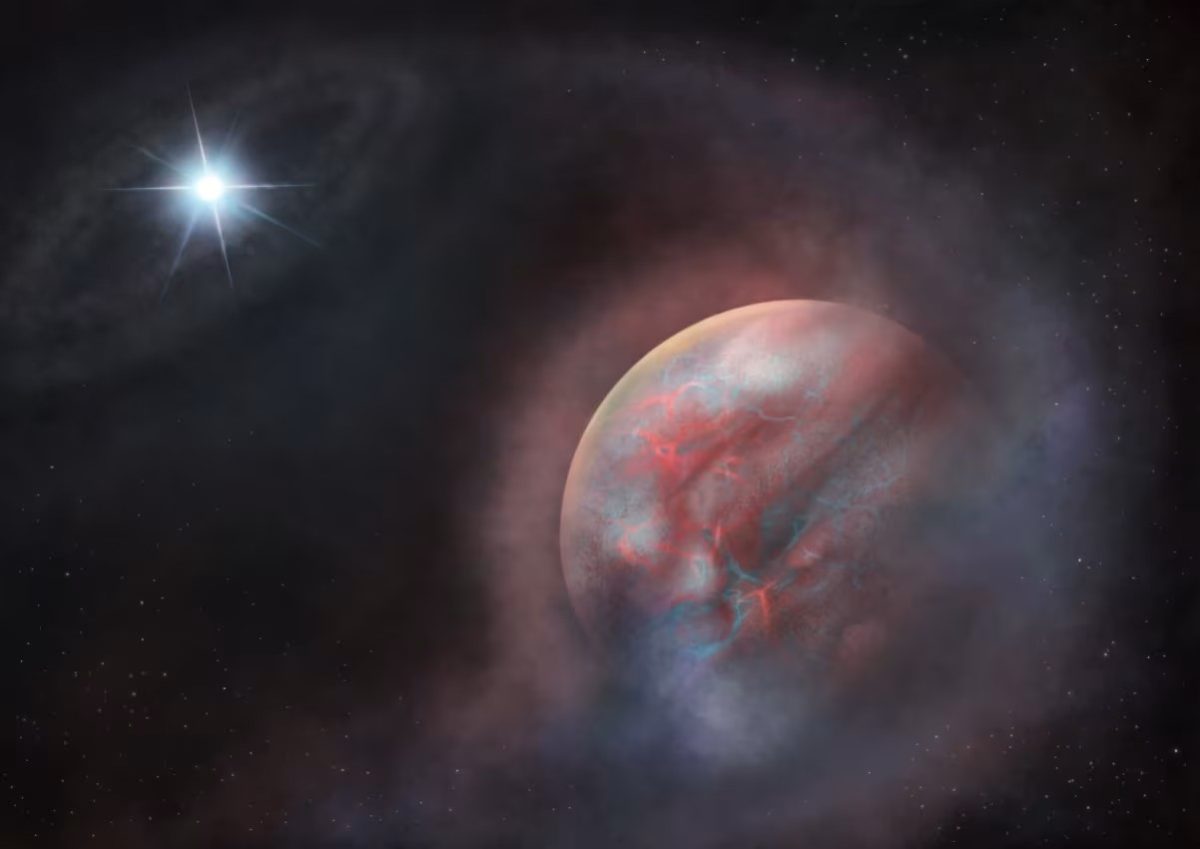
This young world now orbits the white dwarf HS 0209+0832, located approximately 270 light-years from Earth. The findings describing this phenomenon were published in Nature Astronomy.
A Niobium Signature and Clues from TESS
The main evidence for the birth of a second-generation planet came from the unusual composition of the white dwarf’s atmosphere. Using the Hubble Space Telescope, astronomers detected a substantial concentration of niobium on the dead star’s surface.
Heavy elements in white dwarfs usually sink rapidly into the interior under the influence of immense gravity, leaving only the lighter hydrogen and helium at the surface. The presence of niobium indicates that this material arrived at the star from an external source very recently. Scientists believe that intense ultraviolet radiation from the hot white dwarf is literally evaporating the nearby planet’s atmosphere, causing this material to fall onto the star.
Further evidence came from observations by TESS (the Transiting Exoplanet Survey Satellite). The spacecraft recorded regular variations in the white dwarf’s brightness with a period of 4.4 days, characteristic of a large planet passing in front of the stellar disk.
Life from Stardust
The formation of first-generation planets still holds many mysteries, and the mechanism behind the emergence of second-generation planets is even more complex. In the case of HS 0209+0832, scientists propose the following scenario: during its red giant phase, the dying star may have engulfed a close companion, such as a brown dwarf or a small star with about 20% of the Sun’s mass.
This infall prevented the stellar material from dispersing completely into space. Instead, some of the gas and dust began swirling in a dense disk around the remaining stellar core, from which a new exoplanet eventually condensed.
The Future of the Solar System
For the scientific community, this discovery overturns existing ideas about the evolution of planetary systems. White dwarfs cool over tens of billions of years, making their surrounding habitable zones exceptionally stable. If second-generation planets can form under such conditions, they could potentially provide a refuge for life over periods far exceeding the age of our Universe.
The discovery also offers a direct illustration of the future of our own cosmic home. In a few billion years, the Sun will also become a white dwarf. Although Earth will evaporate during this process, a new world could emerge in our system from its remnants and the stellar ashes.
For now, the object near HS 0209+0832 remains a planet candidate. To definitively confirm its existence, the team plans to conduct additional observations using Hubble, Chandra, and the James Webb Space Telescope.
We previously discussed how scientists find exoplanets in space.
Based on reporting by Reuters.
