

The Artemis II crew spotted flashes caused by tiny space objects striking the lunar surface. Such faint light from impacts may never before have been seen with the naked eye. NASA released its preliminary science report on the lunar flyby six months after the mission ended. The astronauts also described the colors of rocks, the terrain, and the solar corona.
Flashes in the Moon’s Shadow
The astronauts recorded five flashes on April 7, when the Moon completely blocked their view of the Sun. The eclipse lasted approximately 56 minutes. Commander Reid Wiseman and Jeremy Hansen saw one of the flashes simultaneously.
According to NASA’s preliminary report, all the flashes appeared on the unilluminated portion of the lunar disk. The crew did not notice any in direct sunlight, leading scientists to consider these flashes the faintest ever seen by humans. They estimate that the objects responsible for the impacts were a few centimeters across. Previously, crews aboard Apollo 16 and Apollo 17 had seen such flashes from orbit on at least three occasions.
The mission flew past the Moon during a period with no major meteoroid streams. The confirmed flashes therefore establish a lower limit on the impact rate. These data will be considered when planning future Artemis missions.
The Corona and Earthshine
For nearly an hour, the astronauts observed the solar corona. They described several coronal streamers—elongated structures formed by magnetic loops. Some pulsated, and toward the end of the eclipse, the corona appeared more symmetrical than at the beginning. This agrees with data from the SOHO observatory.
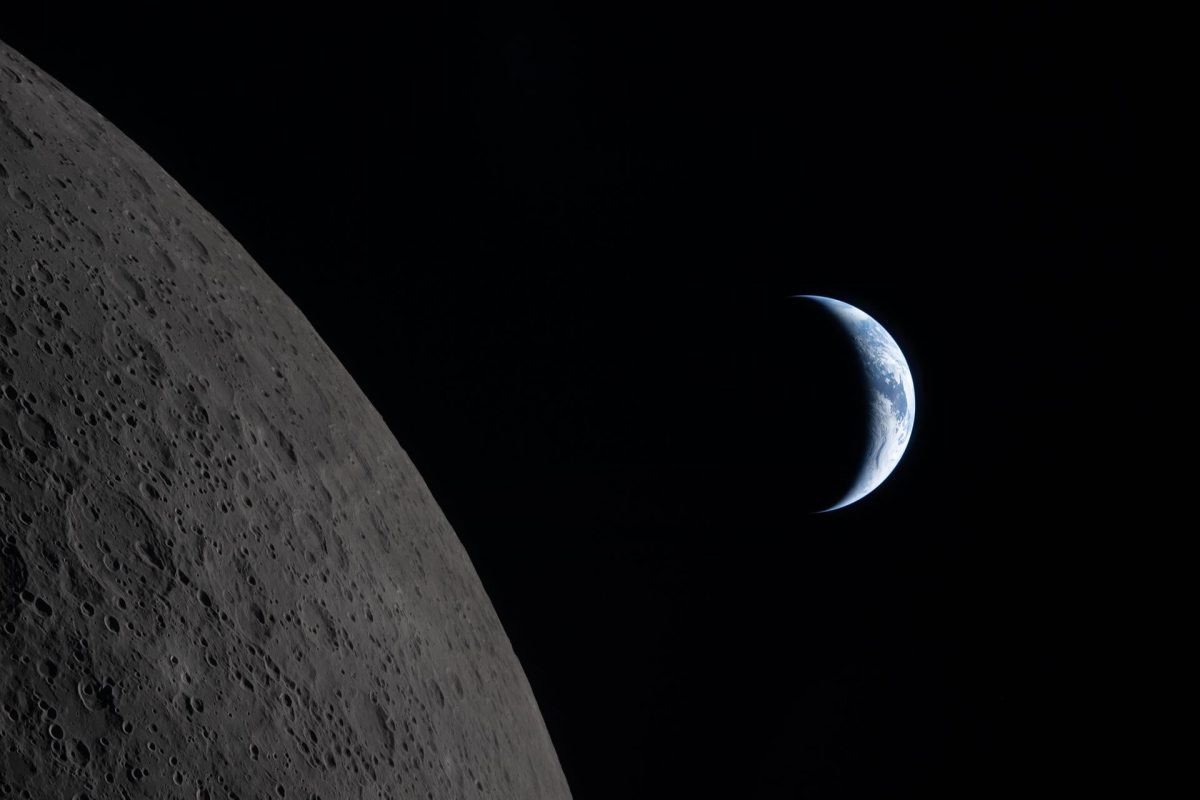
The portion of the Moon visible to the crew was illuminated only by light reflected from Earth. In the astronauts’ photographs, the surface has a bluish tint under this illumination, although the astronauts themselves could not distinguish details on it.
Colors and Terrain
The cameras aboard Orion had not been calibrated for scientific measurements, so the astronauts’ spoken descriptions became the main source of color data. As Universe Today notes, these descriptions will be compared with images from the Lunar Reconnaissance Orbiter.
Christina Koch described the Aristarchus Plateau as yellowish, while Reid Wiseman saw a shade of greenish-brown glass. The brown color could indicate titanium-rich volcanic glass, like that found in Apollo 17 samples. Green could correspond to magnesium-rich glass, like that in Apollo 15 samples.
On the plains of the Ocean of Storms, the crew noticed an arc of light-colored bands. Analysis showed that this was a system of gently sloping tectonic ridges approximately 600 kilometers long. The ridge scarps are only about 100 meters high—roughly the height of a 30-story building. One possible explanation for how they could be seen from thousands of kilometers away is that their gentle slopes subtly altered the illumination along the entire length of the system.
New Names on the Map
Before the flyby, the crew proposed names for two bright craters. The first would become Integrity Crater, named after the spacecraft, and the second Carroll Crater, in memory of Reid Wiseman’s late wife. A submission to the International Astronomical Union is already being prepared.
The report’s authors recommend that future Artemis missions carry calibrated cameras, a dedicated flash detector, and equipment for passive audio recording in the cabin. This time, the spoken descriptions proved to be the most valuable data. The complete archive of images and audio is already publicly available through NASA’s Planetary Data System.
