

Astronomers exploring the most distant reaches of the Universe in search of ancient objects from the era immediately after the Big Bang encountered an unexpected mystery. Pointing their space-based instruments at a seemingly empty patch of sky, they detected unusual emission of unknown origin. The findings were published in The Astrophysical Journal.
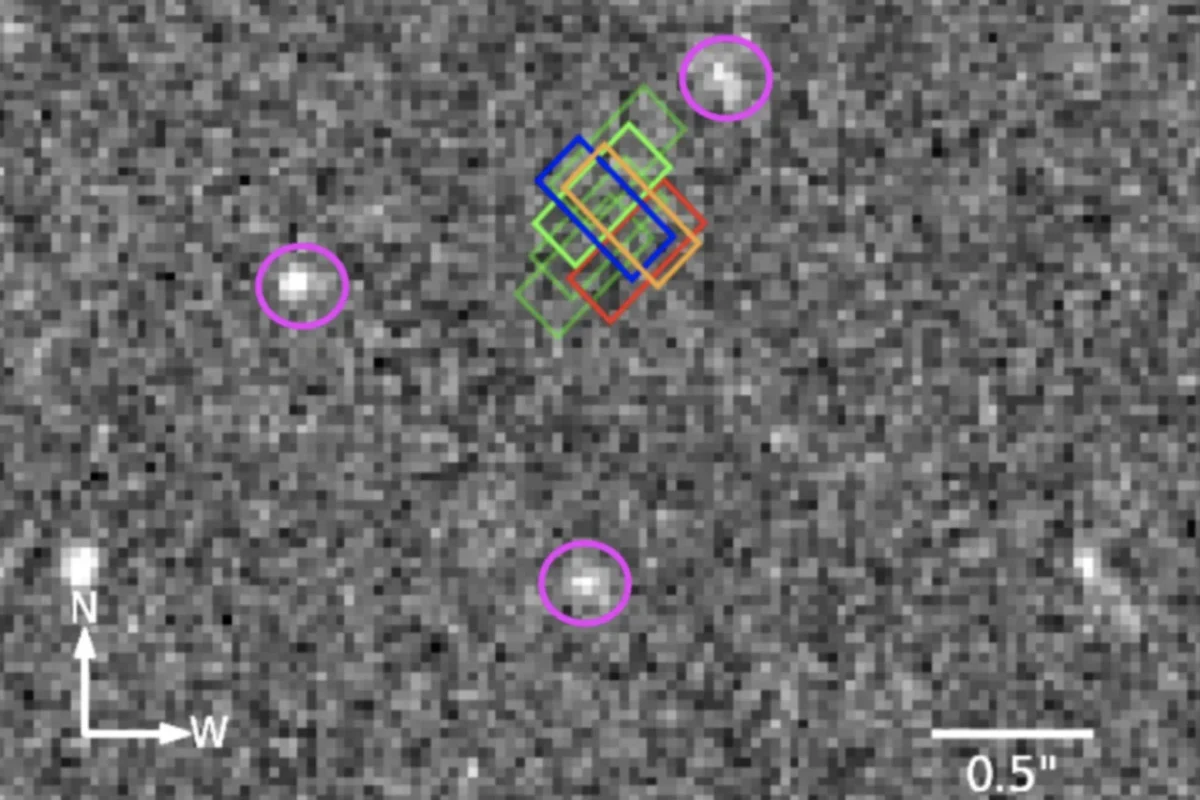
While observing the southern constellation Fornax, astrophysicist Mason Huberty’s team at the University of Minnesota used the Webb Space Telescope’s Near-Infrared Spectrograph. Their primary goal was to search for undiscovered objects by blocking light from known galaxies previously identified by the Hubble Space Telescope.
Six of the seven detected spectral emission lines were successfully linked to distant galaxies. The seventh, however, left the researchers baffled. The strange light signal appeared as a bright line during two observing sessions in August and November 2023, separated by 88 days.
Every attempt to match the signal with earlier images of the region proved unsuccessful. Although both Hubble and Webb had examined this patch of sky repeatedly, no celestial object had been detected there.
Why Did This Spectral Line Puzzle Scientists?
Spectral emission lines are the “fingerprints” of atoms and molecules releasing energy. They allow astronomers to determine the chemical composition, distance, and motion of celestial objects.
Such lines usually appear in groups. This signal, however, was entirely isolated. If it came from a persistent source, its brightness should have been sufficient for it to appear in earlier deep images of space.
Complicating matters further, researchers need to know the object’s distance to identify its nature accurately. As the Universe expands, light waves stretch through space, shifting toward red and infrared wavelengths. The detected photon could therefore have originated as high-energy radiation from an extremely distant object or as lower-energy light from something much closer to us.
Three Hypotheses and No Answer
Researchers are currently considering several possible explanations for the anomaly, although each has its own inconsistencies:
- A nascent galaxy. The signal could have come from a primordial galaxy that formed just a few hundred million years after the Big Bang. However, such an object should also have appeared in earlier images.
- A fading active galactic nucleus. The source could be a supermassive black hole at the center of a galaxy whose activity is declining. Under these conditions, however, spectrometers should have detected other accompanying emission lines.
- A stellar tidal disruption event. The light could be the result of a brief, catastrophic event, such as a star being torn apart by a black hole’s gravitational field. This would explain why the object was invisible a year earlier, but it still does not account for all the spectral details.
Whatever further observations ultimately reveal the object to be, astronomers are convinced that it possesses extreme physical properties and offers new insights into processes occurring throughout the Universe.
We previously reported on how a mysterious object left astronomers baffled.
Based on material from iflscience.com.
