

Winds generated in early galaxies following supernova explosions likely obscured ultraviolet radiation from massive stars. Astronomers reached this conclusion after studying nearby galaxies with intense star formation using the Hubble Space Telescope. These winds carry neutral gas and dust around the stars, which absorb the radiation. Consequently, light from the youngest stars may have cleared the early universe of its hydrogen fog.
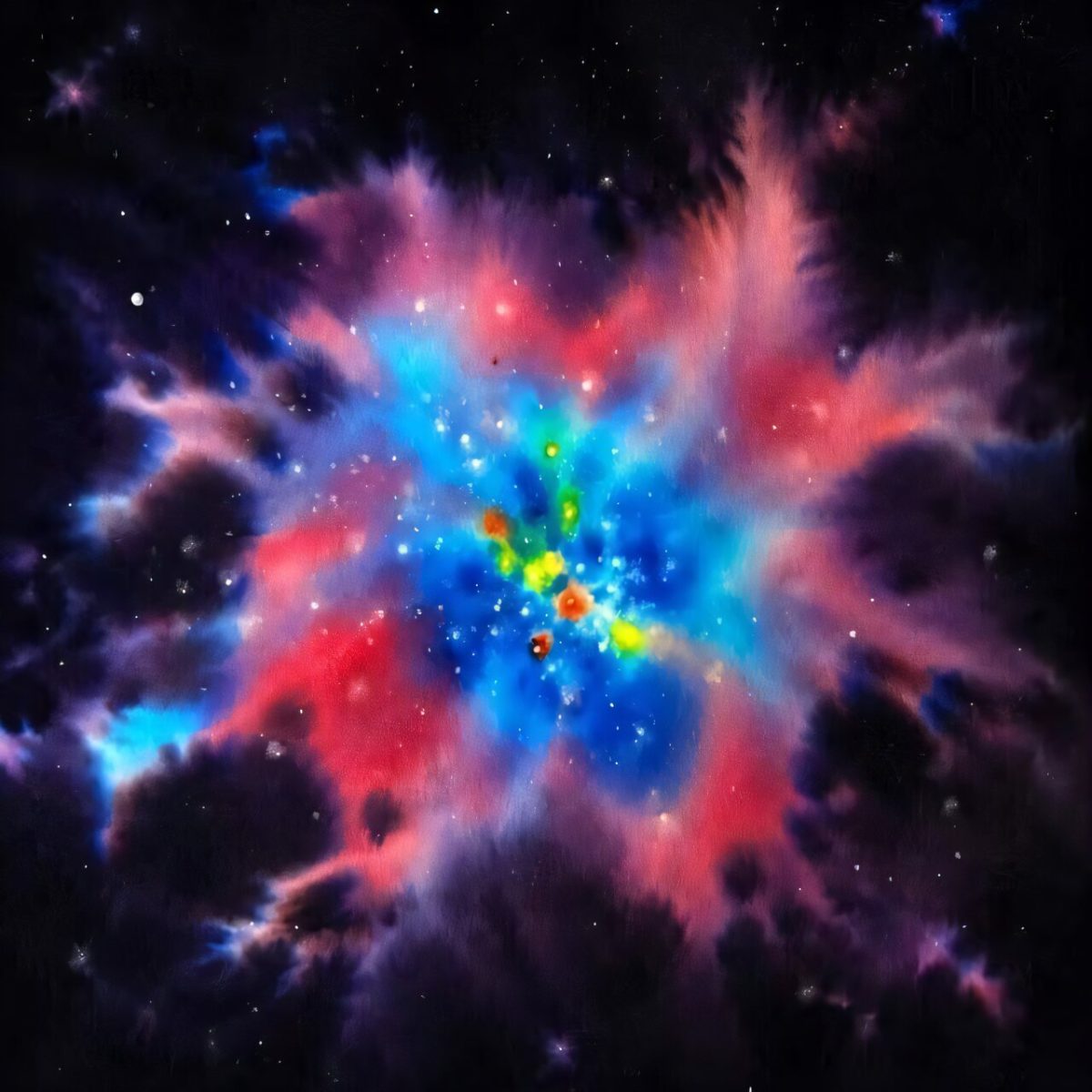
Credit: Siyi Wang
A small window for light
A galaxy emits the greatest amount of ionizing radiation — that is, hard ultraviolet radiation capable of splitting hydrogen atoms — during the first three million years after large-scale star formation begins. This is indicated by the spectra of six similar galaxies in which bursts of star formation began at different times. The study was led by Cody Carr, who conducted the research at Zhejiang University and is now at the University of Michigan. In older systems, the winds were found to be faster and to carry more dust. The article was published in the peer-reviewed journal Nature Astronomy.
The three-million-year limit has a physical basis. The most massive stars survive for only a few million years before exploding as supernovae. While they are still luminous, their radiation and stellar winds exert the strongest influence on the surrounding gas, and a rapid galactic wind has not yet developed. This wind emerges after the first supernova explosions and, over approximately ten million years, sweeps up increasing amounts of matter.
The fog after the Big Bang
During the universe’s first billion years, it was filled with neutral hydrogen, which is opaque to ultraviolet light. Approximately 13 billion years ago, the era of reionization began. Radiation from early galaxies ionized hydrogen atoms, separating them into protons and electrons, and the intergalactic gas gradually became transparent.
However, the objects responsible for producing this radiation and the mechanism by which it was ejected from the galaxies remain unknown. According to phys.org, the leading hypothesis specifically attributed the light’s origin to supernova-driven winds. Astronomers had proposed that these winds clear a path for the light through the gas.
Strong winds reduce the rate of radiation
To measure wind speeds, the light emitted by each galaxy was analyzed by wavelength. Gas within the wind absorbs specific wavelengths, creating gaps in the spectrum. The position and width of these gaps are used to determine the motion of the matter. Galaxies with the fastest winds emitted the smallest fraction of ionizing radiation.
Stephan McCandliss of Johns Hopkins University explains that energy from supernovae disrupts the surrounding environment. Consequently, neutral gas and dust spread across a larger area and absorb ultraviolet radiation.
For observations of early galaxies with the James Webb Space Telescope, ultraviolet brightness does not necessarily indicate a contribution to reionization. A galaxy may emit ionizing radiation only briefly, until powerful winds begin to develop within it. In current cosmological models, galactic emission is attributed primarily to supernovae. Renyue Cen of Zhejiang University, one of the study’s lead authors, considers the next step to be investigating how radiation and winds from young stars affect the surrounding gas before the first supernovae occur.
The authors note, however, that weaker winds near young stars may still play an important role in the escape of radiation. To investigate this possibility, Cody Carr and his colleagues are seeking additional observation time with the Hubble Space Telescope to study a larger sample of galaxies.
