

Earth is nearing the aphelion, the point in its orbit farthest from the Sun. Simultaneously, Europe is experiencing heat waves. Why do temperatures reach their peak precisely when Earth is at its greatest distance from the primary source of heat in the Solar System?

Earth’s aphelion
On July 6, 2026, at 5:30 p.m. UTC (8:30 p.m. Kyiv time), Earth will attain its aphelion, the point in its orbit farthest from the Sun. At that specific moment, the Earth will be approximately 152 million kilometers away from the Sun.
This annual event transpires approximately at the same period each year and is fundamentally connected to the intrinsic characteristics of orbital motion. It is a natural consequence of the Earth moving around the Sun in an elliptical orbit. Orbital motion is determined by the interaction of inertia and gravity: due to inertia, the planet tends to move in a straight line and evenly, and the gravitational attraction of the Sun changes the direction of its motion, keeping it in orbit.
Because Earth’s orbit is not a perfect circle, its distance from the Sun varies throughout the year. After passing perihelion—the point in its orbit closest to the Sun, which Earth typically passes in early January—it gradually moves away from the sun. After reaching aphelion, the planet begins to approach the Sun again..
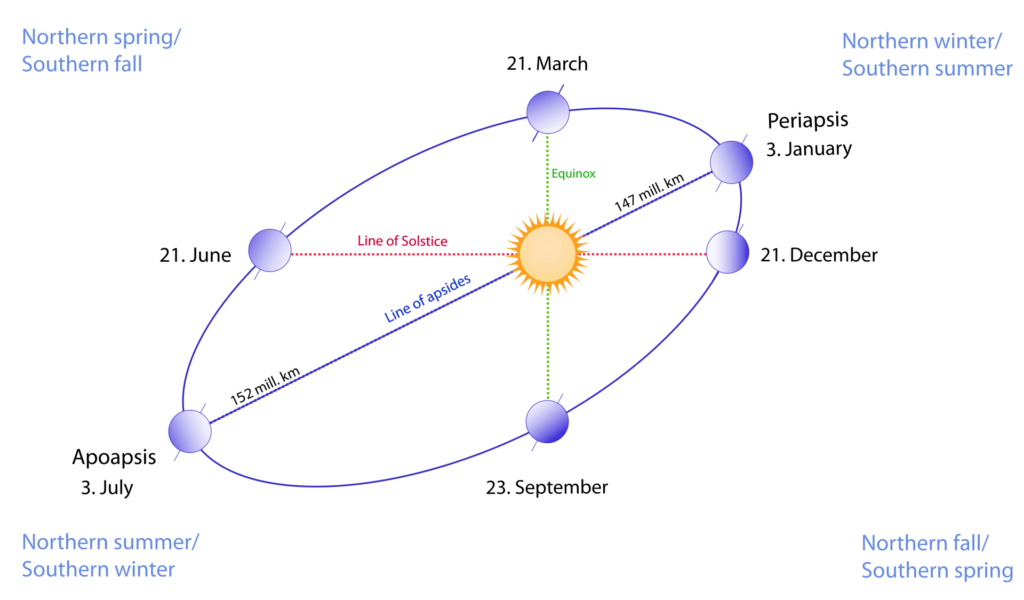
However, as the Earth moves away from the Sun, its orbital speed gradually decreases. At aphelion, it reaches a minimum value, after which gravitational attraction begins to increase the planet’s speed, and the Earth again approaches the Sun. It is aphelion that is the point in the orbit at which the distance from the Sun is greatest and the orbital speed is the smallest.
It is also noteworthy that the precise timing and distance at which Earth traverses the aphelion and perihelion on an annual basis exhibit minor variations. Several factors contribute to this phenomenon. Primarily, the Earth’s orbital shape and inclination experience slight alterations as a result of gravitational interactions with other planetary bodies.
An additional consideration is that the actual period of one complete revolution of our planet around the Sun does not precisely measure 365 days. To account for this discrepancy, an extra day is added during a leap year, which occurs once every four years. During the intervals between leap years, no adjustments are made, resulting in a gradual shift of regular astronomical events over time. Following a leap year, this cycle recommences.

Why does the aphelion exert minimal influence on the weather?
Considering the foregoing, a single question emerges: how can aphelion be observed by the average observer on Earth? The response is straightforward: it is virtually unobservable. Although this is the point at which we are most distant from the Sun, Earth’s orbit is nearly circular, with an eccentricity of merely 0.016.
This is the reason why the disparity in the Sun’s distance at aphelion and perihelion amounts to merely 5 million kilometers. Although this may appear substantial, considering that the Earth’s orbital radius is approximately 150 million kilometers, this represents only about 3% of that distance, rendering the variation practically imperceptible. Consequently, any guidance on how to identify aphelion is therefore futile.
Therefore, it is unsurprising that in 2026, aphelion coincided with the heat wave that traversed Eurasia. The reality is that the angle at which the Sun’s rays strike the Earth’s surface has a considerably greater influence on the planet’s temperature than its proximity to the Sun.
The summer solstice, which signifies the culmination of daylight in the Northern Hemisphere, took place merely two weeks prior. Consequently, it is understandable that residents of Europe, the United States, India, and Japan find the news that the Earth is presently at its greatest distance from the Sun to be almost humorous.

However, it is important to consider that this perception merely results from the fact that the majority of developed nations are situated in the Northern Hemisphere. Conversely, in the Southern Hemisphere, the situation is the opposite: currently, the days are the shortest, and many regions experience cold weather. Consequently, the information that the Earth is at its greatest distance from the Sun is regarded there as entirely natural.
In fact, there is no direct connection between the solstices and aphelion or perihelion. The fact that today the Earth passes aphelion shortly after the June solstice is just a feature of the current configuration of its orbit. On other terrestrial planets, things may be different. If the eccentricity of the orbit is large and it is correspondingly more elongated, and the inclination of the axis of rotation is small, the main reason for the change of seasons will be not the inclination of the axis, but the change in the distance to the star.
However, on Earth, we possess the resources and conditions available to us. Moreover, the climate of our planet is determined not only by the degree of illumination and the amount of solar energy it receives. Equally important is how this energy is absorbed and redistributed. Land, oceans, and the atmosphere heat up differently: land heats up and cools down quickly, while the oceans are able to store large amounts of heat. Atmospheric and oceanic circulation transports this heat, smoothing out temperature differences between different regions. At the same time, greenhouse gases trap some of the Earth’s thermal radiation, preventing it from leaving the atmosphere immediately.
There is no paradox in this situation. Currently, the Earth is indeed at its greatest distance from the Sun. Nevertheless, temperature variations are affected by numerous factors, including human activity. It is the combined influence of these factors that consequently results in heat waves.
