

As a binary system containing a black hole began to fade after a powerful outburst, the outer regions of the disk of matter surrounding the black hole unexpectedly heated up. The opposite had been expected, since the source of radiation was weakening. An international team of astronomers explained this paradox through shadowing. During the outburst, the inner disk swelled and shielded the outer regions, before becoming thinner again. This restructuring began at a much lower luminosity than models had predicted.
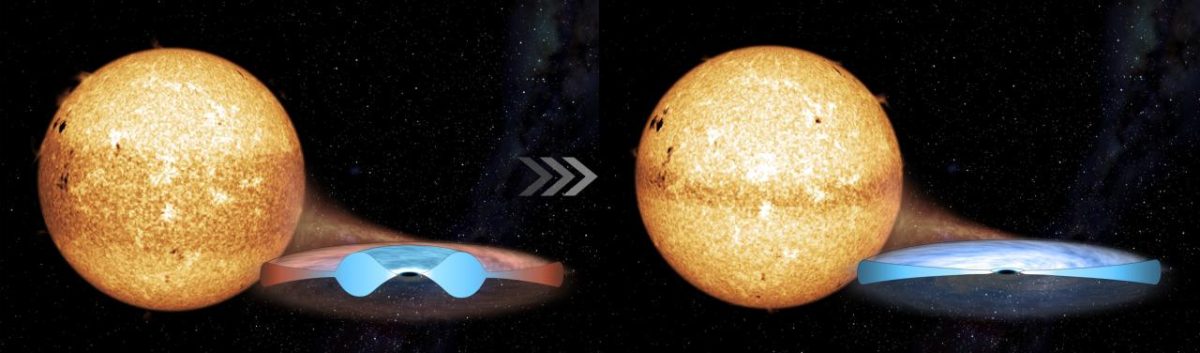
Hotter Under Weaker Light
In the binary system MAXI J0637−430, matter flows from a companion star toward a black hole. The gas first accumulates in an accretion disk. Its inner regions become so hot that they emit primarily X-rays, while the outer regions are studied in visible and infrared light.
According to the Instituto de Astrofísica de Canarias, spectra obtained with the Very Large Telescope’s (VLT) X-shooter spectrograph at the peak of the outburst showed bright hydrogen and helium lines. These typically originate in a relatively cool, weakly irradiated outer disk. Two weeks later, the X-ray luminosity had fallen by approximately half, yet these lines had almost disappeared. The spectrum now indicated a much hotter, strongly irradiated outer disk.
The Shadow of a Swollen Disk
Why did a weaker source heat the outer disk more strongly? Study author Montserrat Armas Padilla of the Instituto de Astrofísica de Canarias explains that, during the brightest phase, the inner disk thickens under the pressure of intense radiation. This thicker region shields the outer disk from X-rays, keeping it relatively cool.
As the outburst fades, radiation pressure drops and the disk becomes thinner again. The shadow disappears. Although the source is now only half as bright, its X-rays can reach the outer regions unobstructed, delivering more energy than they did at the outburst’s peak. Co-author Teo Muñoz-Darias, from the same institute, compares this to dimming a lamp while simultaneously removing its lampshade.
Using X-ray data from the NICER, Swift, and NuSTAR space observatories, the team found evidence that the inner disk also changed as the system faded. The results were published in the peer-reviewed journal Nature Astronomy. Eight scientists from the institute contributed to the study, alongside colleagues from the Netherlands, Japan, Germany, Italy, Chile, the United Kingdom, and the United Arab Emirates.
Far Below the Eddington Limit
According to classical models, an accretion disk remains thin at moderate luminosities and swells significantly only near the Eddington limit. This is the maximum luminosity at which radiation pressure does not yet prevent additional matter from falling toward the black hole. In MAXI J0637−430, the restructuring appears to have begun at just 10–20% of this limit. The authors cannot yet explain why it started so early.
A black hole is fully described by two parameters: mass and spin. Astronomers determine the spins of black holes in binary systems from their X-ray spectra, and the result depends on the disk geometry assumed in the calculations. In 1973, Nikolai Shakura and Rashid Sunyaev proposed a thin accretion disk model, which Igor Novikov and Kip Thorne extended that same year to include the effects of general relativity. Such measurements still rely on this model. If the inner disk swells even at moderate luminosities, some of the values obtained this way may be inaccurate.
