

When the James Webb Space Telescope (JWST) captured its first deep images of the early Universe, astrophysicists saw something they least expected. In almost every image, there were tiny red dots, located billions of light-years away from us. They looked strange, did not match any scientific simulation, and challenged established ideas about how the cosmos formed during the first hundreds of millions of years after the Big Bang.
Instead of spreading their efforts across hundreds of detected dots, researchers focused on one unique target — an object called GLIMPSE-17775. The scientists were fortunate: a galaxy cluster located along the path of the light acted like a giant gravitational lens. Thanks to this effect, 30 hours of observations using JWST’s infrared instruments provided the same data quality and spectral detail that would normally have required nearly 80 hours to collect.
The resulting spectrum turned out to be extremely complex and unusual. The object combined properties that had never before been observed in a single body.
A Star with a Black Hole
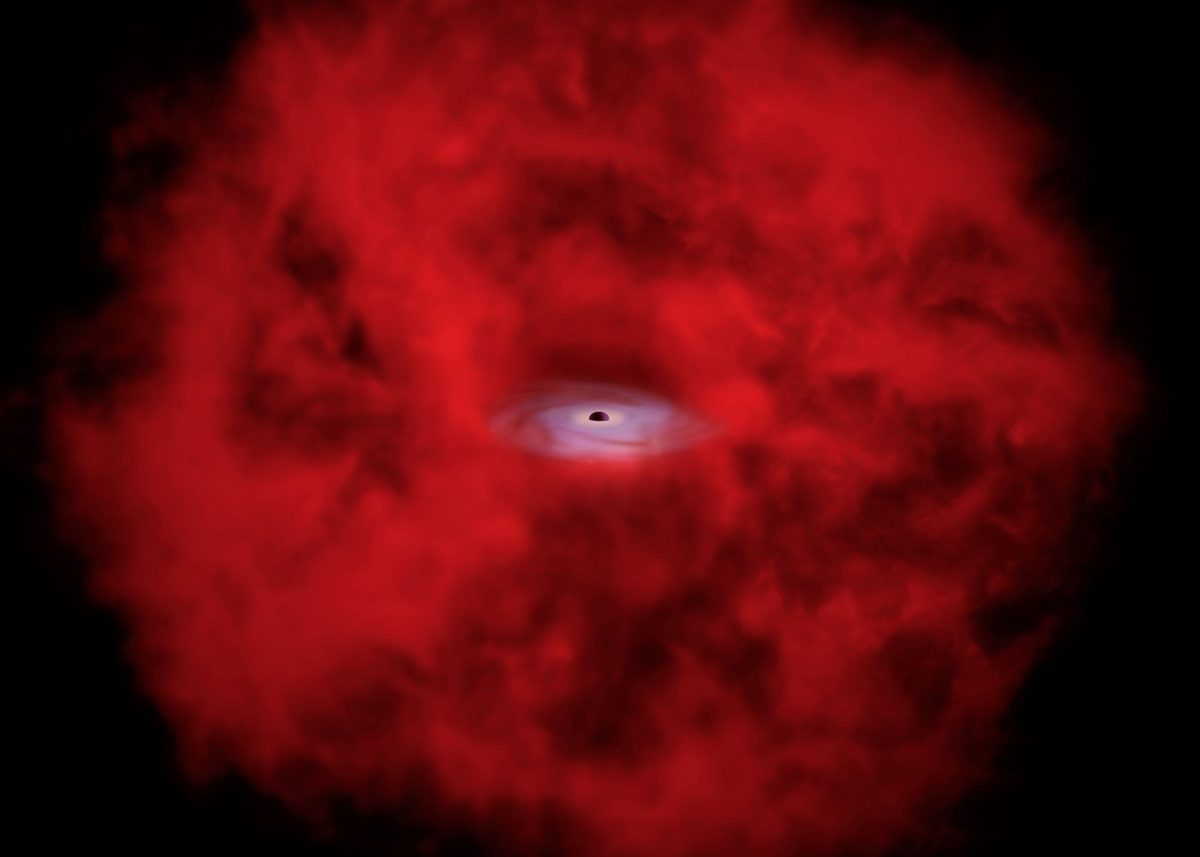
Analysis of the light from GLIMPSE-17775 and similar objects showed that these are not simply supermassive galaxies, as initially assumed. The data point to a hybrid nature: a rapidly growing black hole surrounded by an extremely dense and thick cocoon of gas. Researchers proposed the term “Black Hole Star.”
The main anomaly is that these objects radiate millions of times more brightly than any star known to science. They have star-like spectral features, but ordinary stars are physically incapable of producing such enormous amounts of energy. At the same time, they lack some of the radiation characteristic of standard black holes that are actively accreting matter.
Rethinking the Evolution of the Early Universe
The new data suggest that during the period from 500 million to 1.5 billion years after the Big Bang, black holes and galaxies grew at an astonishing rate. They either formed as giants from the beginning or absorbed surrounding gas much faster than all theoretical limits predicted. This discovery represents an important piece of the puzzle of how the overall matter environment of the young cosmos was able to form supermassive gravitational centers so quickly.
Science as an Exciting Detective Story
Unlike classical laboratory disciplines, where theory can be tested through experiments, astronomy does not allow scientists to change the parameters of the Universe. Researchers can only observe and debate. According to the scientists, discovering an object that does not fit any existing theory is the best thing that could have happened to modern astrophysics.
Over the next year or two, astronomers plan to devote additional JWST observing time to the detailed study of individual “red dots” and to analyzing the entire population in order to finally determine the nature of these cosmic anomalies.
Earlier, we reported on how physicists began searching for hidden dimensions and microscopic black holes.
Based on materials from Gizmodo
