

Astrophysicists from Syracuse University examined ten documented recurring tidal disruption events. In four instances, the maximum luminosity of the repeated flares was observed to be less than anticipated by existing models. Over a period of two years, the research team was unable to identify an explanation for this phenomenon, but they now attribute it to the star’s rotation rate.
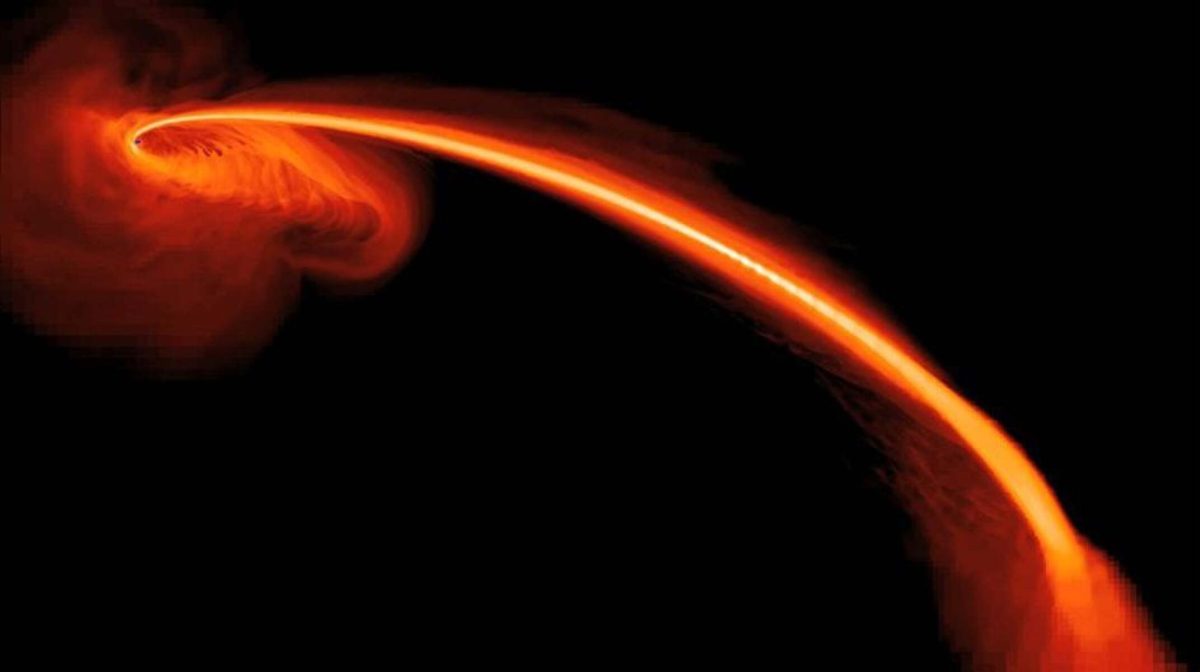
Credit: NASA/S. Gezari (JHU)/J. Guillochon (UCSC)
Rapid rotation diminishes material loss
When a star approaches in proximity to a supermassive black hole, tidal forces extract portions of its outer layers. Simulations indicate that this interaction also results in an increase in the star’s rotational velocity around its own axis. The higher the rotational speed, the less material the star loses during subsequent close encounters, consequently leading to a reduction in the peak luminosity of the outburst.
A research team headed by Ph.D. candidate Ananya Bandopadhyay conducted hydrodynamic simulations regarding massive main-sequence stars. This study is documented in a publication on arXiv. The findings indicate that to generate faint flares, a star must exhibit rapid rotation prior to its initial close interaction with a black hole. Conversely, if the star’s initial rotation is slow, the first encounter markedly increases its rotational velocity, while subsequent encounters contribute less to this acceleration, resulting in noticeably dimmer flares.
The Hills mechanism elucidates the origin of high-velocity stars
The rapid rotation observed in such stars may have a unified explanation. This involves the Hills mechanism, wherein a binary system approaches a supermassive black hole closely. The gravitational forces disintegrate the pair; one star is expelled, while the other remains in a compact orbit around the black hole.
If the stars in a binary system were in close proximity and orbited synchronously, the captured star would maintain a high rotational velocity. It is precisely such an object that could produce recurrent episodes of tidal disruption, exhibiting either a stable flare brightness or a gradual decrease in brightness. According to Universe Today, this scenario aligns with observational data.
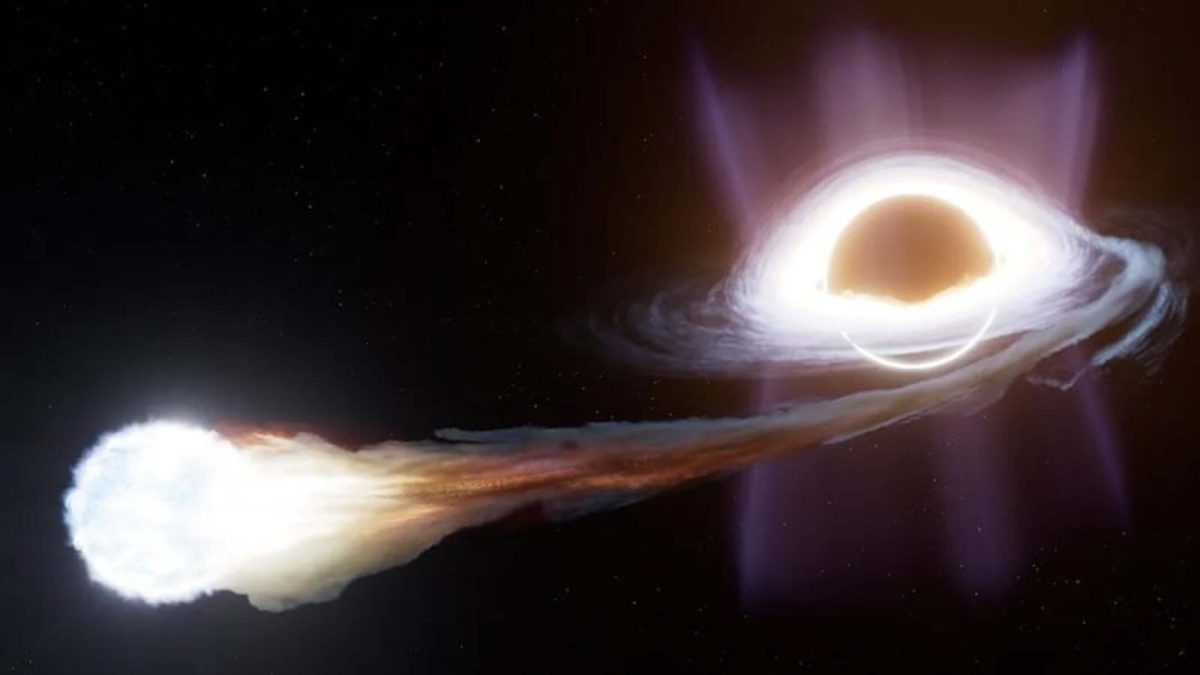
Credit: Ralf Crawford (STScI)
The study’s findings were published in The Astrophysical Journal. Of the ten recurrent events examined by the researchers, four were observed to be less luminous than anticipated. This prompted an investigation into the influence of stellar rotation, as earlier models had only considered mass loss and the internal structure of the star. The article delineates how the initial rotational velocity of a star impacts the attenuation of recurrent flares in such phenomena.
Stars located near the core of the Milky Way
Scientists are concentrating on the star S 301, which encircles the supermassive black hole located at the core of our galaxy. It approaches the black hole more closely than any other recognized star and completes a full orbit every 8.7 years. The nature of this object remains undetermined; however, it exhibits low brightness and low temperature.
The data concerning S 301 were acquired utilizing the GRAVITY instrument mounted on the European Southern Observatory’s Very Large Telescope. The authors of the publication regarding recurring tidal disruption events propose that certain of these objects may have formed from the disintegration of proximal binary systems through the Hills mechanism. Should S 301 indeed be classified as one such star, its activity warrants observation as it advances towards the black hole.
Such stars remain infrequent. Nonetheless, additional observations of S 301 and other objects proximate to the Galactic Center will assist in establishing whether rapid rotation genuinely accounts for the faint flares observed in recurring tidal disruption events.
