

The Sun and other stars orbit the center of the Milky Way, each along its own path. From time to time, they come close to one another. But can they collide? Let’s try to answer that question.
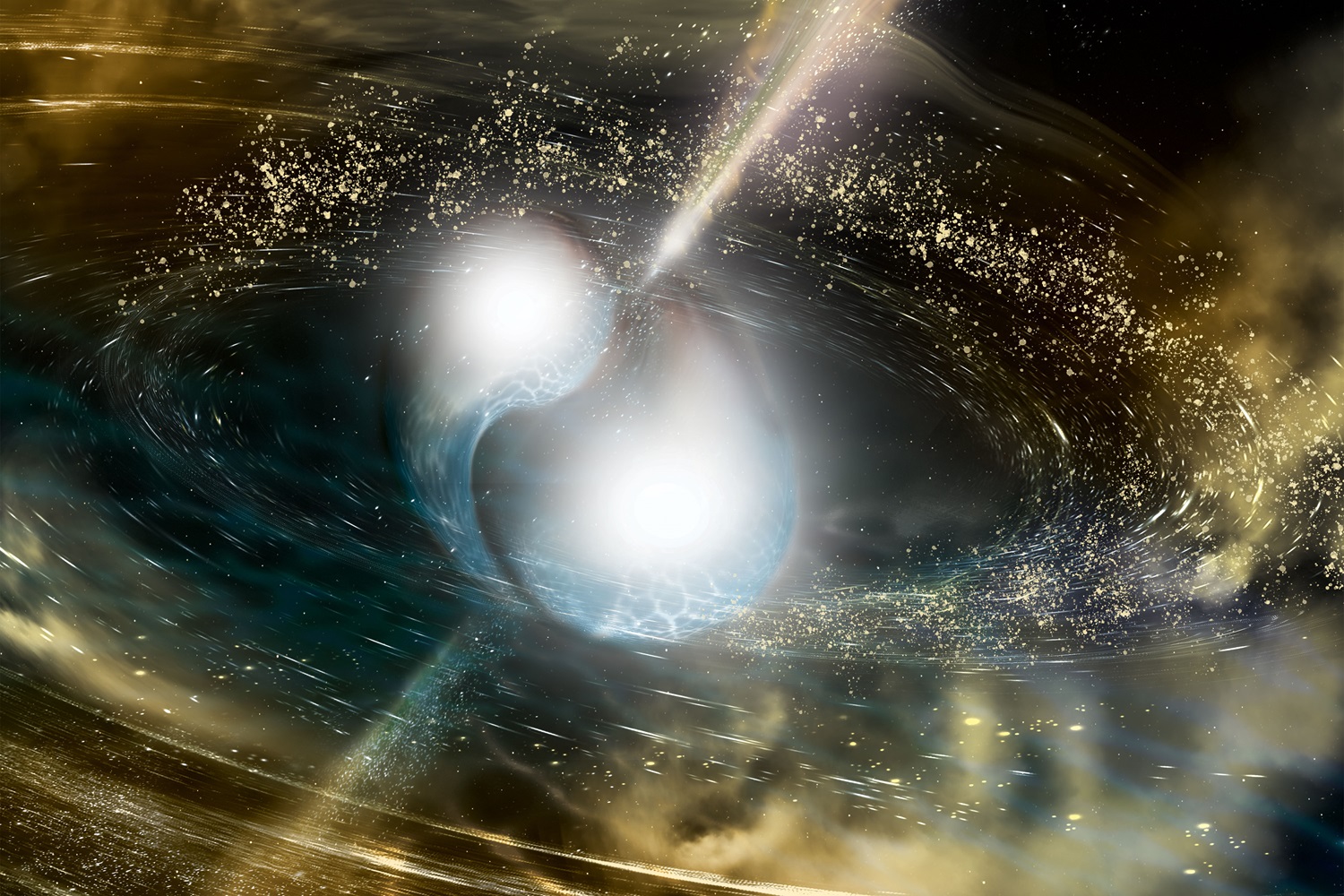
Do stars collide?
Could anything be more terrifying than an asteroid colliding with Earth? Yes, and that would be the Sun colliding with another star. If that were to happen, the entire Solar System would be destroyed; Earth could be knocked out of its orbit, lost in space, and freeze over. All life on our planet would perish without a doubt.
Is this possible? Should we be afraid of it? Yes, and no. Physically, it is possible. Stars, including the Sun, orbit the center of the Milky Way along their own trajectories, and in doing so, they behave like any other physical objects moving in orbit under the influence of gravitational forces—that is, if their paths cross, nothing will prevent the celestial bodies from colliding. On the contrary, gravitational forces would actually facilitate this.
What’s more, scientists say that collisions occur quite frequently. Of course, by cosmic standards, and only within globular clusters. Roughly every 10,000 years, a merger of stars occurs within one of these giant systems. However, it’s important to understand that these are very specific conditions, where these objects have been very close to one another since their very birth.
For the rest of the stars, however, this is a possible but extremely unlikely event. According to scientists’ calculations, for isolated stars, the average waiting time for such a collision is estimated to be approximately 10²⁸ years. By comparison, the Sun’s lifespan is only 10¹⁰ years. In other words, the odds of this happening are 1 in 10¹⁸, which is almost equal to zero.
Have there ever been dangerous close encounters between the Sun and other stars?
To understand why the probability is so low and why there’s no need to fear a collision, it’s worth remembering that the Sun is large—1.393 million km in diameter. But the distance to the nearest star is 4.24 light-years, or 4.48×10¹³ million km. That is 3.2 × 10¹³ times greater than the diameter of our Sun.
Roughly once every 100,000 years (which is 20 times longer than the history of written civilization), a star approaches us to within less than one light-year. But even that is still 7 billion times greater than the Sun’s diameter. About 70,000 years ago, Scholz’s binary star passed by at a distance of 0.8 light-years, or 52,000 astronomical units, from us, and nothing terrible happened as a result.
But perhaps stars don’t actually need to collide with the Sun itself. Is it enough for them to fly by close enough to destroy the entire system? That’s a valid point. However, the average waiting time for a passage at a given distance is inversely proportional to the square of that distance. In other words, as the distance decreases, the frequency of such events decreases.
For example, a comet passing at a distance of 30,000 AU—which is approximately 0.145 parsecs or 0.47 light-years from us—is expected to occur once every approximately 10-12 million years. This effect is already noticeable within the Oort Cloud and may increase the frequency of comets in the middle regions of the Solar System, but it is still too far away to affect the orbits of the planets.
A star passing at a distance of 3,000 AU—which is approximately 0.0145 parsecs or 0.047 light-years—occurs, on average, once every 1.13 billion years. This is still 100 times greater than Neptune’s orbital radius; theoretically, it could slightly alter the planets’ orbits, but not significantly, since its gravitational influence would be much weaker than that of the Sun.
Finally, the passage of a star at a distance of 300 AU or less could indeed cause the planets’ orbits to change significantly. However, we would have to wait longer for this to happen than the Sun has left to exist. That is precisely why there is no need to fear a collision between the Sun and another star.
