

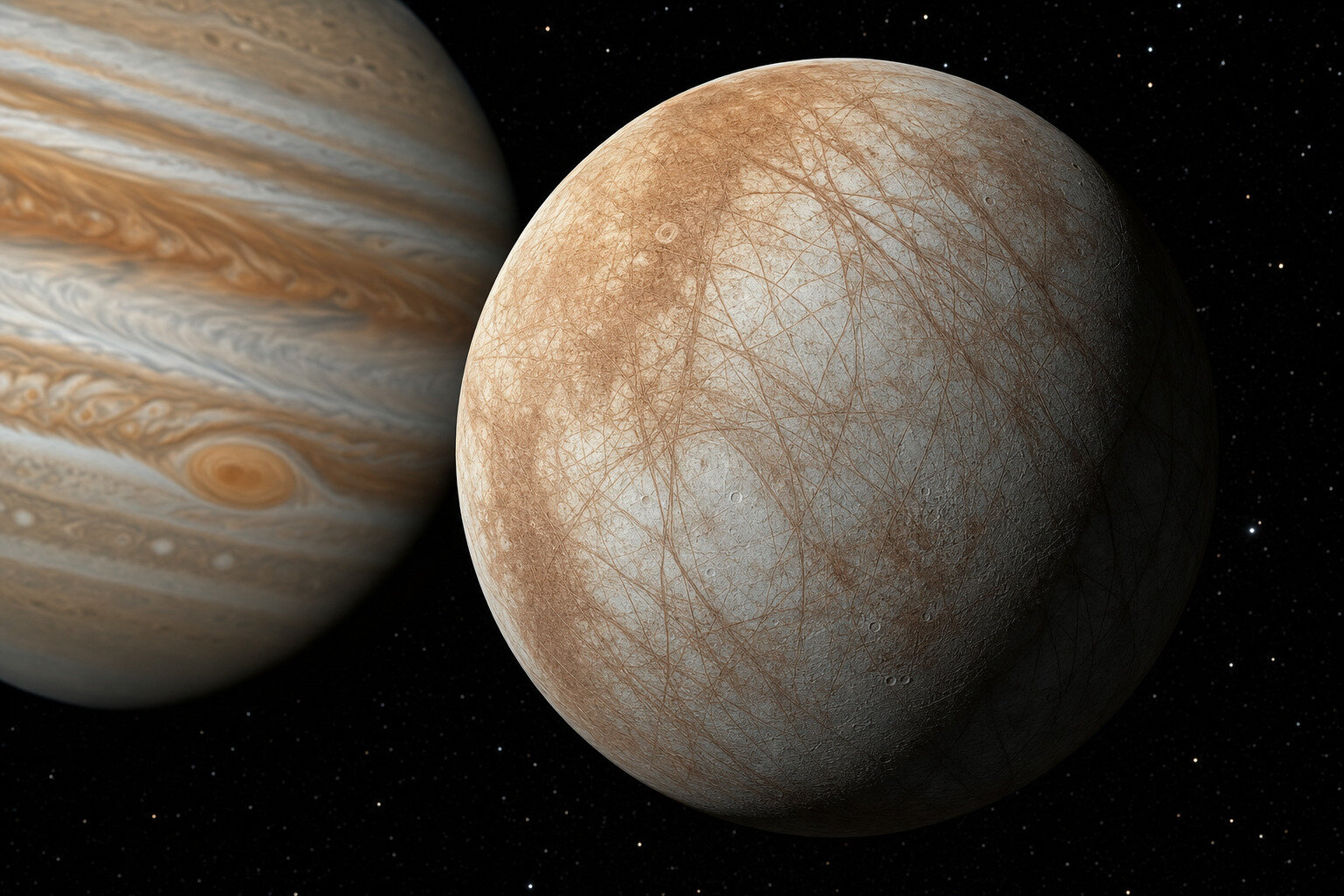
Could Earth have seeded Jupiter’s moon Europa with bacterial life that could have taken root in Europa’s ocean and, perhaps, evolved into something more? This is the hypothesis put forward in a new study by researchers at Tbilisi State University in Georgia.
Panspermia — the idea that life originated in space
What is the probability that dust particles containing living bacteria were ejected from Earth’s gravitational well and landed on Jupiter’s icy moon, Europa? Recently, researchers from Tbilisi University suggested that they could have landed intact and made their way through cracks in Europa’s ice, beneath which lies a vast ocean there scientists believe may be conditions suitable for life to exist
The possibility of panspermia—the idea that simplest forms of life forms could have reached Earth from other parts of the universe—has been discussed for decades. Dust, meteoroids, asteroids, and comets may have carried living organisms when they fell to Earth.
The hypothesis cannot be tested experimentally, but in an article published in the International Journal of Astronomy and Astrophysics, Osmanov, who also works at the E. Kharadze, refers to this as the “problem of reverse panspermia” and has calculated that “over 5 billion years, dust particles can travel distances on the order of hundreds of parsecs in the interstellar medium.”
Furthermore, given the distribution of stars in the Milky Way, “particles emitted from each planet will reach as many as 105 star systems.” Moreover, Osmanov assumed that life could be transported from a single planet to approximately 1,000 star systems.
How can particles of life leave Earth’s atmosphere?
Using methods similar to those described in his previous article, Osmanov viewed the Earth as a source of dust particles and Europa, with its unique glacial and oceanic characteristics, as a destination. Osmanov divides his analysis into three parts:
1. Could life-carrying dust particles have escaped Earth’s gravitational field, and if so, in what quantities? 2. Could such dust particles have landed on Europa without being destroyed, and if so, in what quantities? 3. If they did land, could these particles penetrate Europa’s thick ice shell and reach its liquid surface?
Dust particles about one micron (one-millionth of a meter) in size may contain densely packed bacteria of roughly the same size. Furthermore, for the bacteria to survive any journey, their temperature must not exceed about 300 Kelvin (approximately 27°C).
Dust particles are lifted into the air by atmospheric turbulence; considering the energy transferred to one of them at an altitude of 150 kilometers (93 miles), for example, during a collision with cosmic dust, Osmanov’s 2025 study allowed him to calculate the maximum velocity a dust particle can attain at that altitude—14 km/s, which exceeds the second cosmic velocity of 11.2 km/s.
Simple physical calculations show that the particle will have a speed of 8.4 km/s when it is far from Earth—about 10% faster than the International Space Station orbits the planet. This will continue for the entire 3.5 billion years that simple life has existed on Earth.
Journey from Earth to Europa
Once dust particles leave Earth, three forces act upon them: the pressure of solar radiation, Jupiter’s gravitational pull (which exceeds that of the Sun once the particle has traveled about 97% of the distance from the Sun to Jupiter), and the average drag force of the interplanetary medium in the Solar System.
Osmanov solves the equation of motion for a dust particle and finds that its velocity near Jupiter is 20.1 km/s. The impact of a particle on Europa will be greatest if it falls straight down relative to the moon’s surface. Using the specific heat capacity of a dust particle, he finds that only those particles falling at a very small angle—1 degree to the surface—will survive; that is, only about three out of every thousand bacteria survive the landing.
A flux of approximately one particle per square centimeter per second leaves Earth due to collisions with cosmic dust in the atmosphere—or about 5 × 10¹⁸ particles per second, emitted uniformly in all directions. Using geometry to determine the fraction of dust particles that enter Jupiter’s gravitational field, Osmanov finds that approximately 300 million such particles from Earth should reach Europa’s surface every second.
In addition to the above, the scientist cites two other findings from the scientific literature: bacteria that land on Europa’s surface undergo “deactivation” in approximately 10,000 years, and about 20%–40% of the moon’s ice, which is between 30 and 80 million years old, cracks due to tidal heating and friction caused by Jupiter’s powerful gravitational forces.
What does this mean for the search for life?
Combining all these results, Osmanov concluded that “the total number of particles during the specified period is approximately (3–8) × 10²³,” which is close to one mole of particles. According to him, this “strongly suggests the possibility of life in Europa’s subsurface ocean, assuming that the biological and biochemical conditions are compatible with life as we know it on Earth—a question that would require a new series of studies to clarify.”
According to phys.org
