

A large number of icy moons orbit the giant planets. Scientists suspect that some of them may contain oceans of liquid water beneath their surfaces. A recent study has shown how collisions between these moons may affect them.
Oceans on the Moons of Giant Planets
As phys.org reports, a study by a team of astronomers led by specialists from the University of Maryland has appeared in Nature Astronomy, focusing on the icy moons of giant planets. In it, the researchers analyzed how possible collisions may affect the existence of liquid water beneath their surfaces.
The moons of giant planets contain large amounts of water in the form of ice because solar radiation in these regions of the Solar System was too weak to evaporate volatile substances, allowing them to remain preserved. However, internal heating of these bodies caused by gravitational compression and radioactive decay could have melted their middle layers, so they are considered among the most likely places in the Solar System beyond Earth where life may exist.
But not everything about these tiny worlds is as favorable as it may seem at first glance. They orbit giant planets on closely packed orbits, and both theory and observations show that they do in fact experience catastrophic collisions from time to time. Such events are usually regarded as a threat to the existence of subsurface oceans. This is precisely what the researchers decided to test.
How Do Collisions Affect the Oceans?
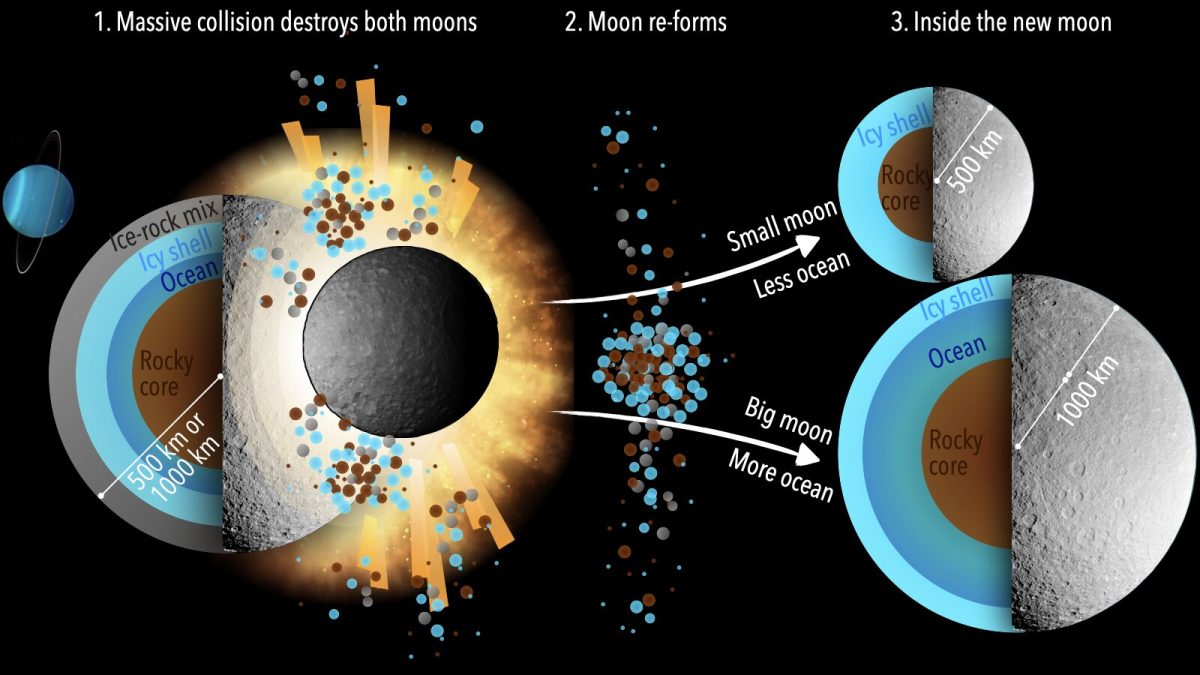
The scientists used computer simulations. They focused on moons of two sizes: those with diameters of around 500 km and those with diameters of about 1,000 km. In the simulations, both types were made to collide with one another, break apart into smaller fragments, and then reassemble under the influence of gravity. This process was modeled over 4.5 billion years so that the scenario would correspond to the observed picture of the Solar System.
The result surprised the researchers. Collisions affected the ability of the modeled moons to retain subsurface oceans for longer in different ways depending on whether the moons were large or small. For the larger moons, the effect was moderately positive. The collisions not only failed to disperse the material into space, but also provided the celestial bodies with the heat needed to keep water in a liquid state.
For the smaller moons, however, the opposite was true. In their initial state, their material was undifferentiated, and a crust made of a mixture of rock and ice acted as thermal insulation, protecting them from heat loss. But collisions caused differentiation in their interiors, leaving only ice on the outside. Ice retained heat less effectively, and the oceans gradually froze.
These are theoretical models, but in the future the researchers hope to confirm them by studying Saturn’s moons Enceladus, Mimas, Tethys, Dione, and Rhea; Uranus’s moons Miranda, Ariel, Umbriel, Titania, and Oberon; as well as Neptune’s moon Triton.
They are particularly interested in Rhea. It is covered with numerous craters, but they appear smoothed, as if they had been partially melted.