

China’s lunar exploration program is preparing an ambitious robotic mission that will include an orbiter, a lander, a rover, a hopper, and a broad range of international experiments, including payloads supported by a wide variety of countries.
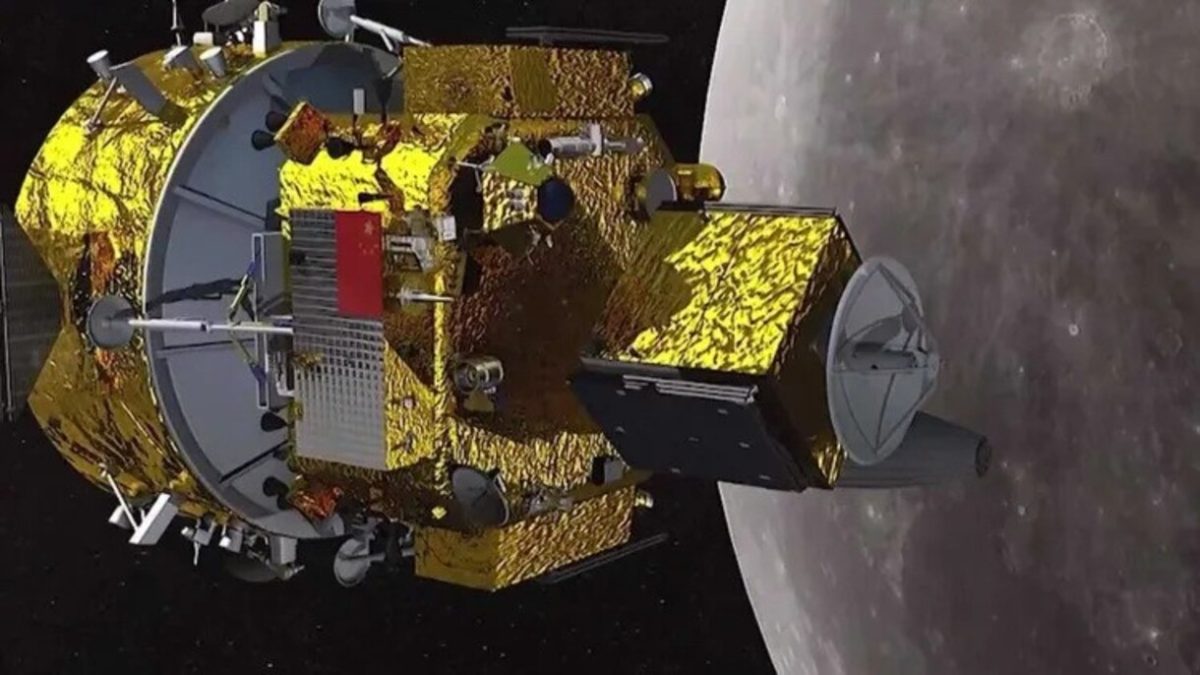
China’s Lunar Pioneer
The website www.space.com reports that back in April of this year, the Chang’e-7 mission hardware was transported to the launch site in Wenchang, with launch planned for August 24 (Beijing time) aboard a Long March 5 Y14 launch vehicle. The lander’s destination is the rim of Shackleton crater in the Moon’s south polar region.
After launch, the Chang’e-7 orbiter will spend several months in lunar orbit before releasing its lander for an attempted touchdown closer to the end of the year. Although Chang’e-7 will conduct ambitious and groundbreaking lunar research, it will also lay the groundwork for China’s first crewed landing on the Moon by 2030.
James Head is a leading lunar scientist in the Department of Earth, Environmental and Planetary Sciences at Brown University in Providence, Rhode Island. He says China’s upcoming lunar mission will set a new standard for Moon exploration.
“Chang’e-7 is the most ambitious, comprehensive and complex robotic lunar mission ever attempted by any nation or organization,” Head said.
Planned Research
After the hopper separates from the Chang’e-7 lander, it will “hop” from sunlit areas into shadowed craters in search of pockets of water ice. The hopper will use active shock-absorption technology to land safely on slopes. The lander will also deploy China’s first “landmark navigation” system for deep-space flight.
Although scientists around the world believe that water ice exists on the Moon, said Ye Peijian, an academician of the Chinese Academy of Sciences, no one has yet definitively found or fully assessed it. “Now China is going to search for it, […] And we are using many methods, from searching on the surface to exploring inside craters,” Ye told China Central Television (CCTV).
The Chang’e-7 mission will use an integrated approach to exploration, combining orbital flight, landing, surface mobility, and hopping to study the environment and resources of the Moon’s south pole, while also carrying out international cooperation.
Moreover, the Chang’e-8 mission is planned for around 2028 and is intended to test technologies for constructing habitats from lunar soil. Together, these two robotic projects — Chang’e-7 and Chang’e-8 — are intended to help establish China’s planned multi-phase International Lunar Research Station (ILRS).
Diversity of Instruments
The Chang’e-7 mission hardware is equipped with a variety of instruments from other countries and organizations, including:
- The PmL-Ch7 package from the Russian Academy of Sciences for detecting lunar dust, as well as Langmuir probes for measuring the temperature and density of the surrounding plasma.
- An Italian laser retroreflector array on the lander, provided by the Frascati National Laboratory.
- A small, advanced wide-field optical telescope mounted on the lander, developed by the International Lunar Observatory Association (ILOA Hawaii) and the Laboratory for Space Research at the University of Hong Kong (HKU-LSR).
- LunaHcam — a camera attached to the Chang’e-7 orbiter and jointly developed by the Bahrain Space Agency and the Egyptian Space Agency to provide high-quality hyperspectral images of the lunar surface.
- The Moon Thai-China Hodoscope (MATCH) aboard the orbiter, developed by the National Astronomical Research Institute of Thailand. It will assess high-energy particles associated with space weather and solar-emitted cosmic radiation.
- A lunar dual-channel Earth-radiation spectrometer aboard the orbiter, provided by the Swiss Physical Meteorological Observatory.
Compact Lunar Camera
The ILO-C instrument from ILOA Hawaii and the University of Hong Kong’s Laboratory for Space Research will be located directly on the Chang’e-7 lunar lander, which is heading for the illuminated rim of Shackleton crater.
“Through visible-color imaging, the ILO-C camera project aims to inspire people’s interest in lunar exploration, astronomy and space science,” said Quentin Parker, Emeritus Professor at the University of Hong Kong. In this way, the camera will help build a social foundation for future scientific missions to the Moon.
Operating under the extreme conditions of the lunar environment, the compact camera will, for the first time, take astronomical color images from the Moon, said Eliza Perednia, president and chair of ILOA. The camera is designed to capture unprecedented wide-angle, full-color images of the Milky Way’s galactic plane from a stable observing point on the Moon, she added.
There is one sad detail: the camera aboard the Chinese lunar lander was developed by ILOA founder Steve Durst, who passed away earlier this year. He was a leading thinker in the field and had worked with representatives of China’s aerospace sector since the 1980s.
