October will be the month of the morning planets: Neptune, Saturn, Uranus, Mars, and Jupiter will all be visible simultaneously in the predawn sky. However, Venus and Mercury will be obscured by the Sun’s glare for observers in the Northern Hemisphere, despite Venus being the brightest planet and Mercury reaching its greatest eastern elongation this month.
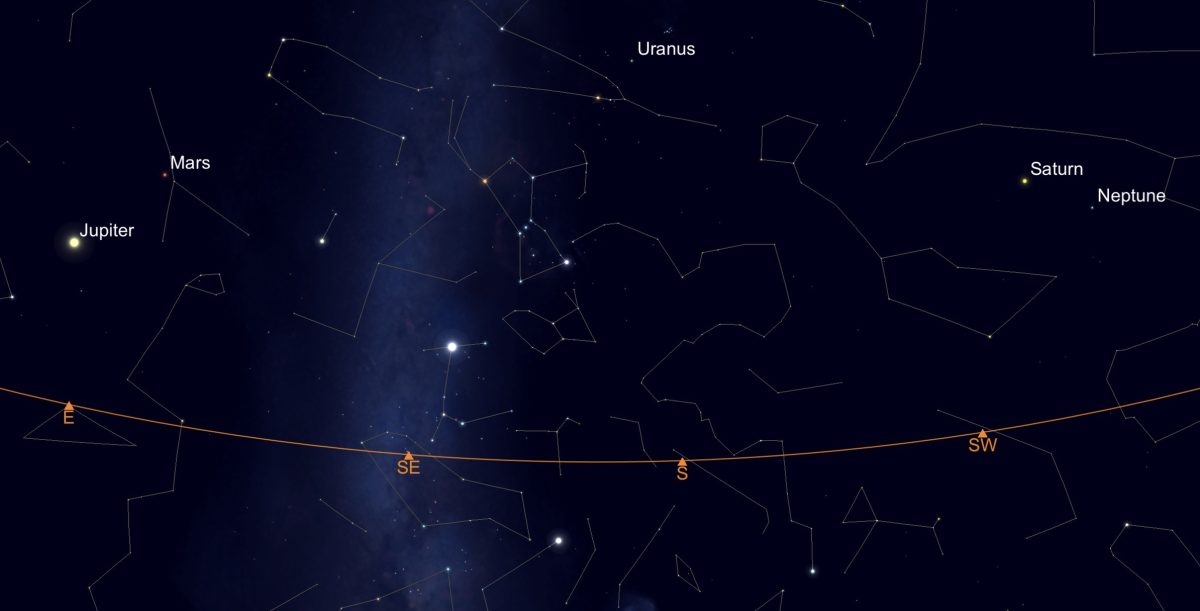
If you plan to observe as many planets as possible in a single night, we recommend viewing during the latter half of the night, approximately from 3:30 a.m. to 5:00 a.m. Moving along the ecliptic from west to east, you will be able to observe Neptune in the constellation Pisces (a telescope is required to view this planet), Saturn near the edge of Cetus, Uranus near the Pleiades in the constellation Taurus (also best viewed through a telescope), and Mars in the constellation Cancer. Mars moves into Leo on October 30, where Jupiter is already positioned.
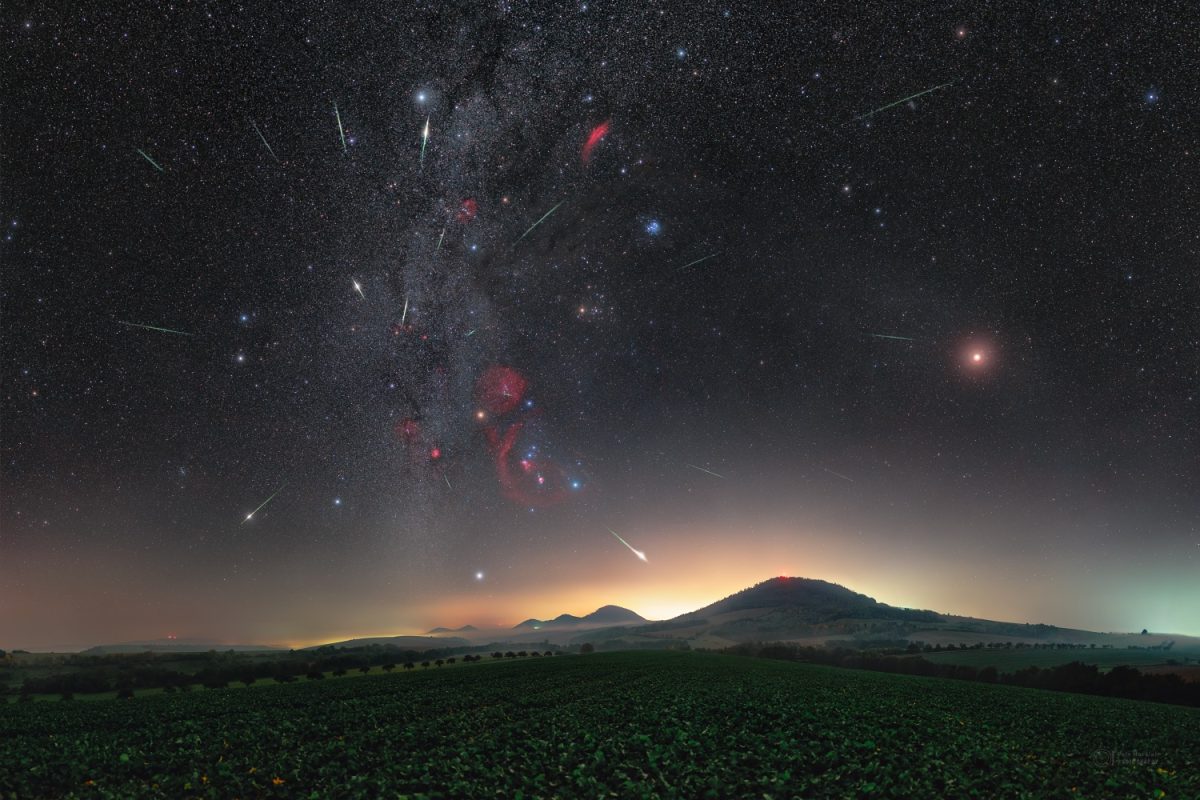
Throughout October and the first week of November, Earth passes through a diffuse stream of particles shed by the well-known comet Halley (1P/Halley), producing the Orionid meteor shower, which is observable from October 2 through November 7. Although this shower occurs annually, its activity varies considerably. No significant activity surges are forecast this year; however, such predictions are exceptionally difficult to make, and an unexpected surge could occur in any given year. The shower is expected to reach peak activity on the night of October 21–22, with an estimated ZHR of 20. Other, less active meteor showers will also occur throughout the month, including the Draconids, the Southern Taurids, and the Delta Aurigids, among others; however, each is expected to produce no more than a few meteors per hour.
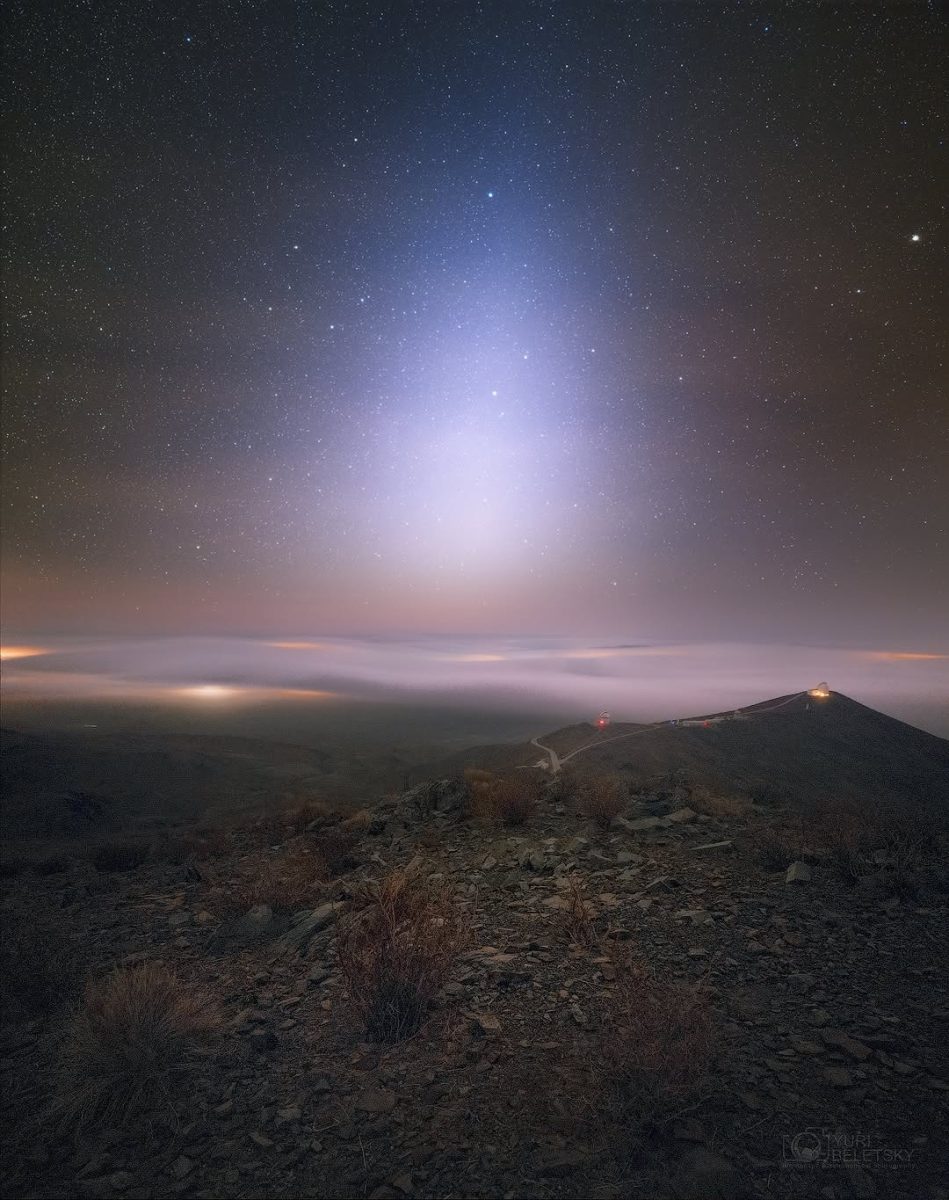
In early October, the zodiacal light, also known as false dawn, remains visible. This faint glow is caused by sunlight scattering off particles of interplanetary dust, particularly cometary dust. At our latitudes, it is best observed in the east before dawn at this time of year. However, viewing requires a dark sky; a camera can capture more than the naked eye can perceive.
General circumstances
October 4 —Saturn at opposition (+0.3m). At this time, it will be almost exactly opposite the Sun.
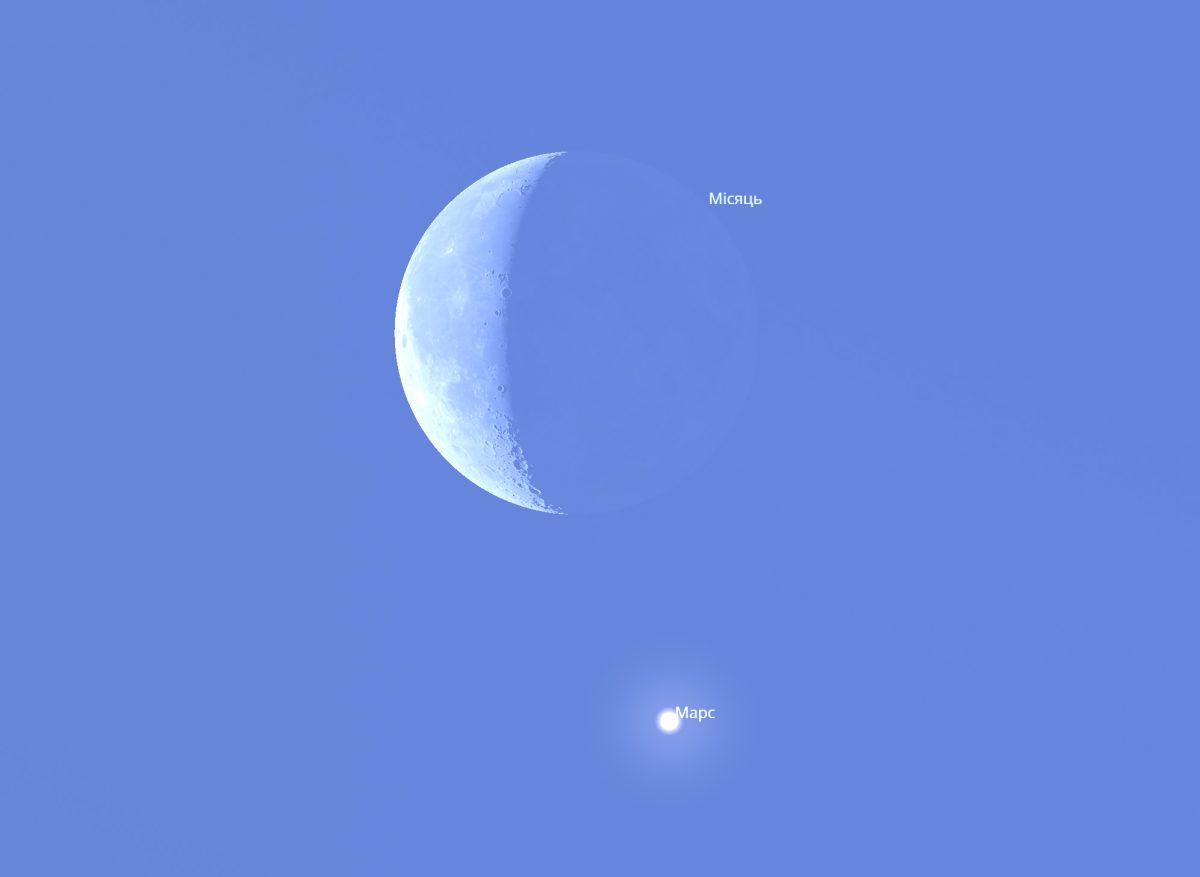
October 5 — a close conjunction of the Moon (31%) and Mars (+1.0m). At 09:11 a.m., the distance between the celestial bodies will decrease to 0.6°, only slightly greater than the Moon’s apparent diameter. As the conjunction occurs during the day, it is best observed before dawn; look for the pair in the eastern sky.
October 6 — conjunction of the Moon (22%) and Jupiter (–1.9m). Both will also be visible in the eastern sky before dawn.
October 10 — new moon. The exact time is 6:50 p.m. (3:50 p.m. UTC).
October 12 — Mercury will reach its greatest eastern elongation. Although it will be as far as 25° from the Sun, the shallow angle between the ecliptic and the horizon in the October evening sky will make observations virtually impossible.
October 11–13 — Mars passes through the open star cluster Beehive (M44) in the constellation Cancer. This event may be of interest for both visual observation and the capture of a series of photographs.
October 13 — asteroid (4) Vesta reaches opposition. Its estimated magnitude is +6.5m. Although it will not be visible to the naked eye, it should be readily observable with a small pair of binoculars.
October 21 — marks the peak of the Orionid meteor shower, with a zenithal hourly rate (ZHR) of 20. The shower is active from October 2 through November 7.
October 24 —conjunction of the Moon (97%) and Saturn (+0.4m), visible in the evening in the east-southeast.
October 26 — full moon. Exact time: 6:12 a.m. (4:12 a.m. UTC).
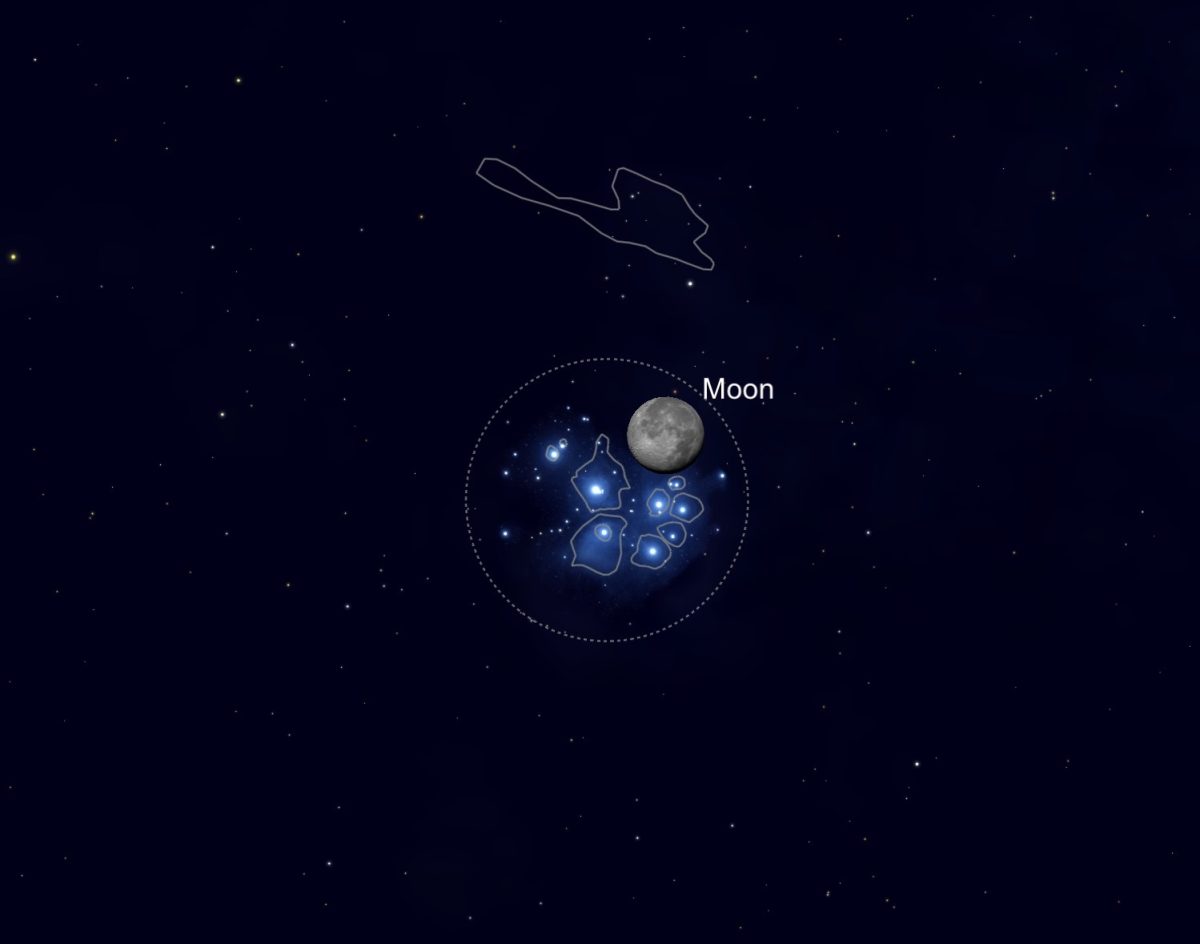
October 28 — the Moon will partially obscure the Pleiades star cluster (M45). This event will be visible before dawn, approximately from 2:50 a.m. to 5:10 a.m. To observe the stars beside the nearly full Moon, we recommend using binoculars or a telescope.
A detailed overview of the most interesting circumstances
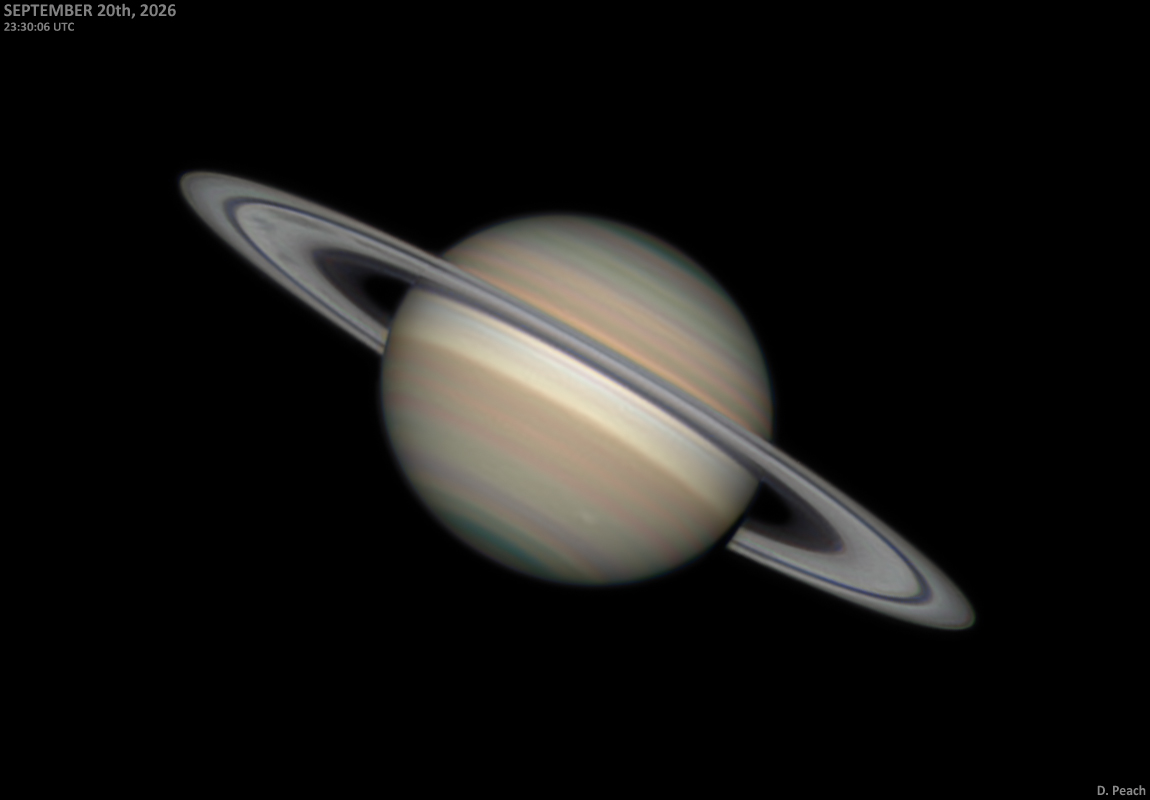
October 4: Saturn’s opposition
It is no coincidence that opposition is considered the most favorable time to observe the outer planets. First, at this time, a planet is at its closest point to Earth for the year and therefore appears largest in angular size. Second, because it is located opposite the Sun in the sky, it rises around sunset and sets at dawn, making it visible throughout the night, particularly against the darkest skies. Saturn will reach opposition on October 4.
It is worth noting, however, that the Lord of the Rings is currently positioned relatively low in the sky in our region. Even at its highest point, it reaches only about 40°–45° above the horizon for observers in Ukraine.
There are two additional reasons Saturn is currently attracting greater attention. First, the so-called “spokes” season is underway: dark regions known as “spokes” are visible in the inner part of the planet’s two broad rings. Astrophotographers with large telescopes are keen to capture images of them. In addition, the rings become brighter in the days immediately before and after opposition, a phenomenon known as the Seeliger effect or the opposition effect. The difference is difficult to discern with the naked eye, so photographing the rings is a better way to observe it.
October 5: The Moon in close conjunction with Mars
Because the planets and the Moon move in nearly the same plane, it is unsurprising that, each month, the Moon appears near each planet in turn. However, observing conditions still vary considerably, owing both to the Moon’s changing phases and to the varying angular distances between these celestial bodies.
In astronomy, such close approaches are referred to as conjunctions. More precisely, a conjunction occurs when the ecliptic longitudes of celestial bodies coincide. The timing of this event does not necessarily correspond to the moment of closest approach; however, it can serve as a useful guide.
The conjunction of Mars and the Moon on this occasion will present a rare opportunity. You may, of course, admire the crescent Moon and the orange-red planet below it before dawn. However, if you have a telescope, you can take this a step further by attempting to locate Mars in the daytime sky, using the Moon’s position as a guide. Technically, the conjunction will occur at 8:32 a.m. (5:32 a.m. UTC), although the two bodies will be closest at 9:11 a.m. (6:11 a.m. UTC). The Moon, which will be 31% illuminated, is relatively easy to spot in the daytime sky. Just below it, at a distance of approximately half the Moon’s diameter, you will find the tiny orange speck of Mars. Seeing this planet against the blue sky is an exceptionally remarkable experience.
October 10: New Moon — an opportunity to gaze into the depths of space
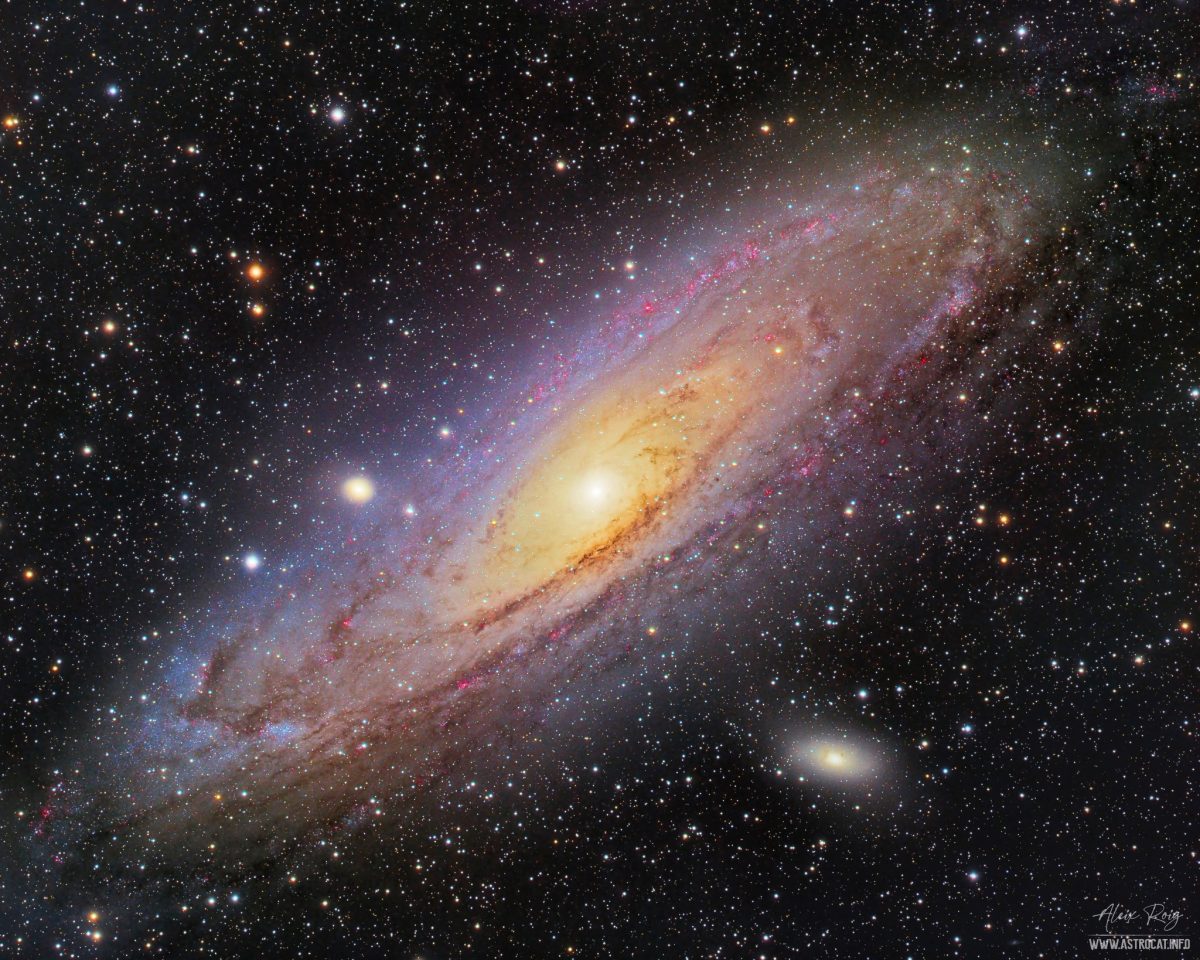
Beneath the dark October sky, at least two nebular objects may capture your attention. Both are well-known and popular targets for astrophotographers: the Andromeda Galaxy (M31) and the pair of open clusters NGC 869 and NGC 884 in Perseus.
When observing M31 through a telescope, attempt to discern the dark bands within it, as they offer a “hint” of the galaxy’s spiral structure. It is also rewarding to observe its nearby companions, M32 and M110, and to sense a certain kinship between this group of galaxies and the Milky Way with its Large Magellanic Clouds.
Also worthy of attention are the chain of open clusters in Auriga (M38, M36, M37), the Triangulum Galaxy (M33), the Alpha Persei Cluster (also known as Melotte 20 or Collinder 39), the M34 cluster, the compact Cat’s Eye Nebula (NGC 6543), and numerous other objects visible even through telescopes with modest apertures.
October 21: The Orionid “meteor shower”
This meteor shower is associated with one of the most renowned comets, Halley’s Comet (1P/Halley). Over its many orbits around the Sun, the comet has dispersed countless tiny fragments along its path, most of them approximately the size of a grain of sand. As Earth passes through this broad stream, it encounters these fragments at a relative speed of 66 km/s. The fragments enter the atmosphere and burn up, producing a bright streak in the sky known as a meteor.
If you trace the paths of all the meteors backward, they will intersect in a single narrow region called the radiant. In this case, this region is located in Orion — hence the name. Since Orion reaches its highest point in the sky around 4 a.m. in the second half of October, the second half of the night will be more favorable for observations, as the Moon will already be below the horizon by that time.
The meteor shower is active from October 2 through November 7; however, for most of this period, observers are unlikely to see more than one or two meteors per hour. The peak occurs on October 21–22, when the ZHR reaches approximately 20. This does not mean that observers will see as many as 20 meteors per hour, as the ZHR indicates the number that could be observed under clear, dark skies if the radiant were at the zenith. A more realistic estimate for rural areas is approximately 7–10 meteors per hour. However, the Orionids can be unpredictable and may sometimes produce bursts of up to 50–70 meteors per hour.