

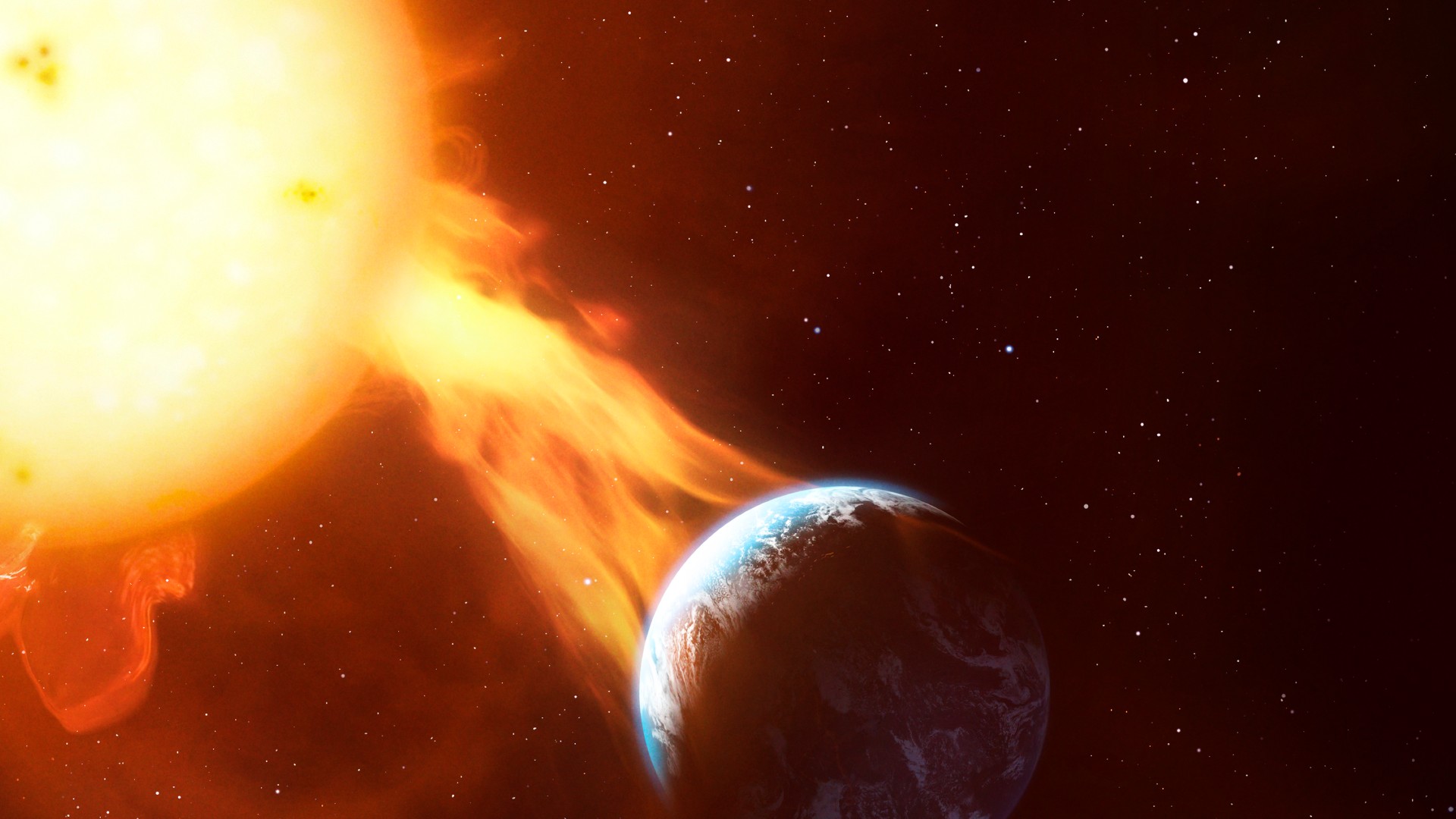
Solar storms are streams of charged particles with incredible energy. There is one proven form of protection against them: a magnetic field. But can permanent magnets, rather than electrical circuits, be used for this purpose? Scientists have found the answer to this question.
Galactic cosmic rays and protection technologies
Protecting astronauts from the deadly radiation they face is the main challenge for anyone developing crewed deep-space missions. Even relatively low levels of radiation exposure over long periods can lead to various consequences, from damage to the central nervous system to cancer.
However, existing solutions, such as passive water shells or active superconducting magnets, have their limitations. To overcome them, Valerio Parisi and his colleagues from Italy and Germany examined in a new paper the possibility of using a permanent magnet — and therefore the magnetic field it creates — to block part of this radiation without the significant energy costs typical of alternative technologies. This was reported by www.space.com.
The most dangerous sources of cosmic radiation are of two types. The first is galactic cosmic rays (GCR), which continuously penetrate interplanetary space. They consist mainly of high-energy atomic nuclei, easily penetrate matter and enter the Solar System from different directions of the Galaxy. Another is a powerful burst of protons – solar proton events (SPE), during which the Sun ejects a huge number of high-energy protons and other charged particles. If a spacecraft finds itself in the path of such a stream, the crew can be exposed to a dangerous or even fatal dose of radiation if it does not have proper protection.
The most common way to protect against these sources of radiation is simply to place a certain amount of material between them and vulnerable biological systems. This technology relies on materials with low atomic numbers, such as aluminum, polyethylene or, in many cases, water, which is needed for many other biological functions on a deep-space spacecraft. The problem with this method is weight. The “tyranny of the rocket equation” means that launching enough material into orbit to protect a crew from SPEs is extremely expensive and may require lifting tens of tons out of Earth’s gravitational field.
Another promising direction that has been actively explored in recent years is the use of superconducting magnets. They are potentially capable of creating a powerful magnetic field around a spacecraft that will deflect some of the charged cosmic particles before they reach the hull. However, such technology has serious technical challenges. Superconducting magnets require maintaining ultra-low temperatures using a cryogenic system, which consumes energy and significantly complicates the design of the ship. If the cooling system stops working, superconductivity will be lost, the magnetic field will quickly disappear, and the crew will be left with only the hull’s protection from radiation.
Permanent magnets and their effectiveness
To address these problems, the authors turned to a compromise option: permanent magnets. They are well studied, extremely reliable, and require no energy to operate. In addition, they weigh much less than other “passive” solutions, limiting the impact of the rocket equation on their economic feasibility. To prove their idea, the researchers developed an analytical model to test whether an array of permanent neodymium-iron-boron magnets, or NdFeB magnets, could alter the trajectory of a collimated proton beam, essentially simulating a solar particle event.
The short answer is yes, it is possible, but only up to certain energy levels. The authors created an array of 1,482 permanent magnets, each measuring 3 × 3 × 3 centimeters, and placed them all over an area of 1 square meter, or 11 square feet. This permanent protective screen, weighing no more than 300 kilograms, or 661 pounds, ultimately deflected about 20 percent of incoming solar particles in the energy range from 0.1 to 10 MeV.
From a functional point of view, that 20 percent actually showed what the permanent magnets were doing: deflecting lower-energy particles. In essence, they acted as a “high-pass” filter, allowing higher-energy protons to pass through while pushing lower-energy ones aside. But this was not the only technical difficulty with the system.
Protection is not provided
The main problem is that it does not block galactic cosmic rays at all. The protective field itself has a pronounced direction, and since galactic cosmic rays move chaotically and come from all directions, it provides virtually no protection against them. Moreover, there is also a possibility that the protons themselves, when colliding with the magnet, could produce “secondary” radiation, such as neutrons or gamma rays.
Although this may not turn any astronaut into a mutant, it could unintentionally increase the local radiation dose if someone happened to be in the wrong place at the wrong time. Even magnets wear out over time, so the final technical obstacle would be the long-term demagnetization of neodymium, which would gradually reduce the effectiveness of the protective screen.
Despite all the drawbacks, even partial shielding is better than no shielding at all, and it is quite possible that permanent magnets will find use in a hybrid system combining all three methods of reducing radiation exposure. To further test the idea, the team plans to continue studying it using improved Monte Carlo simulations to determine how the system would behave in chaotic, multidirectional conditions. After all, astronauts will need every possible form of help to avoid excessive radiation exposure before they reach their destination in deep space.