

A joint research mission of the European Space Agency (ESA), Japan, and the United States, worth nearly $2 billion, has completed its journey to the smallest planet and the one closest to the Sun. After eight years of complex maneuvering, the BepiColombo interplanetary spacecraft has begun the stage of entering Mercury’s orbit by jettisoning its transfer module.
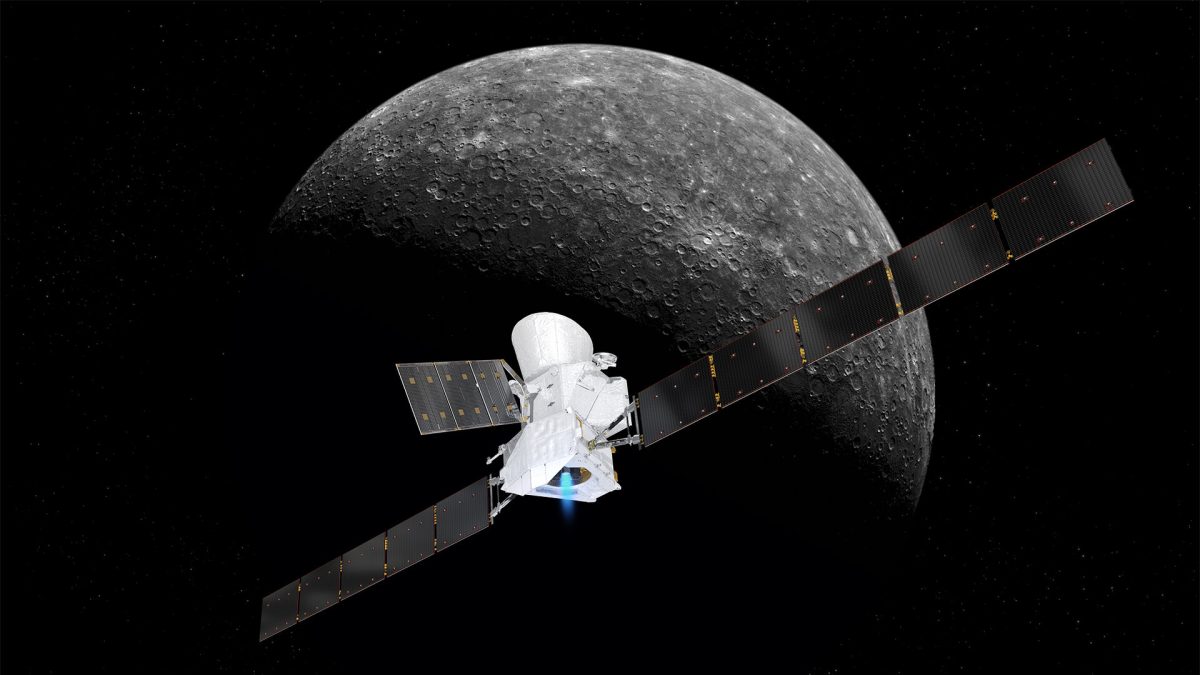
Despite its relatively short distance from Earth, reaching Mercury is extremely difficult because of the Sun’s enormous gravitational pull. To prevent the spacecraft from “falling” into the Sun and instead allow it to slow down and be captured by Mercury’s gravity, more propulsion power is required than for a journey to distant Pluto.
Since its launch in 2018, BepiColombo has traveled more than 10 million km along a spiral-shaped trajectory. The spacecraft performed nine gravity-assist maneuvers near Earth, Venus, and Mercury and also used the most powerful electric propulsion system ever operated in deep space, consisting of four ion thrusters. Despite technical problems in 2024 that forced engineers to extend the cruise phase by a year, the spacecraft has successfully reached the final stage of its journey.
“Surgery” in Open Space
A distinctive feature of BepiColombo is its structure: it consists of three sections. These are the Mercury Transfer Module (MTM), the European Mercury Planetary Orbiter (MPO), and the Japanese Magnetospheric Orbiter (MIO).
Mercury Transfer Module separation confirmed! 📡 ✅
After nearly eight years in space and billions of kilometres travelled, #BepiColombo's Mercury Transfer Module has successfully separated.
Signal acquired via our Cebreros deep-space antenna confirms the spacecraft is healthy… pic.twitter.com/es5v8DqpAT
— European Space Agency (@esa) September 3, 2026
Because the MTM served only as a “space tug” and physically blocked the main scientific instruments and cameras, it had to be discarded before orbital insertion. The separation took place at a distance of 63 million km from the Sun — less than half the distance between Earth and our star.
The operation was carried out under intense radiation and extreme temperatures. ESA specialists compared the maneuver to launching a new spacecraft. After four springs were activated and the sections separated, the autonomous systems of MPO and MIO had to immediately take over thermal control, pointing, and power supply. Telemetry confirmed that the solar arrays of the scientific probes deployed successfully and are already charging their batteries.
A New Era in the Exploration of Mercury
The mission was named after Italian mathematician Giuseppe “Bepi” Colombo, who developed the concept of gravity-assist maneuvers for the Mariner 10 spacecraft in the 1970s. Later, from 2011 to 2015, the MESSENGER probe produced detailed maps of the planet.
🛰️🇪🇺🇯🇵 C’est confirmé ! BepiColombo s’est séparée de son Mercury Transfer Module (MTM) ce 3 septembre 2026 vers 14h00, heure de Paris, alors que la sonde entame son arrivée sur Mercure.
🔹 Après près de 8 ans de voyage, le MTM a terminé son rôle. Ses 4 propulseurs ioniques au… pic.twitter.com/hn9MqqPffF
— Xplora (@XploraSpace) September 3, 2026
However, BepiColombo is expected to make a major scientific breakthrough, because for the first time in history, two scientific spacecraft will be placed into orbit around Mercury at the same time:
- MPO will operate in a low orbit, studying the landscape in detail, analyzing surface colors, and searching for possible deposits of water ice in permanently shadowed polar craters.
- MIO will move into a higher orbit to study the magnetosphere, plasma environment, dust, and the intense effects of the solar wind.
Final insertion into the initial orbit is scheduled for November 21, while separation of the European and Japanese spacecraft from each other will take place in December. The full scientific program aimed at uncovering the mysteries of Mercury’s origin and evolution will begin in April of next year.
Previously, we reported on how BepiColombo recorded the effects of gravity and the solar wind.
According to Ars Technica
