

The galaxy Messier 82 (M82), located about 12 million light-years from Earth, has appeared to astronomers in an entirely new light. The James Webb Space Telescope has revealed unprecedented details of this object, which we see almost edge-on and which is currently experiencing a turbulent era of intense star formation. Thanks to the telescope’s high resolution, scientists were able to examine more than three million stars and reconstruct the history of the development of this galaxy.
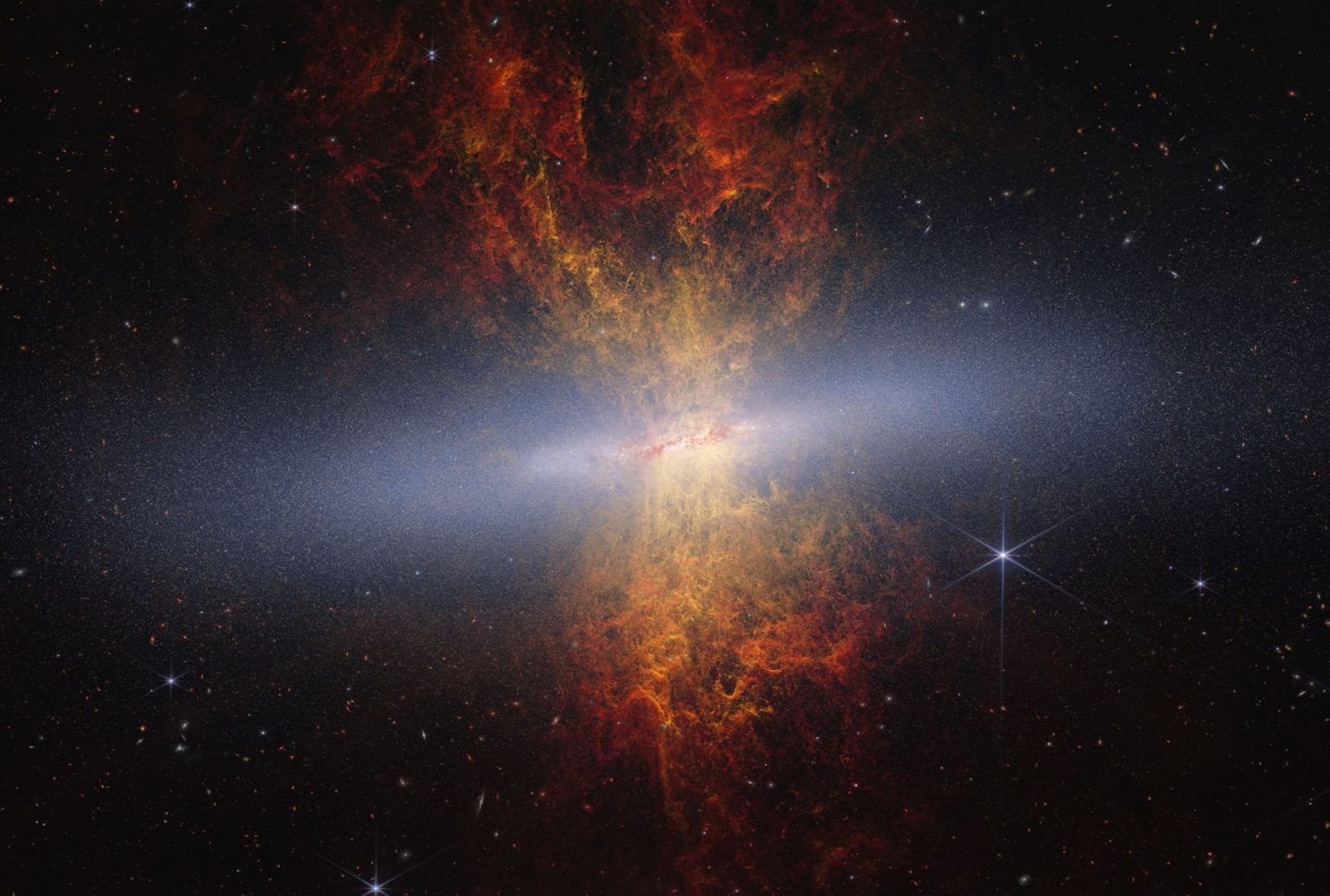
Thanks to its location in the local universe and its extremely high rate of star formation, M82, also known as the Cigar Galaxy, is a unique scientific target. This starburst activity is believed to have been triggered by close gravitational interaction with the neighboring galaxy M81. On astronomical timescales, the phenomenon is temporary, expected to last only a few hundred million years.
Infrared vision through dense dust
Before the launch of James Webb Space Telescope, this starburst galaxy had been extensively studied by other observatories, including the Hubble Space Telescope and the now-decommissioned Spitzer Space Telescope. However, the vast amounts of cosmic dust in M82 acted like a dense curtain, limiting astronomers’ ability to capture high-resolution images.
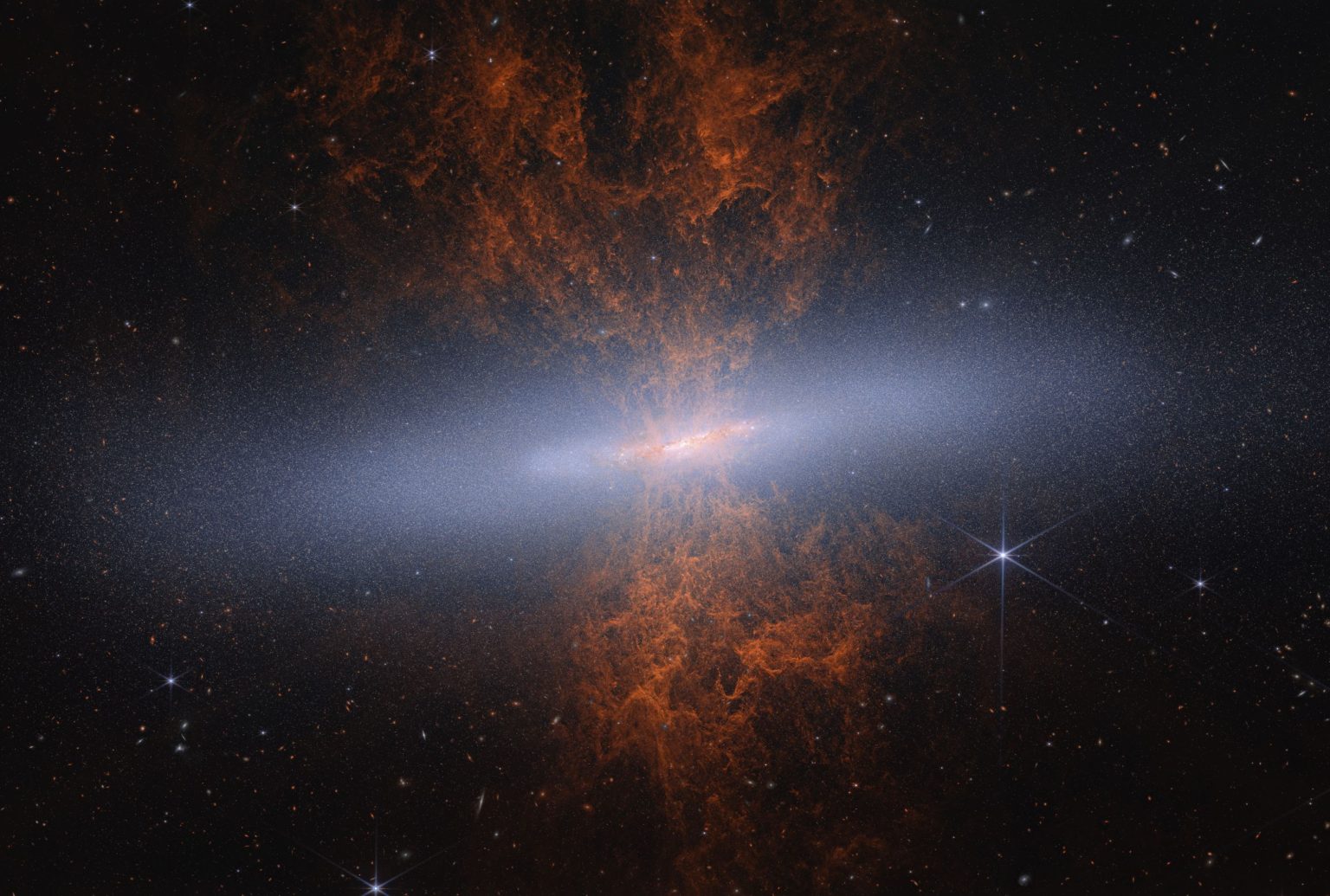
A recent observation program using the NIRCam (Near-Infrared Camera) on the James Webb Space Telescope lasted 65 hours. Thanks to its extremely high infrared sensitivity, the telescope was able to penetrate the dense dust veil surrounding the galaxy. In the new images, astronomers identified the extended structure of the galactic disk and detected approximately 16.5 million individual stars, appearing as luminous blue granules. This represents only a small fraction of the total stellar population of M82, as most of its stars are too faint to be observed directly.
According to team member Benjamin Williams from the University of Washington, the extraordinary number of detected stars makes it possible to build a detailed “paleontological cast” of the galaxy’s formation and evolution.
Mysteries of the warped disk and cosmic outflows
Lead researcher Adam Smercina from the Space Telescope Science Institute describes M82 as “beautiful chaos.” According to him, the galaxy serves as an ideal laboratory for studying multiple physical processes related to galaxy evolution simultaneously—phenomena that cannot be observed together in any other location in the local universe.
New data indicate an increase in brightness and an asymmetry in the shape of the galactic disk toward the center. Differences in radii suggest a distorted structure of M82, a typical consequence of intense galactic mergers.
In addition, the extremely active star formation—about ten times higher than in the Milky Way—is accompanied by powerful outflows. This stellar activity drives bipolar hourglass-shaped streams of material. These outflows show a clear layered structure: yellow regions near the disk consist of ionized gas, while orange clouds farther from the center are made of polycyclic aromatic hydrocarbons—tiny dust grains that help trace the interstellar medium.
Synergy of space missions
Despite the enormous breakthrough, data from the James Webb Space Telescope represent only one part of a much larger mosaic. As researcher Kristen McQuinn emphasizes, galaxies are extraordinarily complex ecosystems. To fully understand their nature, scientists must combine datasets from multiple missions.
Only the synergy between instruments such as the James Webb Space Telescope and Hubble Space Telescope allows researchers to push the boundaries of what is possible, ask more complex questions, and gradually move closer to solving the mysteries of the Universe’s evolution.
Previously, we explained how galaxy mergers occur.
According to NASA