

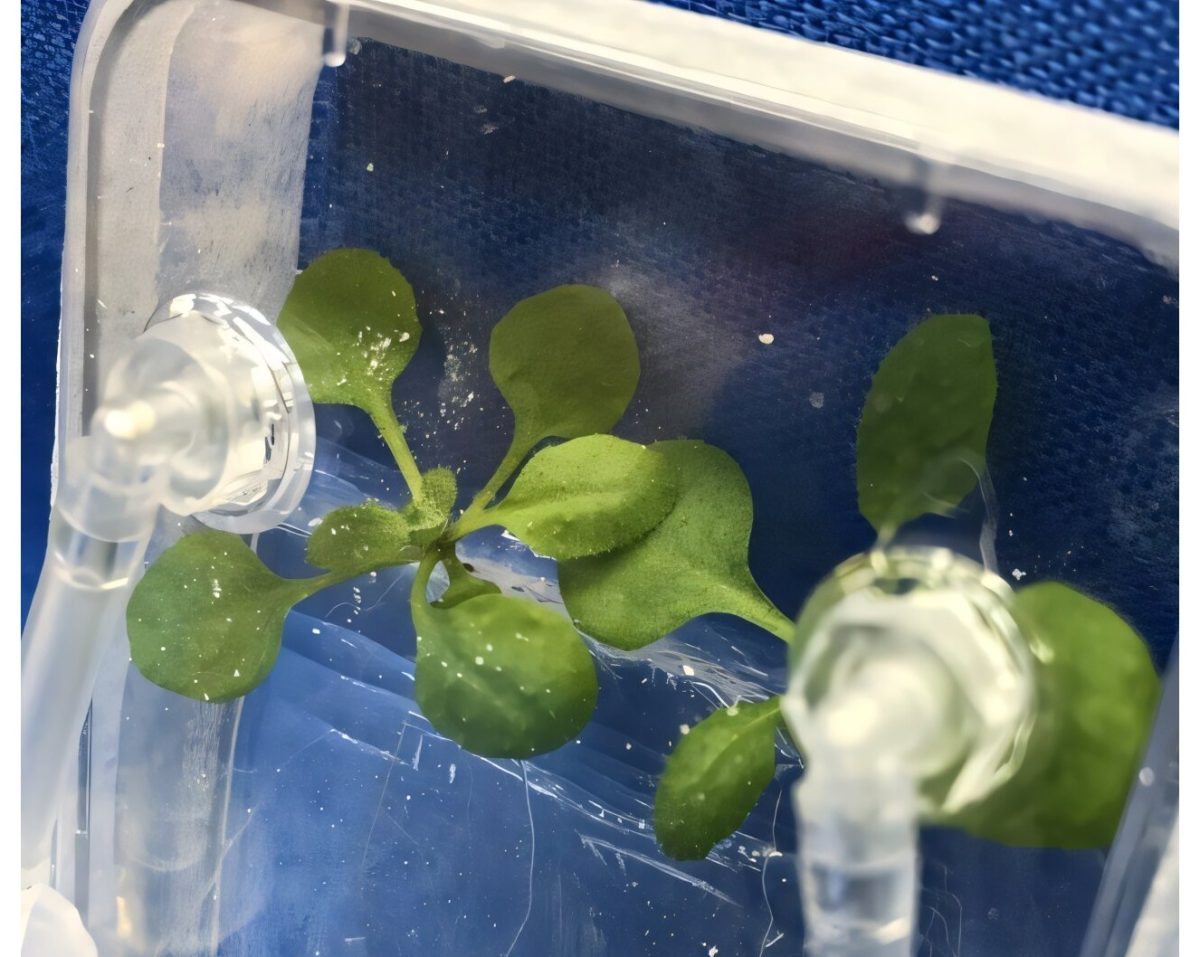
The MVP-Plant-02 experiment launched to the International Space Station on October 13. During the experiment, astronauts will investigate how microgravity affects plants’ resistance to fungal infections. The findings will help support future plant cultivation during long-duration missions, including missions to the Moon.
A Plant Experiment
Scientists are preparing to grow plants in space during long-duration missions. As phys.org reports, the MVP-Plant-02 experiment launched to the ISS on October 13 could provide answers that help make this a reality. It was developed by researchers at the University of Florida’s Institute of Food and Agricultural Sciences.
Growing plants in space for practical purposes has long been a human aspiration. It could not only supply astronauts with oxygen but also allow them to grow food, reducing their dependence on Earth. Scientists established long ago that plants can grow in weightlessness. However, this activity has yet to be scaled up.
One reason is that it remains unclear how plants would respond to a fungal infection. Even the most reliable precautions cannot completely eliminate the possibility of fungi reaching a spacecraft. This is precisely the issue the new experiment will investigate.
What Will Happen During the Experiment?
Fungal plant diseases are commonplace on Earth. Agriculture has suffered from them for thousands of years, and an entire class of chemical treatments—fungicides—was developed to combat them. Even these, however, have not eliminated infections entirely.
Plants also have their own mechanisms for fighting fungi. What remains unclear is how these defenses function in weightlessness. This is what MVP-Plant-02 will test. For the experiment, researchers decided to deliberately infect the plant Arabidopsis thaliana with the fungus Golovinomyces cichoracearum, which causes powdery mildew on its leaves.
To isolate the effects of microgravity from other factors, the scientists selected very similar Arabidopsis thaliana plants and divided them into three groups. One will grow aboard the station in weightlessness. The second also traveled to space but will be grown in a special facility that simulates Earth’s gravity. The third remained on Earth as a control group.
All three groups will be infected with fungal spores using a special device. Researchers will then observe how the infections develop and compare the results. The scientists themselves do not know what to expect from microgravity. It might strengthen the plants’ defenses, weaken them, or have no effect at all. Any outcome, however, will be important for further research.
