

A new theoretical study suggests that an elusive ghost particle may have dominated the Universe immediately after the Big Bang. Its existence could explain a central mystery of astrophysics: why matter managed to overcome antimatter when the cosmos was born—and why our world exists at all.
The findings by theoretical physicists Rishav Roshan of the University of Southampton and Sudipta Show of the Indian Institute of Technology Kanpur were published in Physical Review Letters.
The Quantum “Seesaw”
Neutrinos are fundamental particles that barely interact with baryonic matter. An ordinary neutrino can travel unhindered through a slab of lead approximately 9.5 trillion kilometres thick before interacting with even a single atom.
All known neutrinos are “left-handed”—their spin points in the opposite direction to their motion. However, to explain why they have mass, scientists developed the “seesaw” model. It predicts the existence of heavy “right-handed partners”: the more massive the partner, the lighter the ordinary neutrino.
The standard model of this mechanism considers three right-handed neutrinos. But the third has long been overlooked, regarded as too heavy or inactive. The researchers decided to investigate how this particular particle, approximately 100 trillion times heavier than a proton, influenced the first seconds of the cosmos.
How the Heaviest Particle Changed the Rules
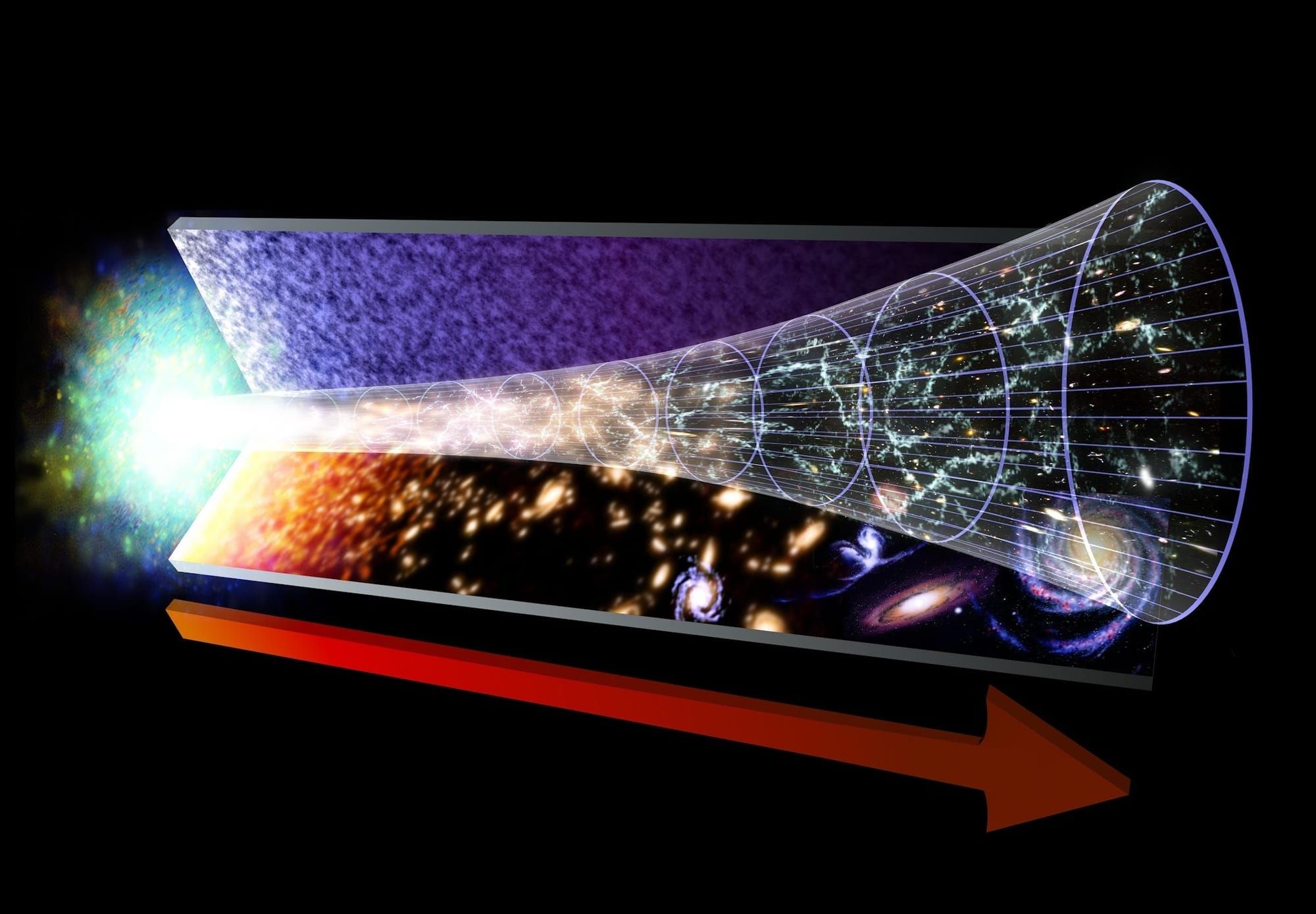
After the Big Bang, this heavy particle travelled at close to the speed of light. As space cooled and expanded, it slowed down, and its mass began to dominate the Universe’s total energy budget.
This temporary dominance of the heavy neutrino increased the rate of cosmic expansion. Interactions between other particles could become effective only when their rates exceeded the rate at which space was expanding. Since space was expanding faster than usual, fundamental processes had to “wait” for the Universe to cool further.
This delay proved crucial. It allowed a lighter neutrino to produce the necessary surplus of leptons—relatives of electrons. This surplus was subsequently converted into the matter that makes up today’s stars, planets, and people, preventing antimatter from annihilating it completely.
How Can the Hypothesis Be Tested?
Producing such a heavy particle in modern accelerators is impossible, so scientists rely on indirect methods. The period of heavy-neutrino dominance should have left a distinctive trace in the background of gravitational waves from the early Universe—an imprint resembling a kink in the signal.
Future observatories could detect these features. These include the European Space Agency’s LISA space mission, scheduled for launch around 2035, and SKAO, a network of giant radio telescopes under construction in Australia and South Africa.
We previously reported on how the Large Hadron Collider captured an elusive ghost particle for the first time.
Based on reporting by Live Science.
