

A star system has been discovered at the center of the Milky Way that has remained virtually unchanged in its galactic environment for 12.5 billion years. New observations have revealed not two, but four populations of stars of different ages within it. This changes our understanding of how the bulge of our galaxy formed.
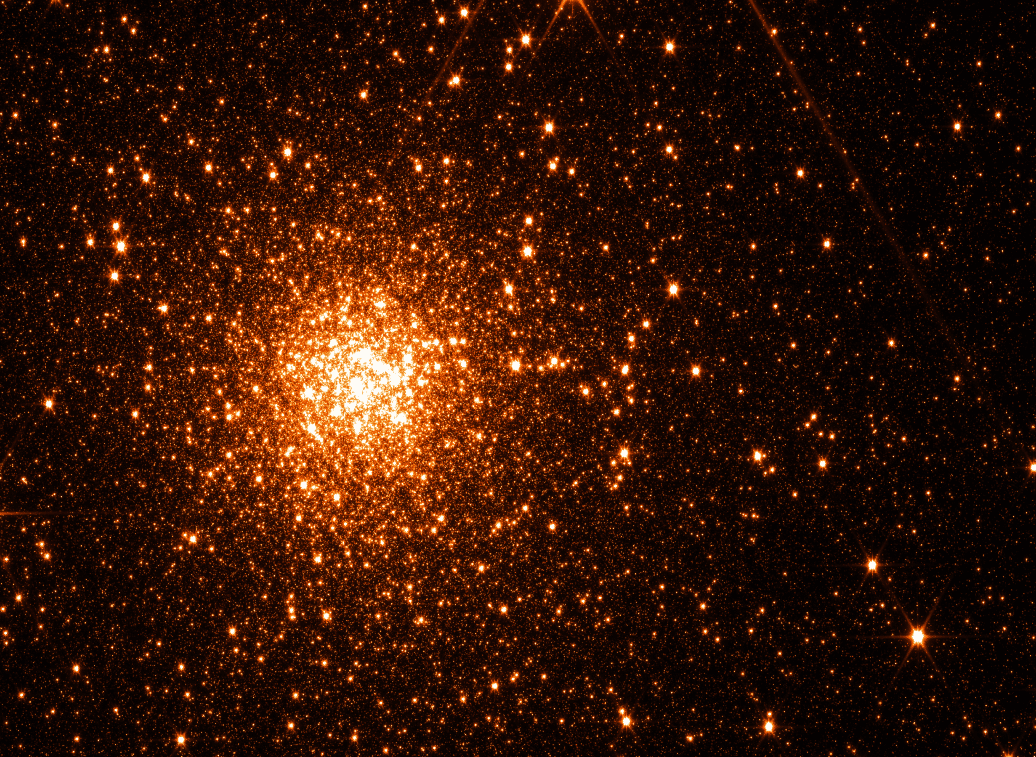
Mysterious star cluster
Terzan 5 is located in the Milky Way’s bulge, approximately 19,000 light-years from Earth in the constellation Sagittarius. Since astronomer Agop Terzan discovered it in 1968, the object has been formally classified as a globular cluster, but none of the known clusters behave in the same way.
Suspicions about the heterogeneous composition of Terzan 5 first arose in 2009, when it was discovered that the object contains two populations of stars with different iron contents. Typical globular clusters form during a single star-formation episode, so the presence of stars with different chemical compositions already indicated a much more complex nature of the system.
A view through the dust
A detailed analysis proved extremely difficult due to the dense clouds of interstellar dust enveloping the galaxy’s inner bulge. Using the James Webb Space Telescope’s Near-Infrared Camera (NIRCam), researchers constructed the most detailed Hertzsprung-Russell diagram of the Terzan 5 system to date, covering stars with luminosities at least 40 times fainter than those previously recorded.
To distinguish the stars that truly belong to Terzan 5 from the background stars and the disk that fall within the field of view, the team turned to archived data from the Hubble Space Telescope. By comparing images spanning more than 20 years, they measured the proper motions of the stars and ruled out extraneous objects. This approach made it possible to reconstruct, with unprecedented clarity, the section of the diagram used to determine the age of stellar populations.
Four generations of stars
After comparing the stars with reference models, two distinct groups emerged, with ages of approximately 12.5 and 4.7 billion years. In addition, evidence was found of two more younger groups of stars with approximate ages of 3.8 and 2.5 billion years, indicating a prolonged, multi-episode process of star formation spanning billions of years.
Current models cannot explain the four distinct generations of stars. The merger of globular clusters or interaction with a giant molecular cloud accounts for at most two episodes of star formation. The study’s authors believe that Terzan 5 is the remnant of a massive primordial gas cloud that formed during the cluster’s formation about 12.5 billion years ago. Thanks to its large mass, it retained gas and heavy elements from supernova explosions, which fueled new generations of stars for billions of years.
Fossilized fragment of a bulge
A research team led by Giorgia Zullo and Francesco Ferraro of the University of Bologna describes Terzan 5 as a “fossilized fragment of the bulge.” The chemical composition of all populations in the system exactly matches that of the galactic bulge. Terzan 5’s orbit barely extends beyond the bulge, indicating that it formed in situ rather than arriving from outside.
Another system in the bulge, known as Liller 1, is also traditionally classified as a globular cluster and has a similar structure, consisting of several stellar populations of different ages. This suggests that Terzan 5 may not be unique, but rather one of the few surviving remnants of the primordial structures that formed the basis of the galactic bulge.
Both systems also hold the record for the number of millisecond pulsars, which is naturally explained by their eventful evolution, marked by numerous supernova explosions in a deep gravitational well. The results were published in the peer-reviewed journal Astronomy & Astrophysics.
According to aanda.org