

Chinese private space company LandSpace has successfully landed the stage of its orbital rocket Zhuque-3 for the first time. It became the third private company in the world after SpaceX and Blue Origin to accomplish this.
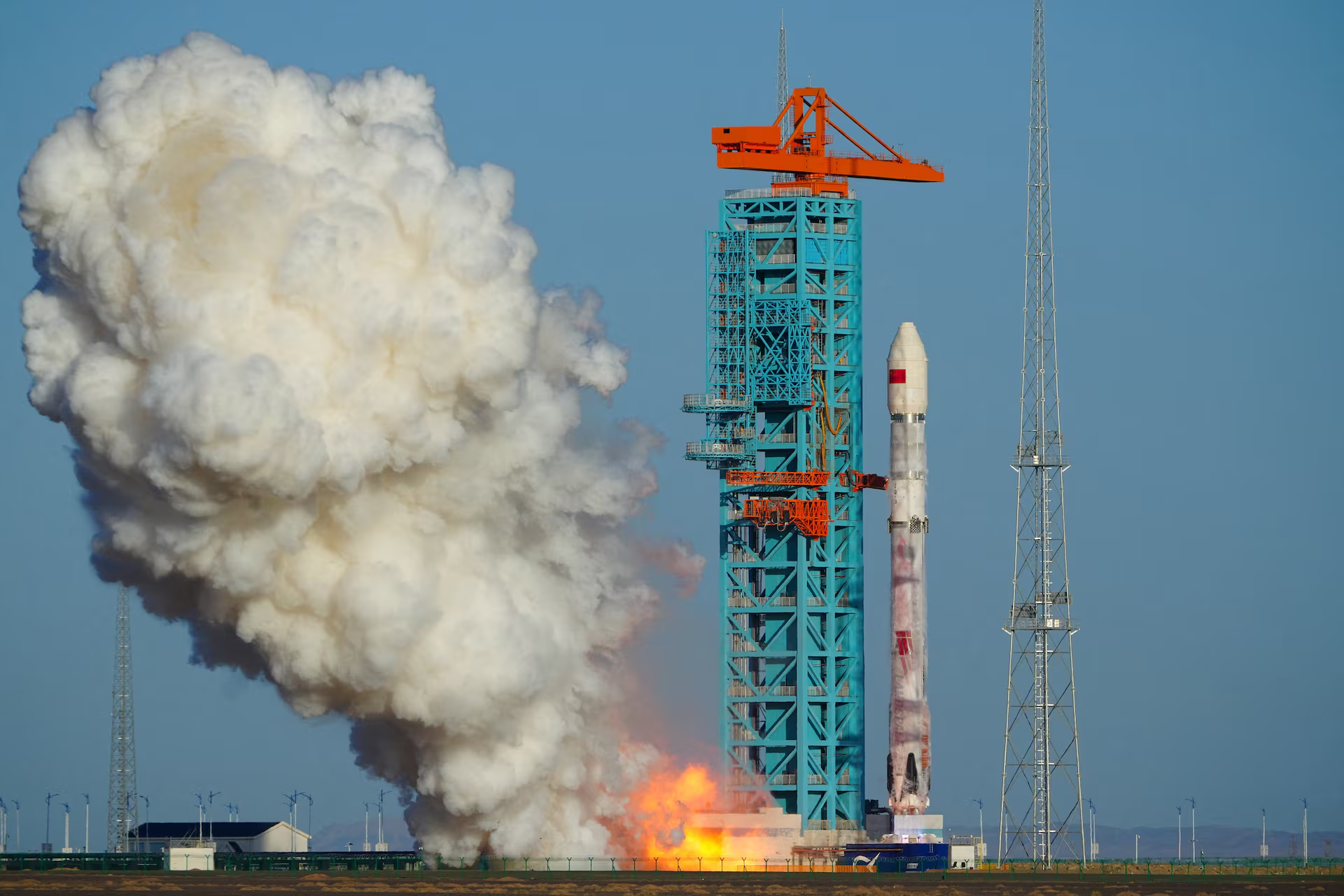
The Stage After Flight
The Zhuque-3 rocket launched from the Dongfeng Commercial Space Innovation Zone in northwestern China. The first stage, equipped with nine engines, separated after the payload was deployed and landed on a landing pad in Gansu Province. The landing site was 390 kilometers from the launch site.
This was LandSpace’s second attempt to land the first stage of Zhuque-3. In December 2025, the company conducted China’s first test of a reusable rocket that reached orbit, but the stage was unable to perform a controlled landing at that time.
Stainless-Steel Structure
The Zhuque-3 rocket is 66.1 meters long and has a stainless-steel body. This material withstands heating during atmospheric reentry better and is cheaper to manufacture than the aluminum-lithium alloy used for SpaceX’s Falcon 9 body.
Zhuque-3’s engines run on methane and liquid oxygen. This propellant combination burns more cleanly than the kerosene and liquid oxygen mixture used by Falcon 9. In expendable mode, Zhuque-3 can deliver 14.2 tonnes of payload to low Earth orbit, while Falcon 9 can carry 22.8 tonnes.
Company Plans
LandSpace expects to use the first stage of Zhuque-3 up to 20 times. The company plans to refly the newly landed stage within the next six months. This will serve as a test of the entire reusable-launch concept for China’s rocket industry.
Interest in the technology is also being driven by financial considerations. LandSpace is preparing for a listing on the Shanghai Stock Exchange and plans to raise 7.5 billion yuan ($1.11 billion), while the company expects to become profitable by 2029.
The Chinese Context
This was China’s fourth attempt to recover an orbital stage. Following an unsuccessful test in December, the state-operated Long March 12A rocket also reached orbit but failed to recover its stage. In July 2026, China successfully tested another technology by landing the Long March 10B stage on a sea platform.
That method differed from a conventional landing on landing legs. Instead, the stage used four lightweight hooks that caught onto steel cables on the platform. The Zhuque-3 landing became China’s first successful ground landing of an orbital stage.
