

A previously unknown comet has been discovered for the first time in images from the Euclid space telescope, which is designed to observe distant galaxies. It was spotted by software that searches the images for moving objects. The comet lies beyond Jupiter’s orbit, and its path is steeply inclined to the plane of the planets. For the European Space Agency, the discovery provided the first test of coordination between the Euclid team and the future Comet Interceptor mission.
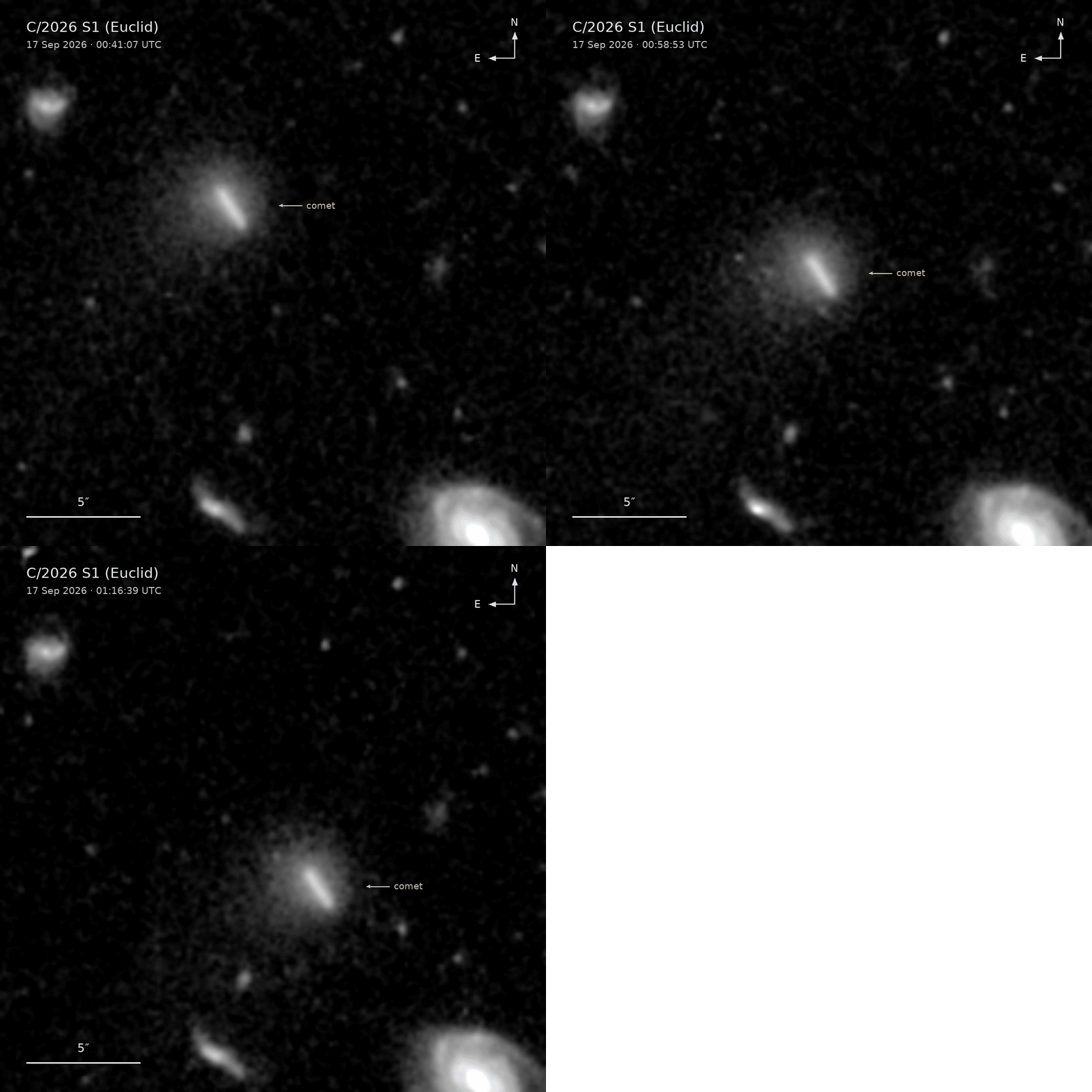
Above the Plane of the Planets
The new comet has been designated C/2026 S1 (Euclid). It is currently approximately 1.3 billion kilometers from Earth—a distance that, measured from the Sun, would place it between the orbits of Jupiter and Saturn. Sunlight reflected by the comet takes 72 minutes to travel this distance.
However, the comet does not lie near the plane in which the planets orbit. Viewed from the Sun, it is almost directly above the Solar System, and completing one orbit takes thousands of years.
This inclination is precisely what made the discovery possible. Euclid was not designed to search for comets: it is built to take long, fixed-pointing exposures of distant galaxies rather than track fast-moving objects in the Solar System.
Observations deliberately avoid the band of sky along the plane of the planets because dust there produces additional scattered light that interferes with imaging faint galaxies. This region is rich in asteroids and comets, so new Solar System objects rarely enter the telescope’s images. Euclid archive scientist Bruno Altieri describes the discovery as a fortunate coincidence between the comet’s orbit and the observing schedule.
A Trail in the Images
The observations were conducted from September 16 to 24, 2026, in Euclid’s deep northern field in the constellation Draco. Software developed by University of Helsinki doctoral student Mikko Pöntinen detected a blurred streak in several images—the kind of trail left by a fast-moving object. After predicting its subsequent path, Pöntinen located the comet in a total of five fields of view across 16 exposures. Comets had appeared in Euclid images before, but all were already known.

A diffuse cloud, or coma, was found around the object. It forms when the Sun’s heat turns cometary ice into gas, which carries dust with it. No matching object appeared in the catalogs, so the data were submitted to the International Astronomical Union’s Minor Planet Center. Following ground-based observations, the Minor Planet Center confirmed on October 8 that the object was a comet.
A Scout for Another Mission
The comet itself is not the main significance of this story. As ESA reports, the rapid progress from detection to confirmation demonstrated that Euclid can spot new comets while they are still far from the Sun. These are the kinds of targets needed by Comet Interceptor.

The three spacecraft of the Comet Interceptor mission will wait for a target at the L2 Lagrange point, approximately 1.5 million kilometers from Earth. The target could be a comet making its first journey from the Oort Cloud or an interstellar object. The spacecraft have limited fuel for long-distance maneuvers, so they can reach only objects that cross the plane of Earth’s orbit at approximately the same distance from the Sun as Earth. The earlier such a comet is spotted, the more time there will be to prepare an interception.
ESA has not specified why C/2026 S1 is unsuitable for Comet Interceptor. Euclid project scientist Valeria Pettorino emphasizes that the discovery provided a real-world test of how the two mission teams will exchange alerts.
Ground-based observatories will now need to refine the comet’s orbital period. Euclid’s survey generally covers each patch of sky only once, and the telescope cannot be redirected to an object on demand.
